


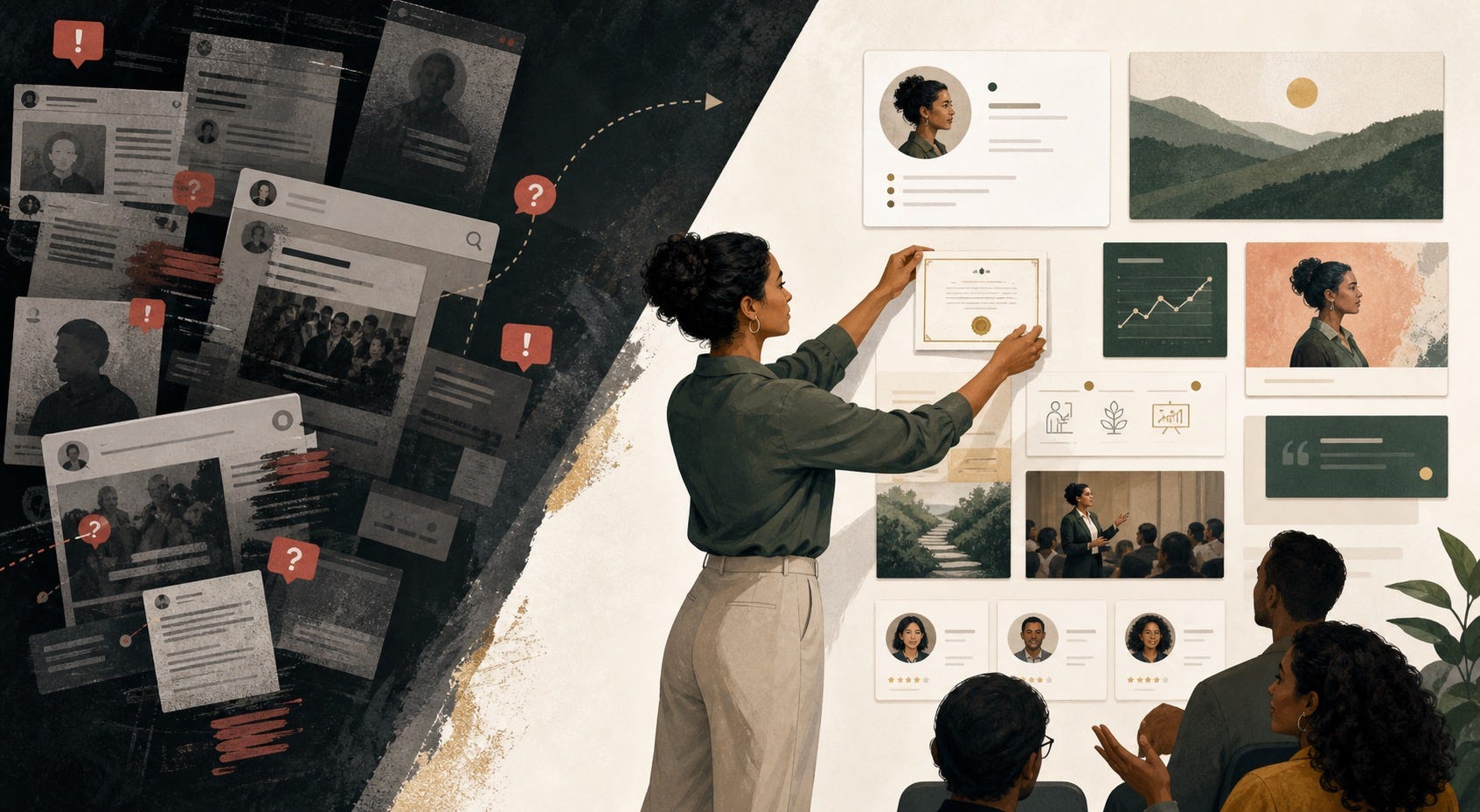
A practical guide for professionals, founders, creators, consultants, and job seekers who want a calm response system before a post, search result, AI summary, or public misunderstanding turns into a reputation problem.
Your personal brand is not only what you publish. It is also what people repeat, what search engines surface, what AI tools summarize, and what strangers assume when they see one screenshot without context.
That is why a personal brand crisis plan now matters even for people who are not famous. A careless LinkedIn post, a badly worded AI-assisted article, a fake quote, a misleading search result, a client dispute, a public correction, or a sudden pile-on can move faster than your ability to think clearly. The goal is not to become paranoid. The goal is to know what you will do before adrenaline starts writing on your behalf.
AI can help here, but only if you keep it in the right role. It should not decide your apology, invent your defense, or bury the facts under polished language. It should help you collect evidence, map audiences, pressure-test drafts, find gaps in your explanation, and turn recovery into visible proof.
Why Personal Brand Crises Feel Different Now
In the old version of online reputation management, a crisis usually meant bad press, a viral tweet, a lawsuit, or a search result that would not go away. Those still matter. But the AI era adds new risks.
First, synthetic content has made everyone more suspicious. Pangram’s July analysis of scanned social content found that long-form posts were especially likely to contain AI-generated writing, with LinkedIn standing out as the most AI-saturated platform in its dataset. That does not mean every polished post is fake. It does mean readers are getting more alert to sameness, overproduction, and manufactured authority.
Second, platforms are tightening their standards. Substack added a reader-facing AI text scanner in partnership with Pangram, alongside a creator process note for explaining how work is made. YouTube has also clarified its monetization policy around generic, repetitive, and inauthentic AI-assisted content, as reported by TechCrunch. The message is simple: audiences and platforms are starting to reward visible human care.
Third, impersonation and AI-enabled scams have moved from edge case to mainstream risk. The FBI’s 2025 IC3 report recorded more than 22,000 complaints reporting AI-related information, with adjusted losses above $893 million. Many professionals will face smaller credibility problems too: copied profiles, fake screenshots, distorted quotes, auto-generated summaries, or suspicious content that looks like them but is not them.
This is the new personal branding reality: trust is easier to damage, harder to verify, and more dependent on the proof you have already built.
What Counts as a Personal Brand Crisis?
A crisis is not any negative comment. If you respond to every jab like an emergency, you train your audience to see you as reactive. A real personal brand crisis threatens one or more of these assets:
Your credibility: people doubt your expertise, honesty, or judgment.
Your identity: people are confused about what you believe, do, or represent.
Your opportunity flow: clients, employers, partners, sponsors, or collaborators hesitate.
Your discoverability: search and AI tools surface a distorted version of your work.
Your trust network: peers and close professional contacts are unsure whether to vouch for you.
Common triggers include a post that lands badly, an AI-written draft that sounds fake, a public disagreement, a bad client experience, a quote without context, a copied account, a false accusation, or an old post resurfacing after your views have changed.
The first question is not “How do I make this disappear?” The first question is “What truth needs to be made clearer, faster, and with proof?”
The AI-Era Personal Brand Crisis Plan
A good plan has five moves: pause, map, draft, repair, and monitor. The order matters. Most people damage trust further because they jump from emotion straight to posting.

A crisis plan gives you a sequence to follow before pressure turns into performance.
1. Pause and Preserve the Evidence
Before you answer, capture what happened. Take screenshots. Save links. Record timestamps. Copy the exact wording of the post, comment, article, search result, AI answer, or message that created the issue. If it involves a client, employer, collaborator, or legal matter, keep private records separate from public notes.
Use AI here as an organizer, not as a strategist. Feed it only information you are allowed to share with the tool. Ask it to create a neutral incident log:
Prompt: “Turn these notes into a neutral incident timeline. Do not add facts. Separate confirmed facts, unclear claims, affected audiences, open questions, and possible next actions.”
This turns a messy event into a document and helps you avoid responding to the loudest version of the story instead of the most accurate one.
2. Map Who Actually Needs a Response
Not every audience deserves the same answer. A stranger on X may need nothing. A close client may need a direct call. A hiring manager may need context. A collaborator may need reassurance. Your audience map should include four groups:
People directly affected by the issue.
People who can verify the truth or provide context.
People who may make decisions about you soon.
People watching casually, without full context.
AI can help you see blind spots. Ask it: “Who might reasonably care about this incident, and what would each group need to know to make a fair judgment?” Then remove any audience that is only there because your ego wants to win them over.
The best response is often smaller than your anxiety wants it to be. A private correction beats a public essay when the harm was private. A public explanation is needed when public misunderstanding is spreading.
3. Write the Human Version Before the AI Version
Never ask AI to write your crisis response from scratch. It will often produce the exact tone people distrust: smooth, vague, over-apologetic, legally timid, and emotionally empty. Start with a rough human note first.
Write five plain sentences:
What happened?
What is true?
What is not yet clear?
Who was affected?
What are you doing next?
Then use AI as an editor. Ask for clarity, not polish:
Prompt: “Review this draft for vagueness, defensiveness, missing accountability, overclaiming, and phrases that sound like corporate PR. Suggest edits that keep the voice plain and specific.”
Keep the final version shorter than you think. People want a clear signal that you understand what happened, that you are not hiding, and that your next action is real.
4. Choose the Right Response Type
There are four useful response types. Pick one before writing:
Correction: Use this when the issue is factual but limited.
Clarification: Use this when your meaning was misunderstood but the wording was yours.
Apology: Use this when you caused harm, used poor judgment, or failed a responsibility.
Boundary: Use this when the issue is false, invasive, manipulated, or bad faith.
AI is useful for scenario testing. Ask: “If I publish this response, what could a fair critic object to? What could a bad-faith critic twist? What should be clarified before publishing?” You are trying to remove avoidable ambiguity.
Build the Repair Layer, Not Just the Response
A response handles the moment. Repair handles the next month. Trust returns when people see a pattern of better evidence.
Your repair layer should include proof, process, and participation.
Proof
Publish or refresh assets that show the real substance of your work: a case study, project teardown, public resource, lesson learned, or recommendation from someone who has worked with you. The point is to make the fuller truth easier to find.
Process
If AI use was part of the problem, explain your process. Readers do not always need a full tool stack, but they often appreciate knowing where your judgment enters the work. A simple process statement can say: “I use AI for research organization and draft critique. Final claims, examples, and opinions are mine.”
Participation
Rebuild trust where trust was strained. Answer thoughtful comments, check in with collaborators, send context to a client, or return to useful posting after the acute moment passes. Absence lets the incident become the most recent story.
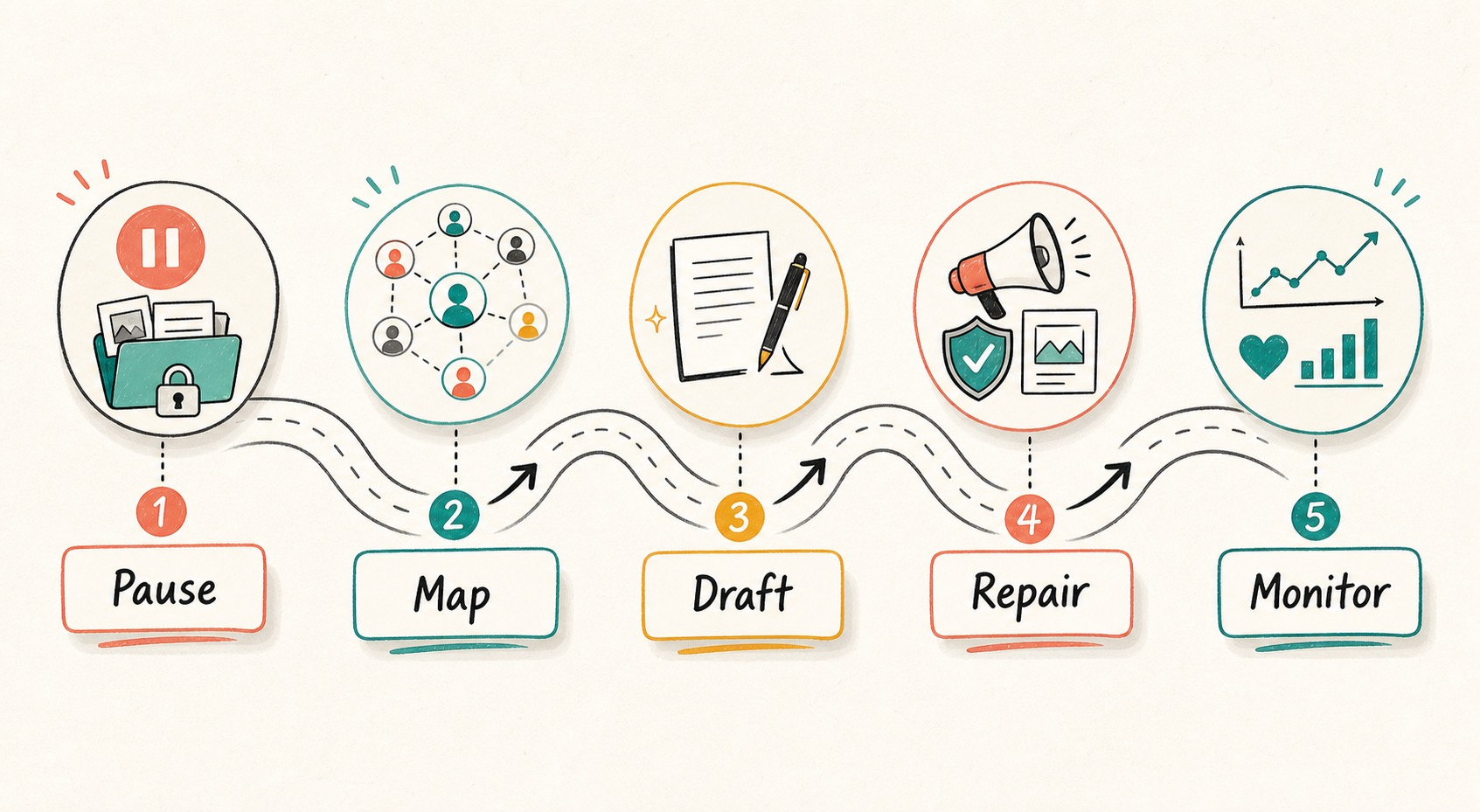
Reputation recovery is less about one perfect statement and more about making better evidence visible.
The Trust-First AI Workflow
Here is a practical workflow you can keep ready before anything goes wrong.
Create a Personal Brand Source File
Maintain a private document with your bio, positioning, proof points, public links, client-safe examples, values, topics you speak on, topics you avoid, and disclosure boundaries. This gives AI a truthful base when you need help quickly.
Keep a Response Decision Tree
Write rules for yourself now. For example: “If a factual error spreads, I correct once with evidence. If a client issue appears, I move details to private channels. If AI-generated content is involved, I disclose the workflow. If the issue includes legal risk, I do not post until counsel reviews it.”
Prewrite Your Holding Statement
A holding statement buys time without sounding evasive. It can be simple: “I am aware of the concern and I am reviewing the context before responding in detail. I want to be accurate rather than fast.” This is useful when silence would look careless but a full response would be premature.
Run a Monthly Search and AI Answer Check
Search your name, your topic, and terms like “review,” “controversy,” “scam,” “fake,” or “AI.” Ask major AI tools basic questions about who you are and what you do. Look for repeated misunderstandings that could become reputation debt.
Build Proof Before You Need It
The best crisis plan is a strong pre-crisis reputation. Publish work that contains your actual judgment, save testimonials, document decisions, and maintain public assets that make your expertise legible to humans, search engines, and AI systems.
What Not to Do During a Personal Brand Crisis
Do not mass-delete unless there is a clear reason. Unexplained deletion can look like hiding evidence.
Do not let AI write a grand apology full of phrases you would never say.
Do not argue with everyone. Choose the audiences that matter and the facts that need correcting.
Do not invent proof after the fact. If you do not have evidence, say what you are verifying.
Do not turn recovery into a content campaign too quickly. Repair comes before thought leadership.
A Simple 72-Hour Recovery Plan
Hour 0 to 6: Stop posting casually. Preserve evidence. Identify whether the issue is factual, ethical, relational, legal, or platform-driven. Decide whether you need legal, HR, client, or platform support before speaking publicly.
Hour 6 to 24: Map affected audiences. Draft a holding statement if needed. Contact directly affected people privately where appropriate.
Hour 24 to 48: Publish the right response type: correction, clarification, apology, or boundary. Keep it specific and add evidence where it helps.
Hour 48 to 72: Start the repair layer. Update proof assets. Clarify your AI-use process if relevant. Monitor search, AI answers, and comments without reacting to every mention.
After 72 hours: Return to useful work. The goal is not to erase the event from history. The goal is to make sure the event is not the only available evidence of who you are.
The Point of a Crisis Plan Is Not Perfection
Personal branding advice often focuses on growth: post more, get seen, build authority, use AI to scale. But a serious personal brand also needs resilience. If visibility creates opportunity, it also creates exposure. The more findable you become, the more important it is to know how you will respond when the wrong thing becomes findable too.
A personal brand crisis plan gives you discipline when attention spikes. It helps you separate facts from fear, public issues from private ones, and AI assistance from AI outsourcing.
The professionals who keep trust are not the ones who never make mistakes. They are the ones who can make the truth clearer, repair what they can, and return to visible proof without sounding like a machine wrote their conscience.
FAQ
What is a personal brand crisis plan?
A personal brand crisis plan is a prepared response system for protecting and rebuilding trust when your public reputation is threatened. It usually includes evidence capture, audience mapping, response rules, draft templates, proof assets, and monitoring steps.
How can AI help with personal brand crisis management?
AI can help organize timelines, identify affected audiences, critique drafts, find vague wording, summarize sentiment, and spot missing context. It should not decide your values, invent facts, or write an apology without your direct judgment.
Should I delete a bad LinkedIn post during a backlash?
Sometimes, but not automatically. If the post is factually wrong, harmful, or misleading, deletion plus a clear correction may be right. If people have already seen it, silent deletion can look evasive. Capture the original first, then decide whether correction, clarification, apology, or removal best fits the situation.
How do I recover from a personal reputation crisis?
Start by understanding the facts and who was affected. Respond only where needed, with specific language and clear next actions. Then rebuild trust through visible proof: updated work samples, stronger process notes, credible recommendations, public corrections, and consistent useful participation over time.
Do I need to disclose AI use in my personal branding?
Disclose AI use when it affects reader expectations, authorship, identity, evidence, or decision-making. You usually do not need to announce every grammar check. You should be transparent when AI helped create images, synthetic media, public claims, ghostwritten posts, avatars, or content that readers might reasonably assume came fully from you.