



Your strongest personal brand may not come from posting. It may come from documenting how you think.
Most professionals do not have a content problem. They have a memory problem.
They make smart calls all week, then forget the details that made those calls interesting. A founder chooses one customer segment over another. A consultant pushes back on a weak metric. A technical leader rejects a trendy AI tool because the governance risk is too high. Each decision contains judgment, context, tradeoffs, and proof of expertise.
Then Friday arrives, and the same person opens LinkedIn or Substack and thinks, “What should I post?” That is how capable people publish generic advice. They ask AI for ideas after the insight has gone cold.
A personal brand decision log fixes this. It captures the choices you are already making, then uses AI to turn those choices into clear, ethical, useful thought leadership.
This matters now because the internet is filling with polished professional noise. Originality.ai reported that 81.2% of a July sample of 5,000 public LinkedIn posts were classified as likely AI, while 404 Media covered browsing data suggesting heavy AI exposure in longform LinkedIn feeds. Whether you trust every percentage or not, the lived experience is obvious: more posts feel smooth, confident, and empty.
The advantage belongs to people who can show how they decide.
What Is a Personal Brand Decision Log?
A personal brand decision log is a private record of meaningful choices you make in your work, career, business, studies, or creative practice. It is not a diary, public brag document, or content calendar.
It is a capture system for judgment.
The basic entry is simple:
The situation: what was happening?
The decision: what did you choose?
The alternatives: what did you reject?
The constraint: what made the decision hard?
The principle: what belief or rule guided you?
The result: what happened, or what are you watching?
The lesson: what would help someone facing the same choice?
The content comes later. The first job is to preserve the raw material while it is still fresh.
That distinction is important. Most AI personal branding workflows start with “write me a post about leadership” or “give me ten content ideas for founders.” The output may be readable, but it usually lacks lived specificity. A decision log gives AI your actual context.
Generic content says, “Here is what I think.” Decision-led content says, “Here is what I noticed, chose, rejected, and learned.”
Why Decisions Make Better Personal Brand Content Than Hot Takes
People can disagree with a hot take and move on. But when you explain a real decision, they can inspect your thinking. They can see your standards, your caution, and where you refuse to fake certainty.
That is what personal branding is supposed to do. It should make your judgment easier to find, evaluate, and remember.
There is also a practical reason this works: decisions are naturally structured. Something was at stake. There were tradeoffs. You had imperfect information. You made a call anyway. That structure is more interesting than another generic lessons list.
This aligns with what serious B2B buyers say they want. LinkedIn’s summary of Edelman research says 52% of decision-makers and 54% of C-suite executives spend an hour or more each week reading thought leadership, and 75% say it led them to research a product or service. The newer Edelman and LinkedIn report frames thought leadership as a trust and alignment tool.
For an individual, the lesson is clear: useful thinking travels. Polished filler does not.
The Decision Log Template
You do not need a complex database. Use a note app, document, Notion page, voice memo folder, or private Slack channel. The best system is the one you can update in under five minutes.
Use this template for each entry:
Decision name: give the entry a plain title, such as “Chose a narrow customer segment” or “Delayed an AI automation rollout.”
Context: write two or three sentences about the goal, pressure, and situation.
Options considered: list the real alternatives. Expertise becomes visible when people see how you compare imperfect options.
Constraint: name the hard part: time, trust, budget, privacy, quality, regulation, team capacity, audience fit, or opportunity cost.
Principle: explain the rule you used, such as “I optimize for trust before reach.”
Outcome or watchlist: capture what happened, or what you are watching if the result is still unclear.
Public lesson: write the takeaway that could become a post, essay section, podcast point, or interview answer.
How to Use AI Without Letting It Flatten Your Voice
AI should not invent your authority. It should interview it.
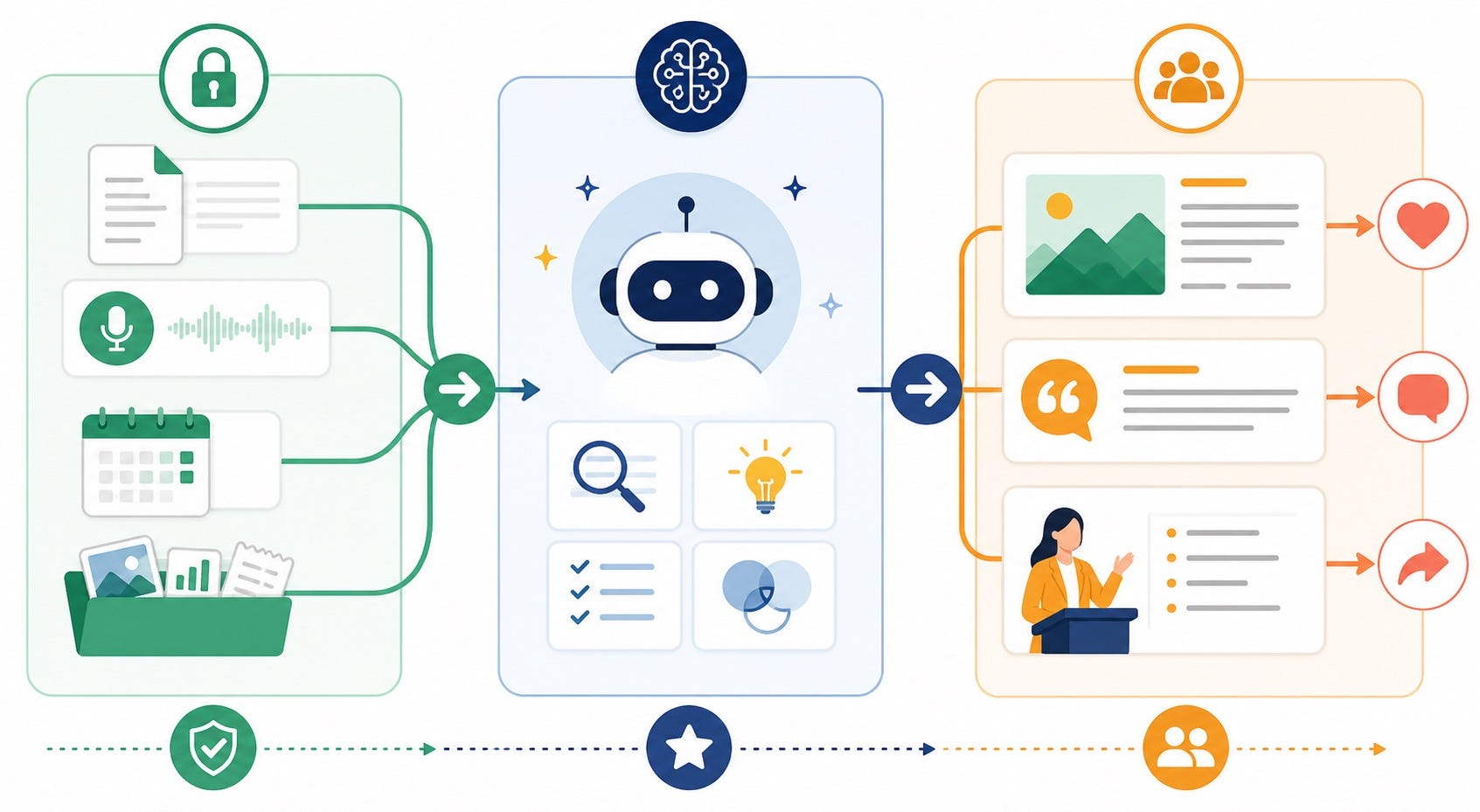
The safest workflow is capture first, generate second. Start with messy notes, voice memos, meeting reflections, or bullets. Then ask AI to help you find the signal. The goal is not to make the decision sound more impressive. The goal is to make the thinking clearer.
Try this prompt after a decision-log entry:
Act as a skeptical editor for my personal brand. Based only on the decision-log entry below, identify the real insight, the tradeoff, the audience who would care, the strongest public lesson, and any claims that need proof. Do not write a post yet. Ask me five follow-up questions that would make this more specific, credible, and useful.
This prompt changes the relationship. AI is no longer a ghostwriter trying to sound wise on your behalf. It becomes a structured thinking partner that asks for specifics before producing content.
After you answer, use a second prompt:
Turn this into three content angles: one for LinkedIn, one for a Substack essay, and one for a professional bio or speaking point. Keep my voice direct. Preserve the constraint, rejected options, and lesson. Remove confidential details. Flag anything generic, exaggerated, or unsupported.
You are not asking AI to perform expertise. You are asking it to shape evidence of expertise.
What Counts as a Decision Worth Logging?
You do not need to log every small choice. The useful entries usually fall into a few buckets.
Positioning Decisions
These decisions show who you serve and what you refuse to dilute. A consultant narrowing from “marketing strategy” to “retention strategy for seed-stage SaaS” has a decision worth explaining.
Quality Decisions
These decisions show your standards. Maybe you delayed a launch because onboarding was confusing, cut a feature because it created false confidence, or refused to publish a case study because the data was too thin.
Customer or Audience Decisions
These decisions show empathy and market understanding. Who did you listen to? Whose feedback did you ignore? What did your audience say in plain language that changed your mind?
Technology Decisions
These are useful for AI builders and technical professionals. Why did you use one model, tool, workflow, stack, or automation boundary over another? What did you keep human?
Career Decisions
These help students, job seekers, and employees build public identity without pretending to be celebrities. Why did you choose a project, volunteer for a messy task, or stop chasing one role and prepare for another?
The common thread is judgment under constraint. If a decision reveals how you think, it can strengthen your personal brand.
A Realistic Weekly Workflow
The decision-log habit should fit your life. If it feels like another content machine, it will fail.
Here is a simple weekly rhythm:
On Monday, create one blank decision-log note called “Decisions this week.”
During the week, add rough bullets when a choice feels meaningful. Use voice notes if typing slows you down.
On Friday, choose the one decision with the most useful lesson for someone else.
Ask AI to interview the entry, find the tradeoff, and flag weak claims.
Turn the best version into one public asset and one private reusable asset.
The public asset might be a post, essay section, newsletter note, podcast pitch, or interview story. The private reusable asset might be a clearer principle, stronger profile bullet, case-study fragment, FAQ answer, or future talk outline.
This is how a personal brand compounds. You are building a library of documented judgment.
Examples Across Different Careers
Founder
A founder decides not to chase enterprise customers yet, even though the logos would look impressive. The constraint is onboarding complexity. The public lesson becomes: growth that creates support debt is not traction, it is borrowed trust.
Consultant
A consultant tells a client that the proposed dashboard will not fix their problem because the team has not agreed on the operating decision it should support. The lesson: metrics are not strategy unless they change a decision.
Job Seeker
A job seeker rewrites their LinkedIn headline around outcomes instead of tasks. The lesson: your profile should help a hiring manager understand what problem you are trusted to own.
AI Builder
An AI builder keeps human approval before publishing customer-facing content. The principle: automation can accelerate review, but it should not remove accountability.

How to Publish Decision-Led Content Without Oversharing
The main risk with decision-led content is not that it is too boring. It is that it can become too revealing.
Use a privacy filter before anything goes public:
Remove names, private metrics, client identifiers, and internal conflict.
Delay publication if the decision is still sensitive.
Change the category of the example if the lesson survives without the details.
Ask whether a reasonable stakeholder would feel exposed.
Separate your lesson from someone else’s mistake.
A good public version preserves the decision logic while protecting the people involved. “We rejected a feature because it would have made onboarding harder for small teams” is useful. Naming the customer and internal conflict is careless.
AI can help here too. Ask it to act as a reputation reviewer:
Review this draft for confidentiality, unnecessary ego, unsupported claims, and reputational risk. Suggest safer ways to express the lesson without making it vague. Keep the decision logic intact.
The Posting Formats That Work Best
A decision log can feed many formats. A few are especially strong for personal branding.
The tradeoff post explains what you could have chosen, what you chose instead, the constraint, and the lesson. The rejected-option post shows taste by explaining why the tempting path was wrong. The decision breakdown essay gives readers the full chain. The interview story prepares you for podcasts, hiring conversations, sales calls, investor meetings, and panels. The profile proof bullet turns vague expertise into a memorable signal: “Known for helping X make Y decision under Z constraint.”
What to Measure
Do not measure a decision-led personal brand only by likes. Likes can reward familiarity, outrage, and easy agreement. Measure reputation signals.
Track whether people mention your ideas back to you. Track saves, replies, qualified DMs, invitations, referrals, better-fit calls, interview callbacks, and people asking for your opinion before a decision.
Also track the quality of your source material. Are your decisions getting more specific? Are your principles becoming clearer? Are you publishing fewer generic claims? That is the quiet advantage: the log improves both your content and the way you notice your own expertise.
The 15-Minute Starter Exercise
If you want to try this today, do not build a big system. Open a blank note and answer these five questions:
What is one decision I made this week that someone in my field would understand?
What made it harder than it looked?
What did I reject?
What principle guided me?
What would I tell someone facing the same choice?
Then feed your answers into AI and ask for three public angles. Do not publish the first draft. Read it once for accuracy, once for voice, and once for trust. Add one concrete detail. Remove one inflated phrase.
That is enough for one strong post.
Final Thought
The future of personal branding will not be won by people who generate the most content. AI made that too easy.
It will be won by people whose work leaves believable judgment.
Your decisions are already telling a story about your standards, values, expertise, and direction. A personal brand decision log helps you notice that story before it disappears into another busy week.
Use AI to organize the thinking. Use experience to supply the substance.
FAQ
What is a personal brand decision log?
A personal brand decision log is a private record of meaningful professional choices, including the context, alternatives, constraints, principles, outcomes, and lessons. It helps you turn real judgment into credible content and stronger reputation signals.
How does a decision log help with AI personal branding?
It gives AI specific source material from your real work. Instead of asking AI to invent posts, you use it to interview your decisions, clarify tradeoffs, identify lessons, and shape content that still reflects your experience and voice.
Is this only useful for founders?
No. Founders can use it for product, customer, hiring, and market decisions, but consultants, freelancers, executives, students, job seekers, creators, and AI builders can use the same method to show how they think and what they are trusted to handle.
How often should I publish from my decision log?
One useful decision-led post per week is stronger than daily generic posting. The point is not volume. The point is to make your judgment visible with enough consistency that people begin to associate your name with a clear kind of thinking.
Can I use client or employer decisions in public content?
Yes, but only after removing confidential details and checking reputational risk. Keep the lesson, constraint, and decision logic. Remove names, sensitive metrics, internal conflict, and any detail that would make a stakeholder feel exposed.
What AI prompt should I use first?
Ask AI to act as a skeptical editor, not a ghostwriter. Have it identify the real insight, tradeoff, audience, public lesson, missing proof, and follow-up questions before it writes anything. This keeps the workflow grounded in your actual expertise.