


If people keep asking what you do, who you help, whether you are a fit, or why your approach is different, you do not just have a messaging problem. You have an answer-structure problem.

A strong FAQ page turns scattered explanations into one structured trust asset that works for humans, search, and AI summaries.
Most personal brands leak credibility in small, repetitive moments. A founder gets asked the same three questions on intro calls. A consultant rewrites the same DM response every week. An executive keeps explaining what kind of work they actually want. A job seeker has projects worth showing, but their public profile still leaves people guessing. None of this feels dramatic, but it creates friction. And friction quietly reduces trust.
That is why a personal brand FAQ page is more useful than it sounds. It is not a support page. It is not filler for your website. It is a deliberate answer layer for your identity. It helps buyers, recruiters, collaborators, podcast hosts, and AI systems understand your expertise through the questions they already ask.
This matters more now because search behavior is changing again. On May 19, 2026, Google announced a broader rollout of AI Mode and deeper AI search experiences. Readers increasingly encounter people through summaries, snippets, answer boxes, and cross-surface previews before they ever read a full About page. A scattered personal brand is harder to summarize accurately. A structured one travels better.
The practical shift: instead of forcing every visitor to reverse-engineer your positioning, answer the core questions once in a clear format and let every other surface reinforce it.
Why this topic is a real content gap
The current search results for personal brand FAQ page and closely related queries are weak. They are mostly generic FAQ templates, broad personal branding lists, or passing mentions inside larger AI-overview articles. They rarely explain how a personal FAQ page works as a trust asset for experts, founders, creators, consultants, executives, and job seekers.
Reddit signals point to the same underlying pain from a different angle. In personal-branding and consulting discussions, people keep asking how to explain what they do, how to build authority without posting constantly, how to move traffic off social platforms, and how to stop repeating the same context in every conversation. Those threads do not usually ask for an FAQ page by name. They ask for the problem an FAQ page solves.
Good content often wins by naming the missing asset people already need, even when they are not using that exact phrase yet.
What a personal brand FAQ page actually does
A strong FAQ page shortens the distance between attention and belief. It answers the obvious questions, but it also handles the hidden ones:
Is this person really clear about what they do?
Do they understand their audience, or are they describing themselves in vague status language?
Can I see how they think before I book a call, reply to a pitch, or refer them?
Would an AI summary of this person likely be accurate, or would it flatten everything into buzzwords?
That last point matters. A personal brand FAQ page creates answer-ready language. Not robotic language. Organized language. It gives your website a place where questions, claims, examples, proof, and framing sit close together. That makes it easier for a human skimmer to trust you quickly and easier for answer engines to understand what you should be associated with.
Who should build one first
This is especially useful for people whose work is nuanced, high-trust, or frequently misunderstood:
Founders who are known for a company but want a clearer personal point of view
Consultants and freelancers whose value is often confused with a cheaper commodity service
Executives building visibility for board roles, speaking, advising, or fractional work
Creators and educators whose niche is clear to fans but not to first-time visitors
Students and job seekers whose public work needs more explanation than a resume can provide
Technical professionals and AI builders who are credible in practice but vague in public positioning
If your brand depends on context, a FAQ page gives that context a permanent home.
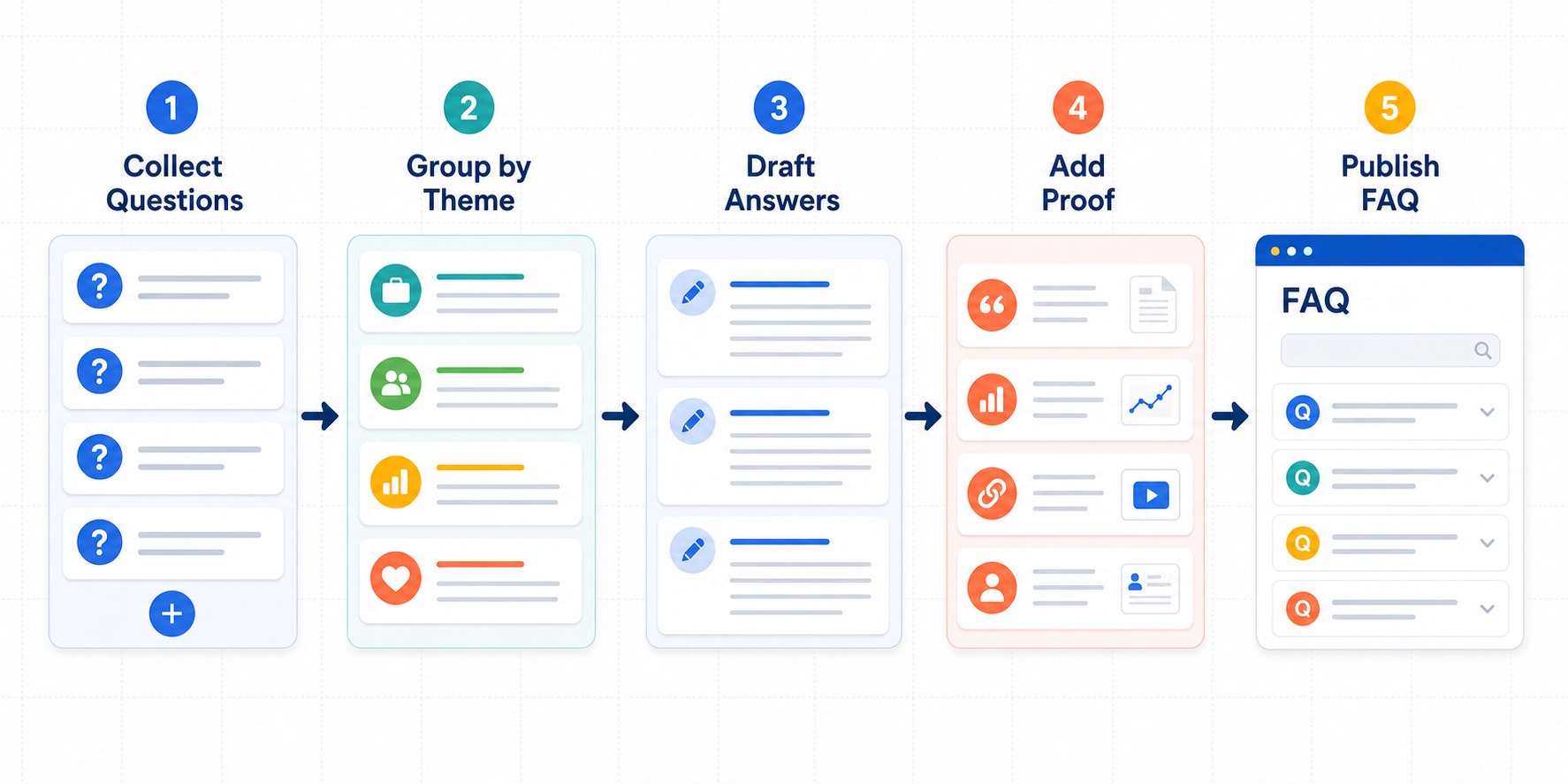
The right workflow starts with real repeated questions, not imagined marketing copy.
The five-part workflow for building a useful FAQ page with AI
1. Collect the questions people already ask
Do not brainstorm from scratch yet. Start with the questions you already answer in real life. Look at DMs, email threads, sales calls, intro calls, recruiter messages, onboarding forms, comments, and meeting notes.
You are looking for repeat patterns such as:
What exactly do you do?
Who do you work with best?
How are you different from other people with a similar title?
What results or outcomes do you usually help create?
Do you offer services, speaking, fractional work, consulting, teaching, or job availability?
How should someone contact you, hire you, or collaborate with you?
A FAQ page built from real repeated questions immediately sounds more relevant than one built from generic branding advice.
2. Cluster the questions into trust categories
Once you have the raw list, use AI to group the questions into a few clear buckets. I like five:
Identity: who you are and what you do
Fit: who you help and who you do not
Method: how you work or think
Proof: what makes the claims credible
Next step: how to work with you, follow you, or contact you
This keeps the page from becoming a random pile of answers. It turns it into a positioning system.
3. Draft answers in plain language before polishing
Use AI to create first drafts, but force the answers to stay grounded. Tell the model to sound like a smart operator, not a brand agency. Good answers are short, direct, and specific. They should sound like something you would actually say on a call.
Rules worth giving AI:
Do not use hype words unless they are supported by proof.
Prefer clear nouns and verbs over identity theater.
If an answer feels broad, ask for a sharper example.
Keep each answer skimmable in under 120 words unless depth is necessary.
Do not make claims stronger than the evidence I can show.
That last rule protects the page from becoming AI-polished fiction.
4. Add proof next to the answers
This is the part weak FAQ pages miss. A question plus an answer is helpful. A question plus an answer plus proof is persuasive.
Proof can take many forms:
A client result or case-study link
A project example or portfolio item
A media mention, talk, interview, or article
A short framework image or checklist
A testimonial line that supports the answer
If one answer says you help technical founders simplify positioning, include an example of a homepage rewrite, a launch narrative, or a short before-and-after explanation. Proof prevents the page from feeling self-declared.
5. Optimize for scanning and reuse
A personal brand FAQ page should not be a dead corner of your site. It should be a reusable source document. The best questions can become LinkedIn posts, website snippets, speaker-page answers, bio improvements, outreach replies, and newsletter intros.
That means the page should be cleanly structured:
Use plain-language questions as headings
Keep answers short and layered
Add links to proof where relevant
Order questions by what a new visitor most needs first
Review it every quarter so it reflects your current positioning
What questions belong on the page
Not every personal brand needs the same set, but most strong FAQ pages should answer some version of these:
What do you actually do?
Who do you help most?
What kind of work are you not the right fit for?
What makes your approach different?
What proof should I look at first?
Do you offer consulting, speaking, advising, hiring availability, or collaborations?
Where should I start if I am new to your work?
The goal is not to answer everything. The goal is to remove the main sources of hesitation.
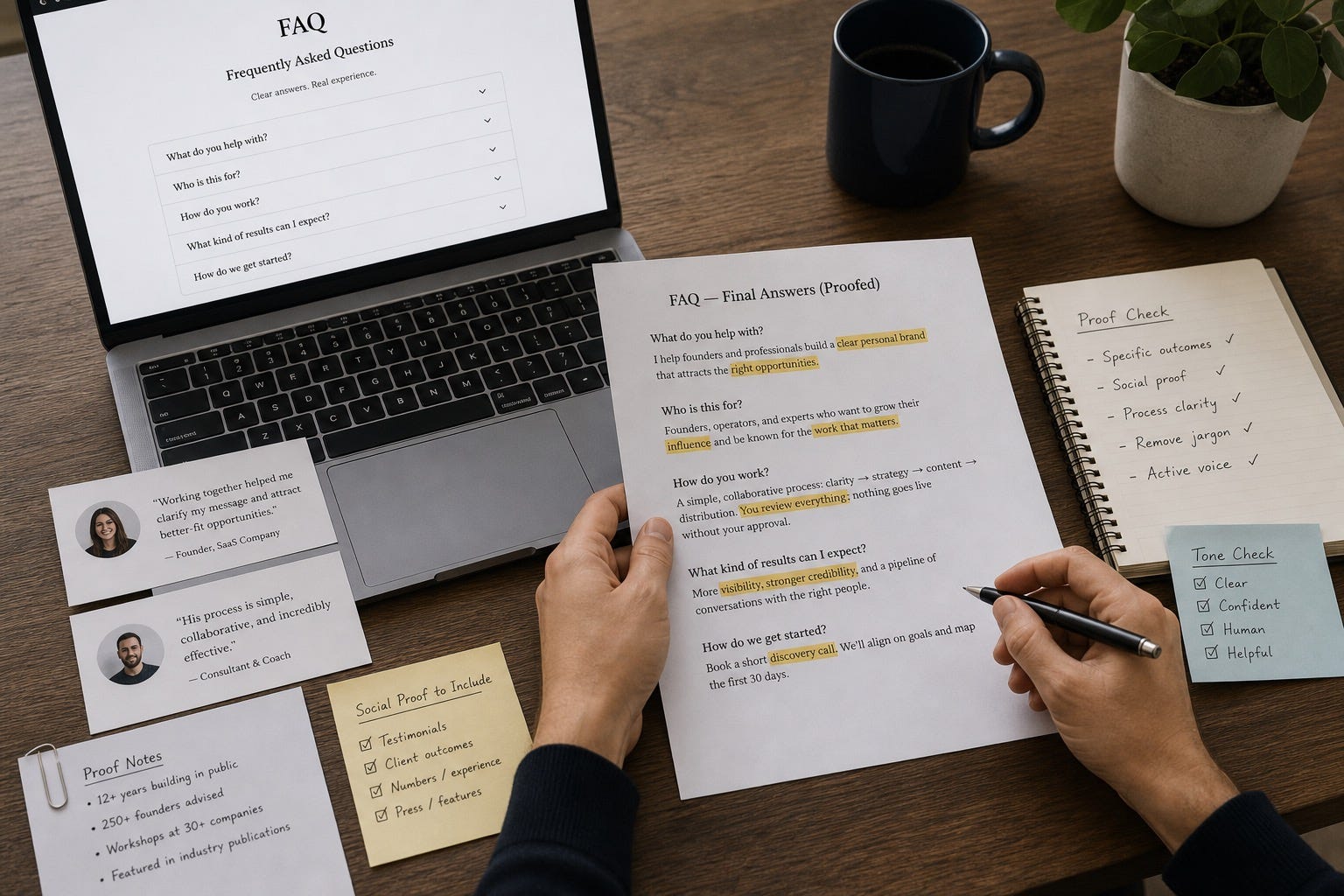
The strongest FAQ pages do not just answer questions. They connect those answers to visible proof and a next step.
How different audiences should use the format
Founders
Focus on your point of view, what you are building, what kinds of conversations you want, and where your experience makes you unusually credible. This is useful when your company site explains the product but not the founder.
Consultants and freelancers
Clarify scope, who you help best, how your process works, what outcomes you tend to drive, and how to know if you are a fit. This reduces repetitive sales friction without turning the page into a services brochure.
Executives and fractional operators
Answer the questions people quietly ask about titles, range, board readiness, advisory work, and level. A clear FAQ can separate real operating depth from inflated LinkedIn positioning.
Job seekers and students
Use the page to explain projects, strengths, interests, learning direction, and the type of role you want. This is especially useful when your experience is stronger than your official title.
The biggest mistakes to avoid
Writing answers nobody asked. If the page sounds like campaign copy, it loses its usefulness.
Making every answer too long. A FAQ page should reduce friction, not create homework.
Using AI to inflate certainty. It is fine to sound clear. It is dangerous to sound more accomplished than your proof supports.
Skipping the “not a fit” questions. Saying no clearly builds trust faster than pretending every opportunity is right.
Forgetting maintenance. If your positioning changes but the FAQ does not, the page becomes a trust leak.
Why this helps beyond your website
The hidden value of a personal brand FAQ page is that it improves every other channel. Once the answers exist in one place, your LinkedIn About section gets sharper. Your speaker bio gets easier to write. Your outreach replies get faster. Your homepage copy gets clearer. Your AI-assisted drafts get better because the source material is better.
That is the broader rule behind modern personal branding. Do not ask AI to generate clarity from nowhere. Build a structured source of truth first, then let AI help you adapt it.
If you keep getting the same questions, that is not a nuisance. It is a blueprint. Capture the questions. Write the answers. Add proof. Turn them into an asset. In an AI-shaped web, the people who explain themselves clearly will keep compounding trust long after the feed moves on.
FAQ
What is a personal brand FAQ page?
It is a website page that answers the most important questions about your work, expertise, fit, proof, and contact path. It helps new visitors understand you faster and trust you sooner.
Why does a FAQ page help personal branding?
Because it removes repeated confusion. Instead of forcing every visitor to guess what you do or message you for context, it gives them organized answers in your own words.
How is a personal brand FAQ page different from an About page?
An About page tells your story. A FAQ page handles objections, clarifies fit, and answers the practical questions people ask before they work with you, follow you, or refer you.
Can I use AI to write my FAQ page?
Yes, but only after you gather real questions and real proof. AI should help structure, tighten, and adapt the answers. It should not invent claims or voice from scratch.
What are the best questions to include on a personal brand FAQ page?
Start with what you do, who you help, who you are not a fit for, how your method works, what proof to review first, and what next step a visitor should take.
Do job seekers and students need a personal brand FAQ page too?
Often yes. It can help explain projects, interests, strengths, and role fit in a clearer way than a resume or LinkedIn headline alone, especially when experience is still emerging.