



Most people use AI to create more content. The smarter move is to first give AI better evidence.
AI can make your personal brand faster, but speed is not the same as credibility. If you ask a chatbot for LinkedIn posts, bios, newsletters, profile updates, podcast pitches, and website copy with only a vague prompt, it will reach for averages. Average phrasing. Average advice. Average stories that could belong to anyone.
That is why so much AI-assisted personal branding feels oddly polished and completely forgettable. The problem is not the tool. The problem is the missing source material.
A personal brand knowledge base fixes that. It gives AI a private, organized source of truth about your work, proof, point of view, audience, boundaries, and lived examples. Instead of asking AI to invent a brand voice from thin air, you teach it what you have actually done, what you believe, and what evidence supports your claims.
This is especially important now because AI systems are becoming a bigger layer between people and opportunity. Google has been pushing Search deeper into AI-powered answers and agents. Google also introduced Pomelli, an experiment that builds a business “DNA” profile from a website so generated campaigns stay grounded in the brand. The same idea applies to individuals: your AI outputs are only as distinctive as the material they learn from.
The goal is not to automate your reputation. It is to stop rebuilding your reputation from scratch every time you open a blank prompt box.
What Is a Personal Brand Knowledge Base?
A personal brand knowledge base is a structured collection of the facts, stories, examples, opinions, proof points, and language that define how you want to be understood professionally.
A normal personal knowledge management system helps someone capture and retrieve their own knowledge. A personal brand knowledge base has a narrower purpose: it helps you communicate your expertise consistently without becoming generic.
Think of it as the operating memory behind your public identity. It can live in Notion, Google Docs, Obsidian, Airtable, a folder of Markdown files, a private ChatGPT project, Claude project, Gemini Gems setup, or any tool that lets you organize and retrieve text. The tool matters less than the structure.
At minimum, it should answer five questions:
What do I want to be known for?
What have I done that proves it?
What do I believe that is not generic?
Who am I trying to help, hire, influence, or attract?
What should AI never exaggerate, fake, or flatten about me?
That last question matters. A good knowledge base is not just a pile of content ideas. It is also a guardrail. It tells AI what is true, what is sensitive, what is off-limits, and what needs human judgment before publishing.
Why Generic AI Content Happens
Generic AI content usually starts with a generic input. “Write me a LinkedIn post about leadership.” “Make my bio sound more executive.” “Create a personal branding strategy for a consultant.” These prompts are easy to write, but they give AI almost nothing real to work with.
When the model does not know your actual decisions, constraints, failures, projects, standards, and language patterns, it fills the gap with safe professional filler. You get phrases like “driving innovation,” “empowering teams,” and “passionate about impact.” They are not illegal. They are just invisible.
This is why Reddit discussions about AI and personal branding keep circling the same anxiety: people want the leverage, but they do not want to sound automated. Founders, freelancers, job seekers, and marketers all feel the same pressure when every feed starts to sound mass-produced.
The fix is not to ban AI. The fix is to change its job.
Do not ask AI to create your personal brand. Ask it to organize, pressure-test, and express the proof you already have.
That shift changes the output. Instead of “Here are five leadership lessons,” you get “Here is the lesson I learned after rejecting a high-revenue client because the operating model would have hurt delivery quality.” One sounds like a content template. The other sounds like a person with judgment.
The Search Gap: People Need the System, Not Another Pep Talk
The search results for personal branding are crowded with broad advice: define your niche, be authentic, post consistently, optimize your profile, use good visuals. That advice is not wrong. It is just incomplete for professionals using AI every week.
Recent search results around “personal brand knowledge base” show a clearer gap. There are general knowledge-base explainers, vendor pages, and business-brand source-of-truth articles, including Search Engine Journal’s argument that AI-ready brand authority depends on knowledge quality and governance. But there is still limited guidance for an individual professional building a source of truth for their own reputation.
That is the opportunity. You do not need a giant content machine. You need a trusted personal archive that turns your real work into reusable brand inputs.
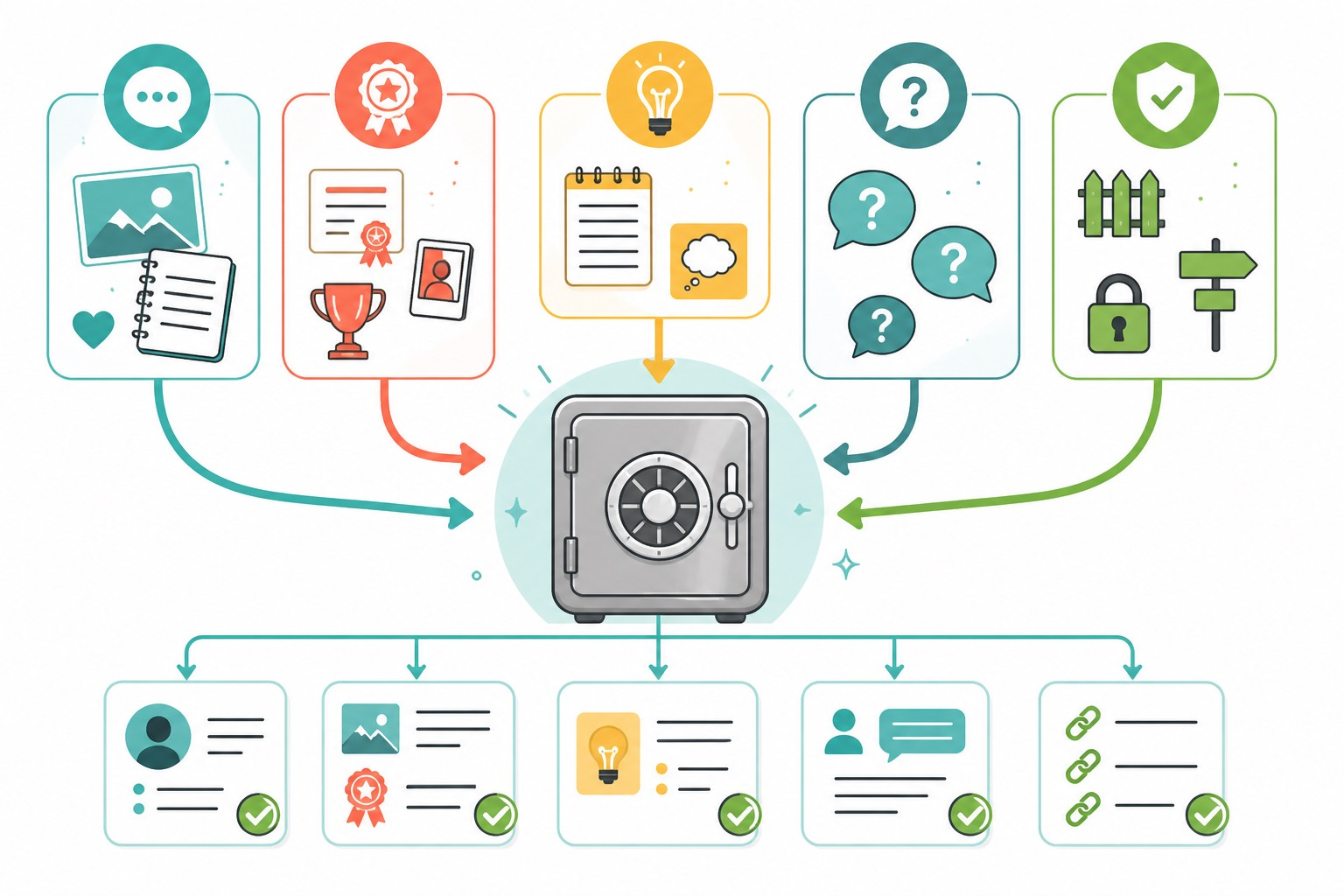
The Six Folders Every Personal Brand Knowledge Base Needs
You can make this simple. Start with six folders or sections. If you use Notion, make them database views. If you use Google Docs, make them headings. If you use Markdown, make them files. The important part is that AI can read them clearly.
1. Positioning
This is the shortest section and the easiest one to overcomplicate. Write down who you help, what problem you are known for solving, what contexts you understand deeply, and what opportunities you want more of.
Use plain language. A strong positioning entry might say: “I help seed-stage technical founders explain complex products to nontechnical buyers, investors, and early hires.” That is better than “I help companies tell better stories” because it names the audience, the stage, the complexity, and the communication problem.
2. Proof
This folder holds evidence. Not hype. Evidence.
Add case studies, project outcomes, testimonials, shipped work, talks, articles, GitHub repositories, client comments, product screenshots, teaching materials, awards, certifications, press mentions, and before-and-after examples. For each item, add a short note explaining what it proves.
Do not only collect big wins. A thoughtful client comment, a tough decision, a hiring lesson, a teardown, or a rejected idea can become stronger proof than a vague claim about results.
3. Stories
Your stories are the raw material AI cannot invent without making you sound fake. Create entries for turning points, mistakes, beliefs you changed, projects that shaped your standards, moments when you disagreed with the default advice, and problems you keep seeing in your field.
Keep each story rough. Capture the scene, the tension, the decision, the result, and the lesson. If you remember a sentence someone said, save it.
4. Point of View
This is where your personal brand becomes more than a record of accomplishments. Write down what you believe about your field, what advice you think is overrated, what trade-offs people ignore, and what you would tell a smart beginner who is about to copy the crowd.
AI is very good at smoothing opinions into polite mush. A point-of-view folder gives it sharper material. Instead of asking for “thought leadership,” you can ask it to expand a real position you already hold.
5. Audience Questions
Save the questions people actually ask you. Recruiters, clients, investors, students, peers, managers, podcast hosts, readers, and customers all reveal your market’s language.
Do not rewrite these questions into formal marketing copy too early. “How do I post on LinkedIn without becoming annoying?” is often more useful than “How can professionals build executive visibility?” Start with the human version.
6. Boundaries
This folder protects your trust. List claims you will not make, topics you will not fake expertise on, personal details you do not want used for content, client information that must stay private, and disclosure rules for AI-assisted work.
Boundaries reduce cleanup. If your knowledge base says “Never imply client revenue impact unless a client-approved number exists,” the draft will be safer.
The 60-Minute Setup
You do not need a perfect system. You need a first pass that is useful enough to change your next AI output.
Set a timer for 60 minutes and build this:
Write a one-paragraph positioning note.
Add five proof points with one sentence on what each proves.
Add five stories from your work history.
Add five opinions you believe more strongly than your peers.
Add ten audience questions you have heard or seen.
Add five boundaries AI should respect.
That is enough to start. The mistake is waiting until your knowledge base is comprehensive. A living source of truth becomes valuable because you use it.
How to Use AI With Your Knowledge Base
Once you have the first version, stop prompting AI like a stranger. Give it context from the knowledge base and assign it a specific job. Here are practical prompts you can adapt.
Prompt: Find the strongest angle
“Use the positioning, proof, stories, and audience questions below. Identify three personal brand content angles that are specific to me. For each angle, explain the proof it should reference, the audience pain it answers, and the claim I should avoid overstating.”
Prompt: Turn proof into a post
“Turn this proof point into a LinkedIn post for my target audience. Keep the tone direct and useful. Do not make the result sound bigger than the evidence supports. Include one concrete lesson and one practical takeaway.”
Prompt: Pressure-test a bio
“Review this bio against my positioning and proof folder. Flag any sentence that sounds vague, inflated, unsupported, or interchangeable with another professional. Suggest replacements using only evidence from the knowledge base.”
Prompt: Build a content series
“From these audience questions, create a five-part content series. Each part should answer one real question, use one proof point, and reinforce one point of view.”
The best prompt pattern is simple: context, task, constraints, evidence rule, output format. Tell AI when it can infer, when it must quote your notes, and when it must ask for more information.
What to Add Every Week
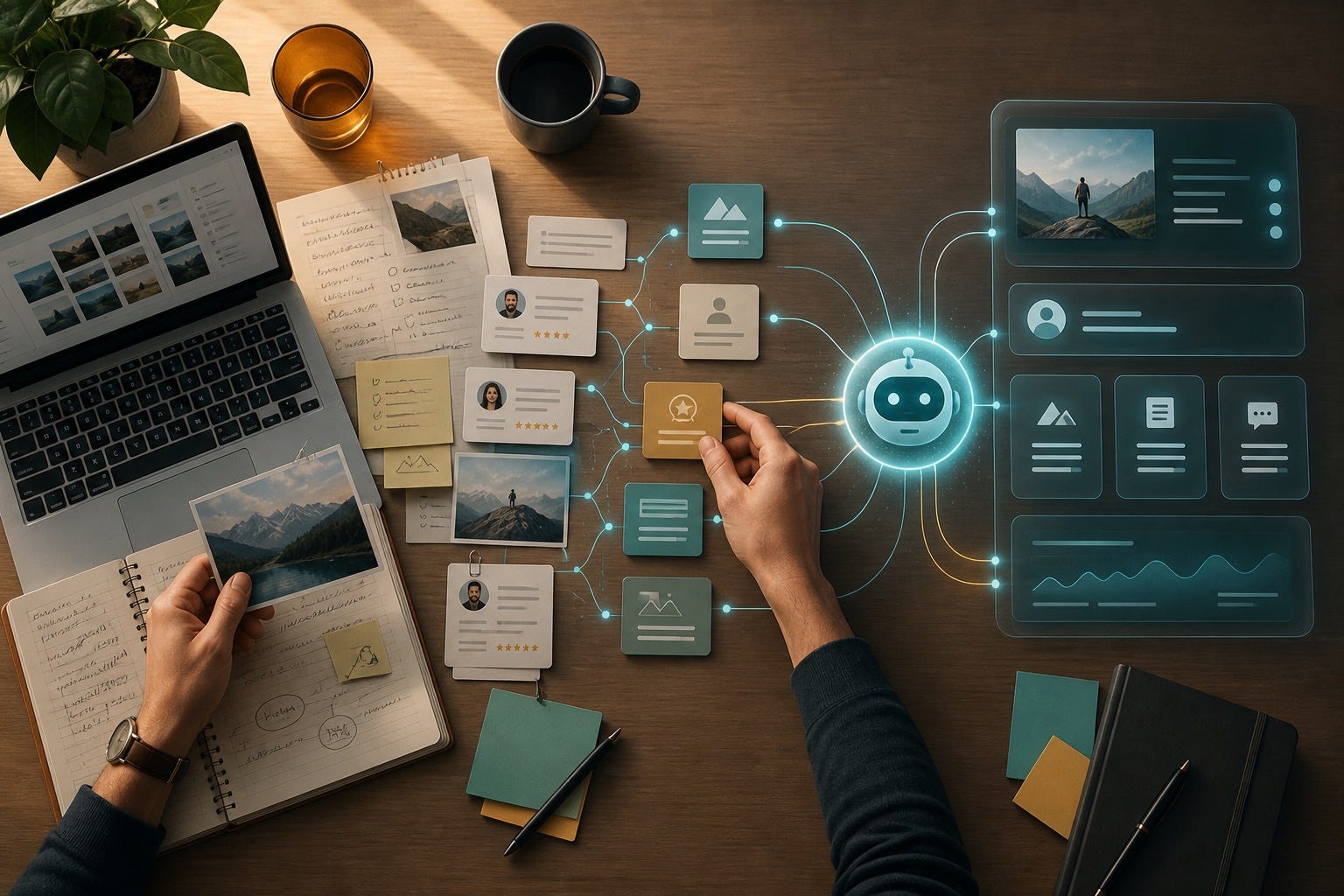
A personal brand knowledge base should not become another productivity guilt system. Keep the update rhythm light. Once a week, add:
One question someone asked you.
One proof point from work completed that week.
One mistake, trade-off, or decision you want to remember.
One phrase your audience used that you would not have invented.
This takes ten minutes. Over a few months, it becomes a serious reputation asset for posts, bios, interviews, speaker pitches, website copy, and clearer decisions about what you should stop saying.
How This Helps Different Professionals
Founders can use it to separate personal judgment from company marketing. Their posts become less about announcements and more about decisions, trade-offs, customer insight, and market beliefs.
Consultants can turn repeated client problems into sharper public explanations. Job seekers can use it as a career proof archive. Creators can test trends against real stories before posting. Technical professionals can make project decisions, trade-offs, debugging lessons, and user impact legible without exposing confidential details.
The Ethics: AI Should Help You Remember, Not Pretend
The trust line is straightforward. AI can organize your experience, find patterns, draft clearer explanations, and adapt your ideas for different platforms. It should not invent credentials, manufacture client results, fake personal stories, imitate vulnerable moments, or create a public persona you cannot back up in conversation.
When the output is based on your knowledge base, disclosure also becomes easier. You can honestly say you use AI for drafting, research, editing, or repurposing while keeping the judgment and source material human.
The practical test is this: if someone asked about a post on a call, could you explain the story behind it without checking the draft? If yes, AI helped you express expertise. If no, it may have borrowed authority you have not earned.
Common Mistakes to Avoid
Do not dump everything into one giant document. Use sections and labels.
Do not save only polished posts. Rough notes, objections, and decision logs are often more useful.
Do not collect only wins. Include lessons, constraints, and things you changed your mind about.
Do not let the system go stale. Review your positioning monthly.
Do not confuse consistency with sameness. Keep the judgment recognizable while the examples change.
A Simple Review Checklist Before You Publish
Before publishing any AI-assisted personal brand content, run this checklist:
Is the main claim supported by a real proof point?
Does the piece sound like something I would say out loud?
Did AI add any result, title, client type, number, or implication that is not true?
Is there a concrete example, not just advice?
Would this help the right person trust my judgment?
Could I defend this point in a live conversation?
If the answer is no, do not publish yet. Add more context, ask AI to revise against the evidence, or write the missing paragraph yourself.
The Real Advantage
The future of AI personal branding will not belong to the people who generate the most content. It will belong to the people with the best source material and the discipline to keep their public identity tied to evidence.
A personal brand knowledge base gives you that advantage. It makes AI less generic, keeps your claims connected to proof, and makes the process less exhausting because you are no longer asking, “What should I post?” from zero every week.
Start small. Save the stories. Label the proof. Capture the questions. Write down the boundaries. Then let AI help you turn the raw material into useful public work.
The best personal brand is not the loudest one. It is the one people can inspect and still trust.
FAQ
What is the best tool for a personal brand knowledge base?
The best tool is the one you will actually maintain. Notion, Google Docs, Obsidian, Airtable, Markdown files, and AI project folders can all work.
How is a personal brand knowledge base different from a content calendar?
A content calendar schedules output. A personal brand knowledge base stores the proof, stories, opinions, questions, and boundaries behind that output.
Can AI build my personal brand knowledge base for me?
AI can organize, summarize, tag, and clean up your notes. It should not invent the substance. Start with real material, then ask AI to find patterns and gaps.
How often should I update my personal brand knowledge base?
A weekly ten-minute update is enough for most professionals. Add one question, one proof point, one story, one trade-off, and one phrase your audience used.
Does using AI for personal branding hurt authenticity?
It can hurt authenticity if AI invents stories, exaggerates claims, or replaces your judgment. It can strengthen authenticity if it helps you retrieve real examples and clarify your ideas.
What should I never put in a personal brand knowledge base?
Do not add confidential client details, private personal information, passwords, sensitive documents, or anything you would not want exposed if a tool were misconfigured.