


For founders, consultants, creators, executives, freelancers, students, and professionals building a reputation that still feels human when AI helps behind the scenes.

Most people think their AI problem is a prompt problem. It usually is not.
The real problem is that they never built a personal brand messaging framework before asking AI to help. So the model fills the gap with safe, polished, forgettable language. Their LinkedIn sounds one way. Their website sounds another. Their bio feels inflated. Their newsletter sounds like a smart stranger.
If you are serious about personal branding, that inconsistency is expensive. It weakens trust, makes your expertise harder to remember, and turns useful AI into reputation drag. The fix is to give AI a stronger system to work inside.
This article shows you how to build that system. A practical messaging framework you can use across LinkedIn, your website, your Substack, your speaker bio, and every AI-assisted draft that leaves your laptop.
What this framework does
Clarifies what you want to be known for
Keeps your voice consistent across platforms
Prevents AI from drifting into generic language
Makes your proof of work easier to package and repeat
Helps people remember you faster
Why personal brand messaging matters more now
AI lowered the cost of producing words. It did not lower the cost of being credible.
The people who win are not the people publishing the most. They are the people whose thinking feels coherent everywhere. When someone reads your LinkedIn, visits your website, and lands on your newsletter, they should feel the same mind behind every surface.
That is what a personal brand messaging framework does. It turns your public identity into a system instead of one-off assets.
AI can scale your expression. It cannot decide what you should be known for. That is still your job.
What a personal brand messaging framework actually is
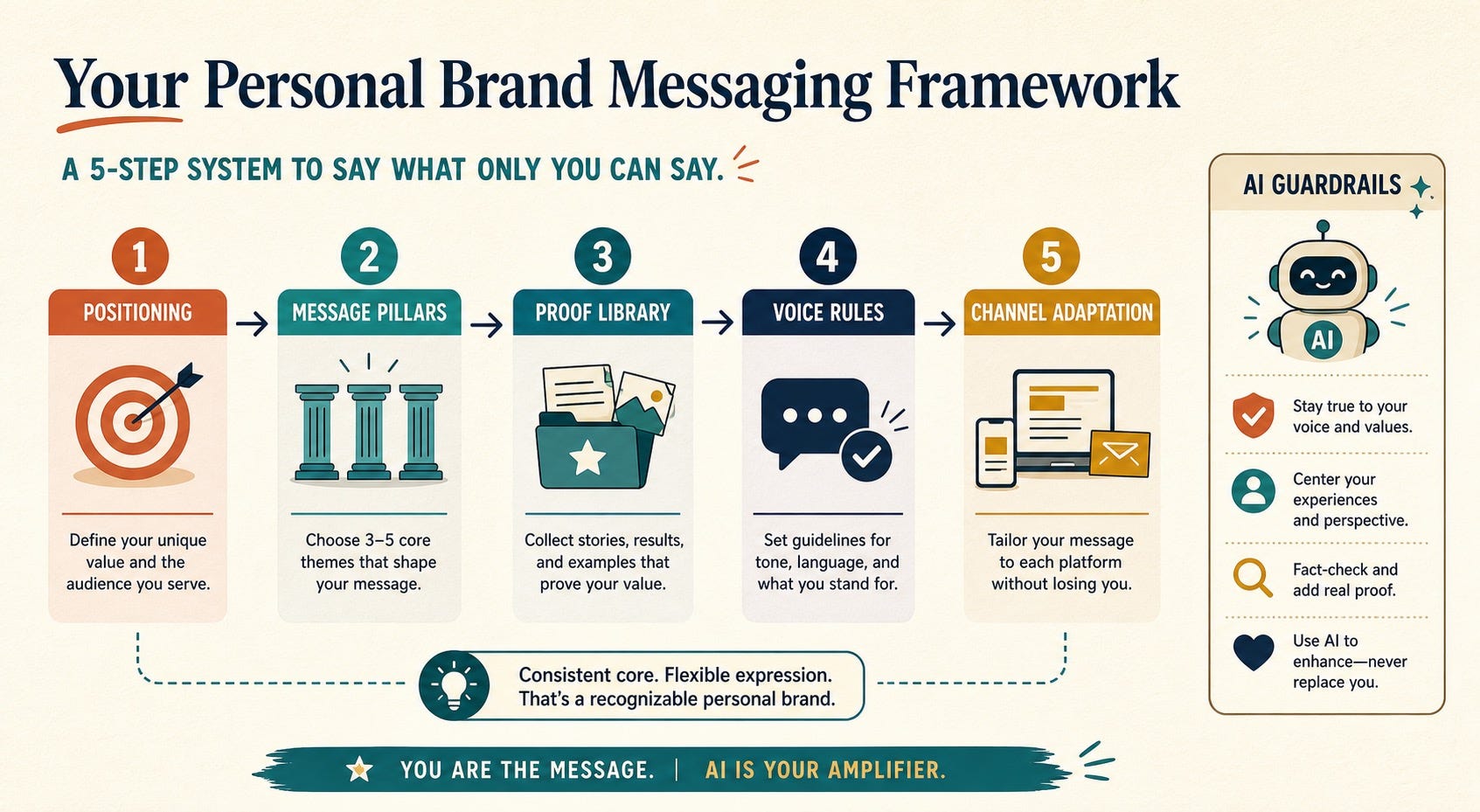
A personal brand messaging framework is a working document that defines how you describe your expertise, what themes you repeat, what proof you use, what language fits you, and what language does not.
Think of it as the operating system behind your visible brand. It is not public-facing by itself. But it shapes every public-facing thing you publish.
A good framework usually includes five parts:
Your positioning: who you help, what you help with, and why your angle is different.
Your messaging pillars: the three to five ideas you want to be associated with.
Your proof library: stories, examples, results, artifacts, and receipts that make your claims believable.
Your voice rules: how you naturally explain things, what tone fits you, and what phrases sound fake coming from you.
Your channel translation rules: how the same core message adapts for LinkedIn, your website, Substack, podcast bios, or intros.
Step 1: Define the reputation you actually want
Most people start personal branding by asking, “What should I post?” Start earlier with a better question: “What should people trust me for?”
Your reputation target should be specific enough that a stranger could repeat it in one sentence. For example:
A founder who makes AI products understandable for non-technical buyers
A consultant who turns messy operations into clear decision systems
A designer who explains product thinking in plain English
A job seeker who shows real analytical work instead of claiming to be “passionate”
If your message is too broad, AI will make it broader. If your target reputation is clear, AI can help you reinforce it.
A simple positioning formula
Use this sentence as a starting point:
I help [specific audience] solve [specific problem] by bringing [distinct method, lens, or proof].
Do not obsess over perfect wording yet. What matters is that the sentence forces clarity. You are defining the lane your messaging will defend.
Step 2: Build three to five messaging pillars
Messaging pillars are the recurring ideas your audience should hear from you often enough that they start to associate your name with them.
This is where many personal brands collapse. They post random useful things, but there is no pattern. The content may perform individually, yet the person remains blurry.
Choose three to five pillars that sit at the overlap of:
What you know deeply
What your audience cares about
What you want opportunities to come from
For example, a founder in B2B AI might choose:
Making AI useful in real workflows
Translating technical complexity into buyer clarity
Building trust through visible proof and honest trade-offs
Founder-led distribution and public learning
Your public output should keep reinforcing the same strategic memory.
The anti-generic filter
If a pillar could apply equally to you and ten thousand other people, it is too weak. “Innovation,” “leadership,” and “growth mindset” are not pillars. They are wallpaper.
Stronger pillars usually include a point of view. Not just what you talk about, but how you think about it.
Examples:
Not “AI productivity,” but “AI workflows that preserve human judgment”
Not “personal branding,” but “proof-first personal branding for skeptical buyers”
Not “leadership,” but “calm decision-making under ambiguity”
Step 3: Create a proof library before you create more content
If your messaging framework has claims but no proof, it will still sound synthetic.
Your proof library is the raw material that makes your brand believable. This is where you collect the things AI cannot invent safely: stories, screenshots, lessons, client outcomes, process notes, frameworks, examples, and honest before-and-after moments.
Create a running document with sections like:
Projects I am proud of
Repeated problems I solve
Client or team feedback I keep hearing
Mistakes that changed how I work
Strong opinions I can defend
Proof artifacts I can reference publicly
AI is much stronger when it is transforming your raw material than when it is generating from nothing.
Personal brand rule
Do not ask AI to invent authority. Ask it to organize evidence you already earned.
Step 4: Define your voice rules and your banned language
Most people define voice too vaguely. They write words like “authentic,” “insightful,” or “professional.” That is not enough for human writers, and it is definitely not enough for AI.
Instead, define voice as observable behaviors.
For example:
Short, direct opening sentences
Concrete examples before abstract theory
Skeptical of hype, but not cynical
Clear language over jargon
Honest about trade-offs and constraints
Then define what your voice should avoid. This part is underrated. A banned-language list is one of the best ways to stop AI from flattening your brand.
Your banned list might include phrases like:
“In today’s fast-paced digital landscape”
“Unlock your full potential”
“Thought leader” when used as a self-label
“Leverage,” if you never say it in real life
Any exaggerated claim you cannot prove
Also define your preferred substitutes. If you hate saying “leverage,” maybe you say “use,” “apply,” or “build around.” Voice is built from repeated micro-choices.
Step 5: Translate one message across every surface
One of the biggest personal branding mistakes is writing every asset from scratch. That creates drift. Your LinkedIn headline becomes punchy. Your website becomes formal. Your speaker bio becomes inflated. Your newsletter becomes introspective. Soon, people are meeting four different versions of you.
Instead, keep one core message and adapt the format around it.
Example of message translation
Core message: “I help technical teams explain complex AI products in language buyers trust.”
LinkedIn headline: AI product strategist helping technical teams turn complex products into buyer clarity
Website hero: Clear positioning, messaging, and proof systems for AI products that make sense to buyers
Speaker bio: Known for translating technical complexity into practical language that executives and customers can act on
Newsletter promise: Notes on making AI products easier to understand, trust, and buy
What changes is the format and emphasis. What stays the same is the strategic identity.
Step 6: Use AI as a messaging assistant, not a personality substitute
Once you have your positioning, pillars, proof library, voice rules, and channel translations, AI becomes genuinely useful. You can ask it to draft, compress, expand, organize, test angles, or adapt a message for a specific platform. But the system stays yours.
Useful AI tasks include:
Turning a messy voice note into three post angles tied to one messaging pillar
Rewriting a website paragraph so it matches your LinkedIn positioning
Generating five versions of a bio for different contexts without changing the core message
Flagging sentences that sound too generic, inflated, or inconsistent with your rules
Pulling proof examples from your library to support a claim
Less useful AI tasks include:
Inventing your point of view
Writing your entire personal brand from zero context
Replying to people in your voice without your review
Creating authority claims you have not earned
A practical prompt structure
If you want better output, give AI inputs in this order:
Who you help and how you help them
The messaging pillar this draft should reinforce
The proof or example it must include
The voice rules to follow
The phrases to avoid
The channel and goal of the draft
That structure usually produces better work than asking for “a strong personal branding post” because it gives the model a real system to honor.
Step 7: Audit your current surfaces for message drift
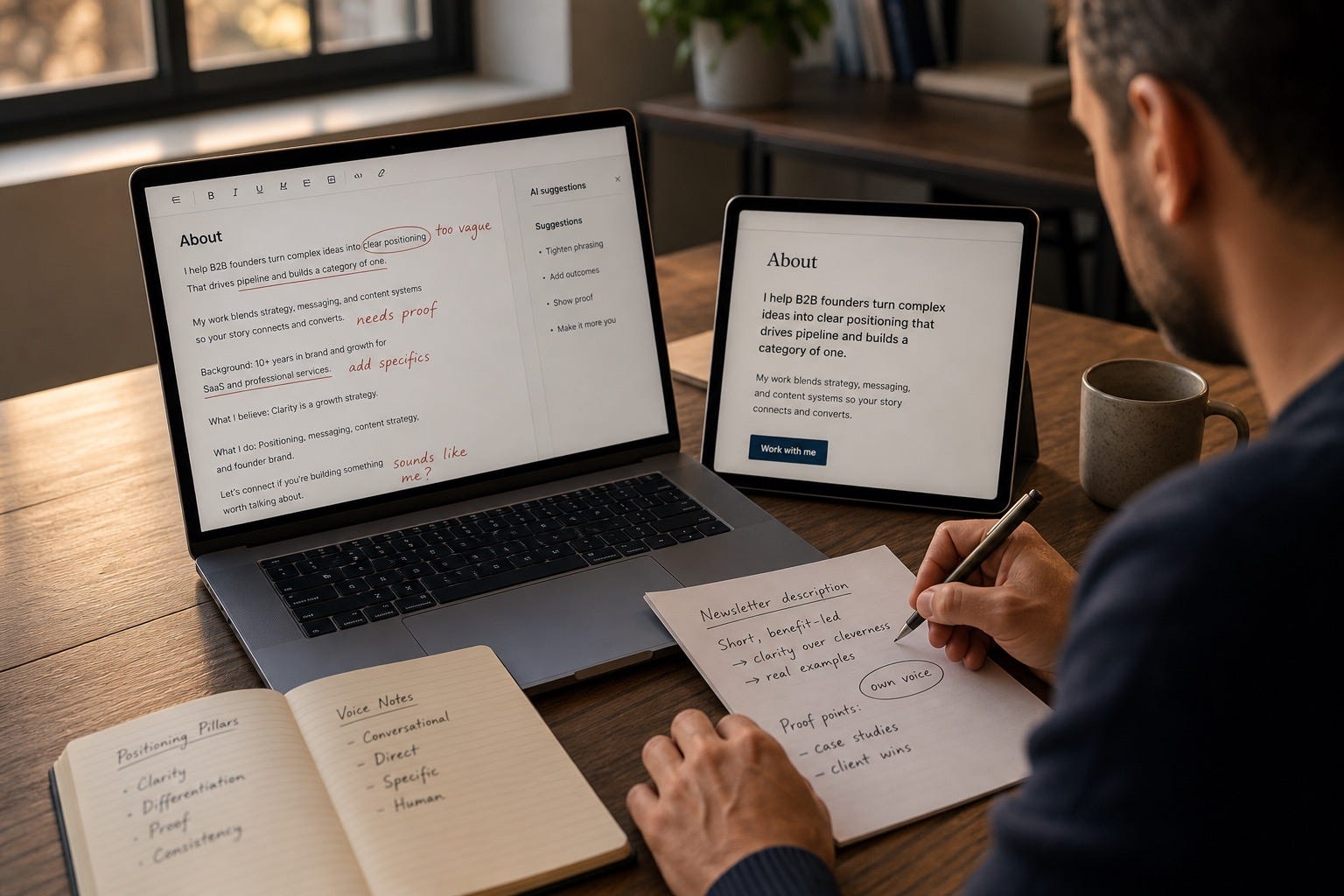
Before you publish anything new, audit what already exists. Open your LinkedIn headline, About section, website home page, bio, and newsletter description side by side.
Then ask:
Would a stranger think this all belongs to the same person?
Is the same expertise clear in every place?
Do I repeat the same proof, or does each surface make different unsupported claims?
Does my language sound natural, or does some of it sound auto-generated?
Am I known for specific ideas, or just general competence?
You do not need perfect consistency. You need recognizable consistency. The goal is trust.
Common mistakes that weaken personal brand messaging
1. Optimizing every channel separately
This creates local improvements and global confusion.
2. Confusing aesthetics with clarity
A polished banner, headshot, or website is useful, but visuals cannot rescue unclear messaging.
3. Using AI before collecting proof
Without source material, the model defaults to average language.
4. Trying to sound impressive instead of precise
Precision builds trust faster than inflated authority language.
5. Changing your message too often
People need repetition before they create a stable memory of who you are and what you do.
A simple 30-minute reset
If your brand feels scattered right now, here is a fast reset:
Write one sentence describing what you want to be trusted for.
Choose three messaging pillars you want to repeat for the next 60 days.
Collect five proof examples that support those pillars.
Make a short list of phrases you never want AI to use for you.
Rewrite your headline, bio, and website intro using the same core message.
Only then start drafting new content.
That is enough to stop the drift and make your next AI-assisted draft much stronger.
The strategic payoff
A strong personal brand messaging framework does more than clean up your copy. It helps people remember you, helps referrals describe you accurately, gives AI better raw material, and makes every asset you publish feel like part of one body of work instead of random output.
That is the real goal of AI personal branding. Not more noise. More identity density.
If your content keeps sounding generic, do not start by blaming the model. Start by tightening the message. AI usually reveals the weakness that was already there.
FAQ
What is a personal brand messaging framework?
A personal brand messaging framework is a document or system that defines your positioning, messaging pillars, proof points, voice rules, and channel adaptations so your public identity stays consistent across platforms.
How is personal brand messaging different from a personal brand statement?
A personal brand statement is usually one concise sentence. A messaging framework is broader. It includes the sentence, but also the ideas, proof, tone, and language rules that shape everything else you publish.
Can AI help build a personal brand messaging framework?
Yes, but it works best as a thinking partner and drafting assistant. AI can help organize themes, test phrasing, adapt messages for channels, and spot inconsistencies. It should not invent your core identity or unsupported authority claims.
What should I include in a brand voice guide for AI tools?
Include your target audience, tone behaviors, preferred vocabulary, banned phrases, sample writing that sounds like you, proof examples, and instructions for how different channels should adapt the same core message.
How many messaging pillars should a personal brand have?
Most people do best with three to five. Fewer than three can make the brand feel narrow. More than five usually creates topic drift and makes it harder for people to remember what you stand for.
Why does AI-generated personal branding often sound generic?
Because the model is usually working with weak inputs. If you do not provide a clear position, proof library, voice rules, and anti-phrases, AI fills the gaps with safe average language that sounds polished but forgettable.