


AI can copy your format, polish your profile, imitate your tone, and flood every feed with competent-looking content. Your moat is what it cannot fake: accumulated trust, specific judgment, and proof that real people associate with your name.

A personal brand used to mean looking polished enough to be taken seriously. A good headshot, a sharp LinkedIn headline, a few case studies, a newsletter, and a clean website could separate you from people who looked invisible online.
That gap is closing fast. Anyone can now ask AI to write a better bio, generate content ideas, summarize their experience, design a homepage, or produce weeks of posts. The surface layer of credibility is becoming cheap.
That does not make personal branding less valuable. It makes the weak version of personal branding less valuable. The new question is not “How do I look credible?” It is “What can people learn, remember, verify, and trust about me that a generic AI system cannot manufacture?”
That is your personal brand moat.
What a Personal Brand Moat Actually Is
A personal brand moat is the set of reputation advantages that make you hard to replace, hard to confuse, and hard to copy. It is not your follower count. It is not your logo. It is not a perfectly optimized profile. Those things can help, but they are not the moat.
Your moat is the combination of:
The problems people associate with you.
The way you explain those problems.
The proof that you have solved, studied, built, tested, or survived them.
The trust memory you have created in other people’s minds.
The public trail that helps strangers verify your competence before they contact you.
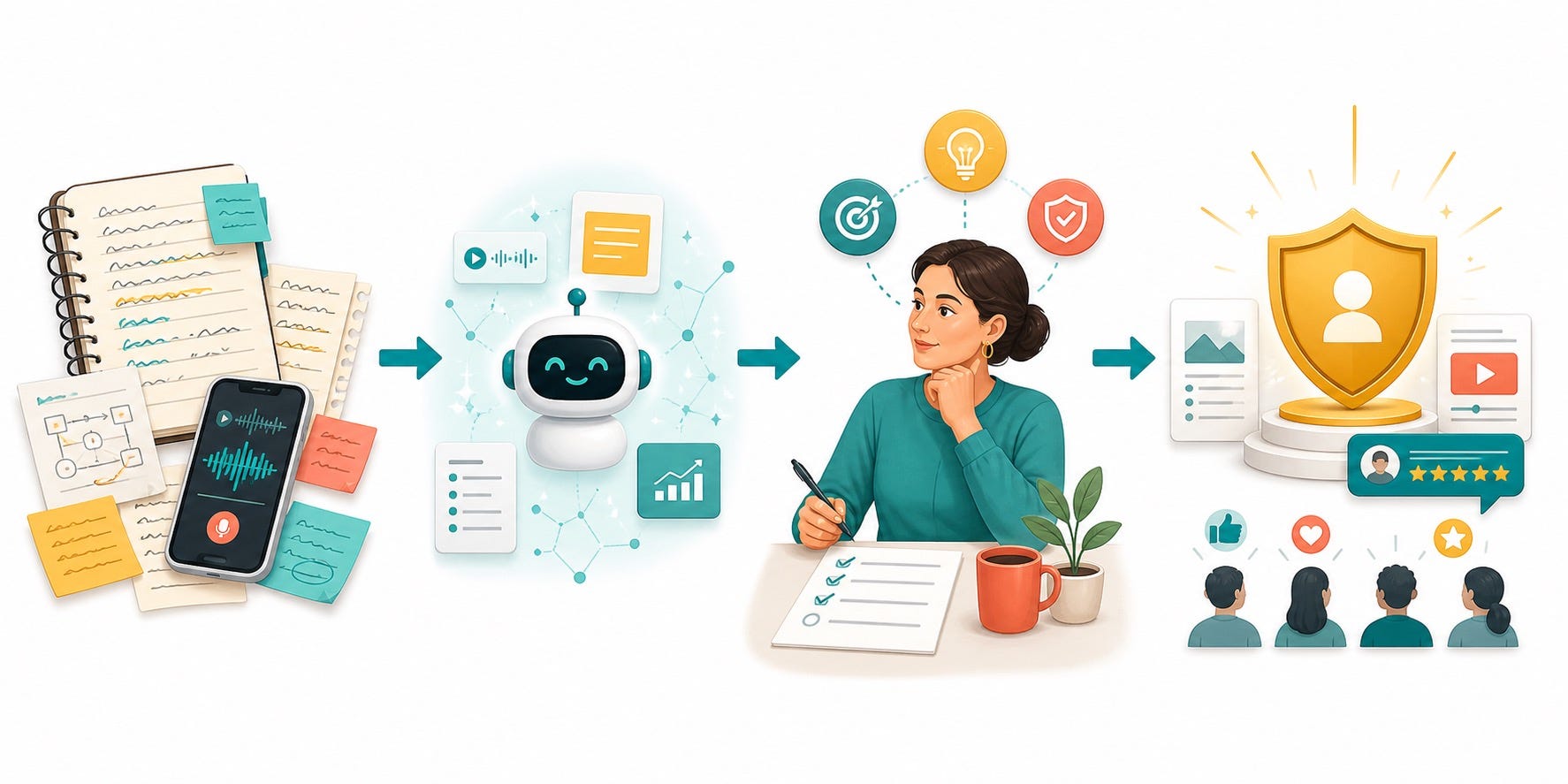
AI can help you package that. It can interview you, organize messy notes, find patterns, draft outlines, repurpose ideas, and pressure-test your positioning. But AI cannot create the moat by itself because the moat depends on lived experience, taste, choices, and social memory.
That distinction matters now because trust is becoming a platform-level issue. Substack recently introduced AI-detection features with Pangram and a way for creators to explain how they make their work. Canva’s State of Marketing and AI report says AI has removed creative friction, while judgment, direction, and human touch are becoming differentiators. LinkedIn has been investing in creator credibility because buyers and marketers increasingly trust people with visible expertise, not faceless brand output.
The signal is clear: AI-assisted content is normal. Untraceable, generic, no-one-home content is the problem.
The Mistake: Building a Content Machine Instead of a Reputation System
The easiest way to use AI for personal branding is also the easiest way to become forgettable. You feed a tool your niche, ask for thirty post ideas, approve the ones that sound smart, schedule them, and call it consistency.
That may create activity. It rarely creates memory.
A content machine asks, “What can I publish today?” A reputation system asks, “What should people know about my judgment after seeing me for six months?”
The difference shows up in the output. A content machine produces lessons, tips, threads, carousels, and polished opinions that could have come from anyone in the category. A reputation system produces proof of how you think: decisions you made, constraints you faced, mistakes you corrected, client patterns you noticed, product tradeoffs you chose, and unpopular lines you will not cross.
If your content can be produced by someone who has never done your work, it is not a moat. It is decoration.
This is why many professionals feel uneasy about AI personal branding. They are not rejecting AI. They are rejecting the feeling that they are being slowly replaced by a smoother version of themselves.
The fix is not to stop using AI. The fix is to change what AI is allowed to do.
The Four Layers of a Strong Personal Brand Moat
1. Proprietary Insight
Proprietary insight is what you know because of your actual work. It does not have to be a secret dataset or a dramatic founder story. It can be a recurring pattern you see before your audience sees it.
A consultant might know why good clients hesitate before buying. A job seeker might know what a career transition feels like from the inside. A founder might know the hidden reason customers churn after a promising onboarding call. An AI builder might know which workflows look impressive in demos but fail in daily use.
AI can help extract these insights. It can ask better questions than a blank page:
“What have I changed my mind about in my field?”
“What do beginners misunderstand because experts explain it badly?”
“What problem do clients describe one way but experience another way?”
“What advice sounds true online but breaks under real constraints?”
The goal is not to ask AI for opinions. The goal is to use AI as an interviewer that helps you recover your own.
2. Visible Proof
People trust what they can inspect. A strong personal brand moat has receipts: case studies, before-and-after examples, teardown notes, build logs, public experiments, testimonials, GitHub repositories, workshop clips, annotated screenshots, essays, podcasts, talks, or even a simple page that collects your best thinking.
Proof does not need to be flashy. It needs to be specific. “I help founders grow” is a claim. “Here are the three positioning changes that helped a founder reduce bad-fit calls” is proof. “I am passionate about AI” is a claim. “Here is the workflow I use to test whether an AI agent actually saves time” is proof.
Use AI to turn raw proof into public proof. Record a five-minute voice note after a project. Paste messy notes into an AI tool. Ask it to extract the decision, constraint, lesson, and artifact. Then edit it yourself until the final version sounds like a person who was actually there.
3. Recognizable Point of View
Your point of view is the pattern in your judgment. It is what people expect you to say because they have seen you think consistently over time.
A strong point of view does not mean being loud or contrarian for attention. It means being legible. You have standards. You prefer some tradeoffs over others. You believe some popular advice is incomplete. You can explain why.
For example:
A career coach might believe job seekers should build proof before optimizing applications.
A founder might believe build-in-public only works when it is tied to real customer problems, not vanity metrics.
A consultant might believe AI should accelerate expertise capture, not replace client empathy.
A technical leader might believe executive presence is mostly clarity under pressure, not polished language.
AI is useful here because it can find consistency across your past work. Give it your posts, notes, call transcripts, essays, and project reflections. Ask: “What do I keep arguing for? What do I keep warning against? What standard am I applying that I have not named yet?”
Then name the pattern in plain language. That name becomes a handle your audience can remember.
4. Community Memory
A personal brand moat becomes durable when other people remember you for something before you enter the room. That memory can come from public content, private referrals, community participation, podcast appearances, comments, collaborations, or helpful conversations in niche groups.
This is where many people misunderstand “build in public.” The point is not to disclose everything. The point is to create a visible track record. Share enough of your process that people can see how you think, what you care about, and whether you keep showing up after the launch excitement fades.
The best personal brands are not built by broadcasting constantly. They are built by becoming reliably useful in the same few contexts.
How to Use AI Without Weakening the Moat
AI should support your personal brand in the background. It should not become the personality in the foreground.
Here is a practical workflow.
Step 1: Build an Evidence Bank
Create one private folder or document called “Evidence Bank.” Add raw material every week:
Client questions you answered.
Sales objections you heard.
Project decisions you made.
Mistakes you corrected.
Screenshots of results or process artifacts.
Good comments, testimonials, or DMs.
Questions people keep asking in communities.
Do not polish this folder. Its value is raw specificity. Once a week, ask AI to cluster the material into themes, but do not let it invent lessons. Your prompt should be strict:
“Analyze these notes. Extract only patterns supported by the material. Separate direct evidence from interpretation. Suggest three personal brand insights I could publish, but do not write the final post yet.”
Step 2: Turn One Real Moment Into Three Assets
Most people try to create too many original ideas. A better system is to create more formats from fewer real moments.
Take one real moment: a client objection, a failed experiment, a product decision, a career lesson, or a conversation that changed your mind. Turn it into:
A short LinkedIn or X post focused on the lesson.
A longer newsletter section explaining the context.
A proof asset on your site or profile that shows the underlying artifact.
AI can draft the first version. You should add the things AI will usually smooth away: the constraint, the tradeoff, the uncertainty, the exact language someone used, the reason the obvious answer did not work.
Step 3: Create a “Cannot Copy” Checklist
Before publishing, ask whether the piece contains at least two of these moat signals:
A specific situation you witnessed.
A decision you made and why.
A result, artifact, or observable change.
A named principle you apply repeatedly.
A useful disagreement with common advice.
A boundary about what you will not do.
A question you are still honestly exploring.
If the answer is no, the piece is probably too generic. Keep it as a draft, not a public asset.
Step 4: Disclose Process Where It Builds Trust
You do not need to label every grammar fix. But if AI materially shaped the work, helped generate an image, simulated an interview, or supported analysis, consider explaining your process. That is especially true on platforms where readers are already sensitive to AI authorship.
Disclosure should be simple and non-defensive: “I used AI to organize my notes and pressure-test the structure. The examples, final argument, and editing are mine.” That sentence does more for trust than pretending the tool was not there.
What to Stop Doing
If you want a personal brand moat, stop optimizing for signals that AI has made abundant.
Stop posting generic lessons that could fit any consultant, founder, or creator.
Stop mistaking frequency for credibility.
Stop hiding behind polished language when a rough but specific example would be more believable.
Stop outsourcing your judgment to a tool trained to average everyone else’s language.
Stop making your profile a museum of claims with no proof trail.
AI raises the floor. That is useful. But your personal brand moat comes from raising the ceiling: clearer thinking, sharper evidence, more recognizable standards, and deeper trust.

A Simple Weekly Personal Brand Moat Routine
You do not need a giant content calendar. Start with ninety minutes a week.
Twenty minutes: Capture raw evidence. Review calls, notes, messages, shipped work, and questions from your audience. Drop anything useful into your evidence bank.
Twenty minutes: Ask AI to cluster themes and suggest angles. Reject anything that sounds like it came from a generic thought leadership template.
Thirty minutes: Draft one useful asset from one real moment. Make it specific enough that someone in your field would recognize the truth in it.
Ten minutes: Add proof. Link to an artifact, describe a constraint, include a before-and-after, or explain how you know.
Ten minutes: Publish or save. If it is strong, post it. If it is not, keep it in the evidence bank. Consistency matters, but trust matters more.
Do this for twelve weeks and your public identity starts to change. Not because you are louder, but because your name becomes attached to a pattern of useful judgment.
The Real Advantage
The future of personal branding is not human versus AI. It is generic versus specific.
The professionals who win will use AI constantly, but they will not use it to become easier to copy. They will use it to remember more of their own experience, ask sharper questions, turn messy work into usable proof, and make their judgment easier for other people to see.
That is the personal brand moat: not a prettier public image, but a reputation with roots.
When someone searches your name, reads your profile, hears you on a podcast, sees your comments, or lands on your site, they should not merely think, “This person looks credible.” They should think, “I understand how this person thinks. I can see what they have done. I know why I would trust them.”
AI can imitate the look of authority. It cannot borrow the trust you have earned in public, over time, with evidence.
FAQ
What is a personal brand moat?
A personal brand moat is the reputation advantage that makes you hard to copy or replace. It comes from specific expertise, visible proof, recognizable judgment, and the trust people associate with your name.
How can AI help build a personal brand moat?
AI can help you interview yourself, organize notes, find patterns, draft outlines, repurpose ideas, and identify gaps in your public proof. It should support your thinking, not replace your experience or final judgment.
What makes a personal brand hard to copy?
A personal brand becomes hard to copy when it includes lived experience, proprietary insight, real artifacts, specific decisions, community relationships, and a clear point of view built over time.
Is posting more content enough to build a personal brand?
No. Posting more can create visibility, but visibility without memory is weak. A stronger strategy is to publish fewer, more specific assets that show how you think and what you can prove.
Should I disclose AI use in personal branding content?
Disclose AI use when it materially shaped the work, generated media, summarized research, or affected reader expectations. Simple process transparency can build trust, especially as platforms and audiences become more sensitive to AI-generated content.
What is the best first step for building a personal brand moat?
Start an evidence bank. Collect real questions, decisions, project notes, results, testimonials, and lessons every week. Then use AI to help turn that raw material into public proof and useful content.