


A practical weekly system for founders, consultants, executives, creators, and job seekers who want to catch reputation drift early and strengthen the public record around their name.
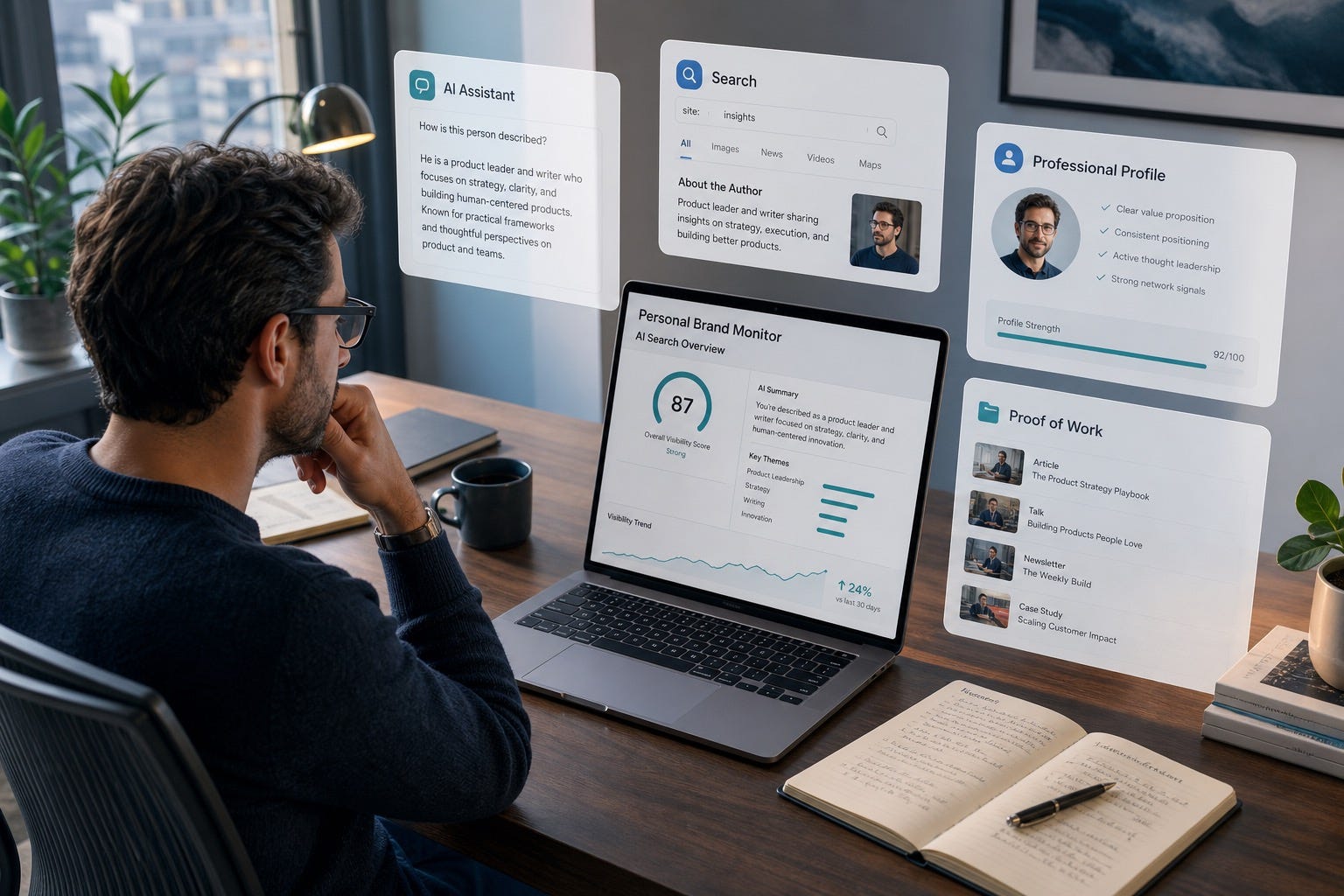
In the AI era, your reputation is often summarized before anyone clicks through to verify it.
Most people still think personal brand monitoring means googling your name once in a while, setting up a few alerts, and reacting only when something embarrassing appears. That model is already outdated.
Your public identity is now shaped by systems that summarize, compare, and compress what the internet says about you. A client asks ChatGPT who the credible experts are in your field. A recruiter scans LinkedIn before reading your resume. A buyer sees a Google AI answer before they ever reach your site. If those surfaces tell an incomplete story, the damage is subtle but real. You look generic. Unclear. Harder to trust.
This is why personal brand monitoring matters now. Not because everyone is in crisis. Because more people are being described before they are deeply researched.
There is a timely reason to take this seriously. In June 2026, Google Search Central announced dedicated Search Console reporting for generative AI features. That does not solve personal branding by itself, but it signals something bigger: AI-mediated visibility is now measurable enough to manage. The old split between “search,” “social,” and “reputation” is breaking down.
The core shift: a one-time profile polish is no longer enough. You need an ongoing monitoring loop that catches narrative drift, missing proof, and outdated signals before other systems repeat them for you.
Why personal brand monitoring changed in the AI era
Traditional reputation advice was built around blue links. You controlled your website, tuned your LinkedIn profile, maybe published a few articles, and hoped search results stayed clean. That still matters. But AI systems add a new layer: they turn scattered evidence into a single interpretation.
That interpretation can go wrong in five predictable ways:
Your expertise is described too broadly, so you sound like everyone else in your category.
Old work gets surfaced while newer, stronger proof stays invisible.
Your best ideas live in one place, but other platforms still show weaker or outdated positioning.
Your name appears without enough third-party validation, so you look self-claimed rather than independently recognized.
Your public identity is consistent enough to be found, but not specific enough to be chosen.
The real risk is not just being missing. It is being summarized inaccurately in a way that feels plausible.
That is why a personal brand monitoring system should not be treated as vanity. It is closer to editorial operations. You are checking whether the public record still matches the person you are trying to be known as.
What you should actually monitor every week
The goal is not to monitor everything. The goal is to watch the handful of surfaces that shape trust quickly.
1. Your name query
Search your full name in Google and note what occupies the first page. Then search your name with your niche, role, or expertise. If you are a founder, try combinations like your name plus company, product, market, and category. If you are a consultant or job seeker, use your name plus the problem you solve.
You are looking for three things: whether the right assets rank, whether the snippets reinforce your positioning, and whether weak or irrelevant results dominate the page.
2. Category queries that should return you
Most people monitor only their name. That is too narrow. The more important question is whether you appear when someone searches for the type of expert you want to be.
Examples:
best B2B messaging consultant for SaaS
fractional product marketing leader for AI companies
startup advisor for pricing strategy
LinkedIn creator for enterprise sales
These category queries reveal whether your public proof supports discoverability beyond your own name.
3. AI summaries of your reputation
Run a few recurring prompts across tools like ChatGPT and Google’s AI search experiences. Ask what kind of expert you seem to be, what topics your name is associated with, and what proof supports those claims. Do not just test your exact name. Test your name plus job, niche, audience, and problem space.
Useful prompt pattern:
Based on publicly available information, how would you describe [Name] as a professional?
What topics does this person seem most credible on?
What evidence supports that assessment?
What feels unclear, outdated, or weak?
The point is not to treat the answer as truth. The point is to see what a busy prospect might absorb in ten seconds.
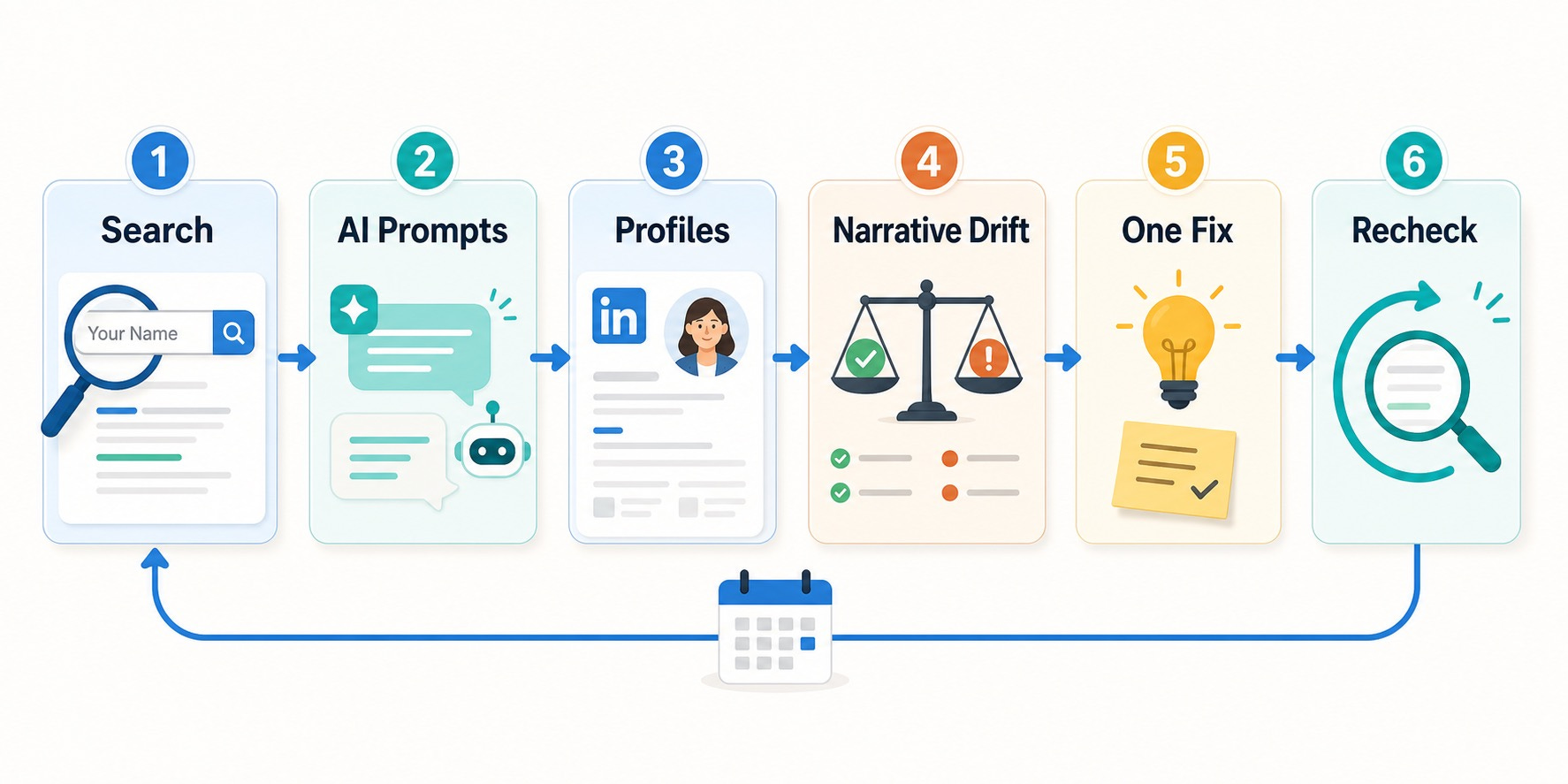
A useful monitoring system is simple enough to repeat every week and sharp enough to show where trust is leaking.
4. Your proof surfaces
Monitoring is not just about mentions. It is also about the assets that should be doing more work for you. Review your LinkedIn profile, website bio, speaker page, pinned posts, recent articles, featured media, recommendations, and case-study pages. Ask one blunt question: if a smart stranger landed here first, would they understand why I am credible?
If the answer is no, you do not have a discovery problem. You have a proof packaging problem.
5. Trust signals that reduce doubt
In AI-shaped discovery, small trust markers matter more than many people think. Verification, recent interviews, podcast appearances, guest bylines, testimonials, citations, awards, and recognizable communities all help systems and humans reach the same conclusion faster: this person is real, active, and independently validated.
Google’s own guidance for AI features still points back to the same foundation it uses elsewhere: indexed pages, strong snippets, and helpful, reliable, people-first content. That is a useful reminder. Your personal brand does not need tricks. It needs clearer public evidence.
The 30-minute weekly personal brand monitoring workflow
The best system is one you will repeat. Here is a practical weekly cadence that works for most professionals.
Step 1: Run five recurring checks
Search your full name in Google.
Search your name plus role or niche.
Search one or two category queries where you should plausibly appear.
Run a reputation prompt in ChatGPT.
Review your LinkedIn profile from the perspective of a skeptical stranger.
Step 2: Log the narrative, not just the links
Most people save screenshots and stop there. Better approach: write down the story a stranger would infer.
For example:
Maya looks experienced, but her strongest visible proof is two years old.
David seems credible on AI operations, but his public profile still overemphasizes general growth marketing.
Priya appears active on LinkedIn, but there is not enough third-party validation to support her niche authority.
This is the most important move in the whole system. You are not tracking pages. You are tracking narrative drift.
Step 3: Classify the issue
Most visibility problems fall into one of four buckets:
Absent: you do not show up where you should.
Inaccurate: you are described in ways that no longer fit.
Generic: you show up, but the positioning is too broad to matter.
Unproven: the positioning is clear, but the evidence is thin.
Once you classify the problem, the next move becomes much clearer.
Step 4: Make one corrective change per week
Do not panic-edit everything. Pick the highest-leverage fix.
Examples:
Rewrite your LinkedIn headline so it states the problem you solve, not just your title.
Turn a buried case study into a pinned post or featured asset.
Publish a short article that answers the exact question you want your name associated with.
Update your website bio to reflect the work you want more of now, not the work you used to do.
Ask for one recommendation or testimonial that speaks to a specific outcome, not a vague compliment.
Step 5: Recheck the following week
Personal brand monitoring only works if it becomes a loop. Small public corrections compound. A stronger headline, a better About section, a better proof page, and one specific third-party mention can shift how both humans and AI systems understand you.
How to use AI without letting AI flatten your reputation
AI is useful in this process, but not as an autopilot. The best use of AI is diagnosis, synthesis, and drafting. The worst use is letting it invent your identity from thin input.
Here are three strong ways to use AI in personal brand monitoring:
Use AI to compare versions of your public identity
Paste in your LinkedIn summary, website bio, speaker intro, and latest article intro. Ask AI to compare them for consistency. You want similar positioning with different expressions, not four conflicting mini-brands.
Compare these four public descriptions of me.
Where is the positioning consistent?
Where does it drift?
Which version sounds the most credible and specific?
What proof is missing across all of them?
Use AI to find the gap between claim and proof
If you say you are known for something, AI can help you test whether your public evidence actually supports the claim.
I want to be known for [positioning statement].
Based on the public assets below, does the proof support that claim?
List the strongest supporting signals, the weak spots, and the missing assets.
Use AI to create a correction backlog
After each weekly review, ask AI to turn your notes into a ranked action list. This is especially useful if you manage multiple surfaces and tend to over-edit low-value pages.
What AI should not do is write generic “thought leadership” to paper over weak public proof. That usually makes the problem worse. Google’s guidance on generative AI content is blunt: AI-assisted content can be useful, but scaled content without added value risks becoming low-quality noise. Personal branding has the same rule. Faster output does not equal stronger trust.

The goal is not cosmetic polish. It is moving from plausible but vague to specific and trusted.
The mistakes that quietly weaken personal brand monitoring
Mistake 1: Only searching your own name
Name searches matter, but category searches reveal whether your brand works outside your existing network.
Mistake 2: Confusing activity with credibility
Posting often can increase surface area, but it does not automatically increase trust. A slower stream of specific proof usually outperforms a heavier stream of generic advice.
Mistake 3: Monitoring mentions but not meaning
A mention is just a signal. The deeper question is what conclusion that signal helps a stranger reach.
Mistake 4: Fixing weak copy instead of weak evidence
If your headline is vague, rewrite it. But if your proof is weak, better copy will not save you for long. Publish artifacts. Show work. Update the evidence trail.
Mistake 5: Treating reputation work as cleanup
The strongest professionals treat monitoring as strategic maintenance, not emergency response. They do not wait for confusion. They reduce it steadily.
A simpler way to think about it
Your personal brand is not just what you post. It is the public pattern that forms around your name.
Monitoring helps you answer three questions over and over:
What am I currently being associated with?
Is that association specific enough to help me?
What proof would make the right story easier to believe?
If you can answer those questions every week, you do not need to obsess over every mention. You just need to keep strengthening the public record in the direction you want.
That is what good personal brand monitoring looks like now. Not fear. Not vanity. Just a steady system for making sure the internet tells a truer story about your work.
FAQ
What is personal brand monitoring?
Personal brand monitoring is the practice of tracking how your name, expertise, and credibility appear across search, AI summaries, social profiles, and public proof assets. In the AI era, it also means checking how systems like ChatGPT and Google summarize your reputation.
How often should I monitor my personal brand?
For most professionals, once a week is enough. That cadence is frequent enough to catch narrative drift and maintain your key surfaces without turning reputation work into a daily distraction.
What should I search when monitoring my personal brand?
Search your full name, your name plus your niche, and category queries that should plausibly return you. Also run AI prompts asking how you are publicly described and what evidence supports that description.
Can AI help with personal brand monitoring?
Yes, if you use it for analysis rather than identity creation. AI is useful for comparing bios, spotting positioning drift, summarizing weak points, and ranking corrective actions. It is less useful when you ask it to invent authority you have not publicly supported.
What is the difference between a personal brand audit and personal brand monitoring?
An audit is usually a one-time review. Monitoring is ongoing. An audit tells you what is wrong today. Monitoring helps you notice what changes over time and whether your public story is improving or drifting.
How do I fix inaccurate AI summaries about my profile?
Start by improving the public sources those systems can see: your LinkedIn profile, website bio, featured proof, recent articles, third-party mentions, and structured descriptions of your work. AI summaries tend to get better when the public record becomes clearer and more consistent.
Does LinkedIn still matter for personal brand monitoring if I have a website?
Yes. For many professionals, LinkedIn is one of the first trust surfaces a stranger checks. A strong website helps, but an outdated LinkedIn profile can still create enough doubt to weaken the rest of your positioning.