


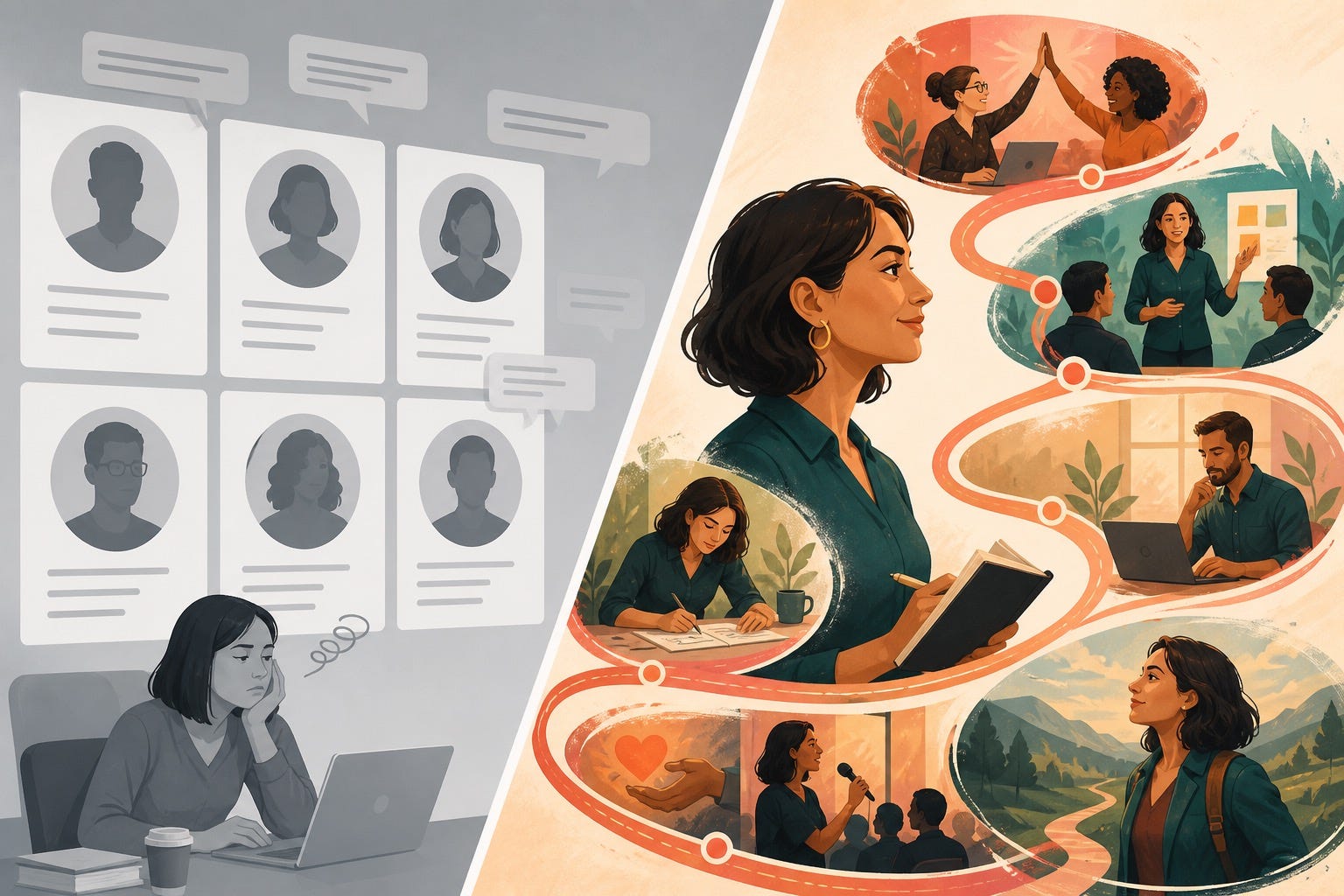
A practical workflow for professionals, founders, creators, consultants, and job seekers who need a clearer public story without sounding scripted, inflated, or machine-written.
AI can summarize your career in seconds, but a summary is not a reputation.
That is the mistake many professionals are making right now. They ask an AI tool to write a LinkedIn About section, a founder bio, a newsletter intro, or a speaker blurb. The output is clean. It uses confident words. It says they are passionate, strategic, innovative, and results-driven. It also sounds like it could belong to almost anyone.
A strong personal brand narrative does something different. It explains why your work makes sense. It connects your past to your present. It shows what you have learned, who you help, and why people should believe you. It gives your scattered experience a shape.
This matters more in an AI-heavy internet. Generic content is easier to produce, so specific human context becomes more valuable. Recent coverage of LinkedIn “AI slop” has shown that formulaic posts can still attract engagement, but attention is not the same as trust.
The good news: AI can help you build that story, if you use it as an interviewer, pattern finder, and editor instead of a replacement memory. The workflow below will help you create a personal brand narrative that is useful across LinkedIn, Substack, your website, podcast intros, investor calls, client proposals, job interviews, and everyday networking.
What a Personal Brand Narrative Actually Is
Your personal brand narrative is the throughline people use to understand you.
It is not your job title. Titles change. It is not your niche. Niches can narrow too early. It is not your origin story alone. Origin stories can become self-centered if they never connect to the audience. It is the believable explanation for why you are the person to pay attention to in a specific area.
A good narrative answers five questions:
What pattern has shaped your work?
What problem do you keep returning to?
What proof shows you have earned your view?
Who benefits when you share what you know?
What do you now believe that makes your perspective distinct?
Your narrative is not the most dramatic version of your life. It is the most useful explanation of your credibility.
Why AI Makes Narrative More Important, Not Less
AI has made the surface layer of personal branding cheap. Anyone can generate a polished bio, a list of content ideas, a tidy profile headline, or a confident founder post. That does not make personal branding irrelevant. It raises the bar.
When everyone can sound fluent, readers start looking for signals that are harder to fake: lived experience, specific examples, consistent judgment, public proof, and clear tradeoffs. A narrative helps those signals make sense together.
There is also a trust issue. Kit’s State of AI in the Creator Economy found that most surveyed creators who use AI still review and edit the output before publishing. That is not just a workflow preference. It is a trust practice.
The same rule applies to your personal brand. AI can help you find patterns in your work, but it cannot know what actually cost you something. It can suggest a story arc, but it cannot decide what you are willing to stand behind. It can make a sentence smoother, but it cannot create proof you do not have.
Use AI to reduce blank-page friction. Do not use it to outsource the part that makes your story yours.
The Proof-First Narrative Workflow
Most people start with the wrong prompt: “Write my personal brand story.” That invites the model to invent shape before you have supplied evidence.
Start with proof instead. Gather raw material from your real work before asking for narrative. This can include project notes, client feedback, performance reviews, GitHub commits, talks, essays, testimonials, old job descriptions, portfolio pieces, course projects, failed experiments, customer calls, Slack praise, tough lessons, and questions people keep asking you.
Then use AI in four passes.
Pass 1: Extract the recurring problems
Paste a cleaned set of notes into your AI tool and ask:
Review these career notes and identify the problems I keep solving, the audiences I keep helping, and the situations where my judgment seems strongest. Do not write my bio yet. Only extract patterns and cite the evidence from my notes.
This prompt keeps the model in analyst mode. You are not asking for personality. You are asking for pattern recognition.
Pass 2: Find the earned point of view
Once you have patterns, ask for the belief underneath them:
Based on these patterns, what are five possible points of view I may have earned through experience? For each one, explain what evidence supports it, what audience would care, and what common advice it challenges.
The phrase “earned through experience” matters. It pushes the model away from slogans and toward proof. A personal brand narrative should contain a point of view, but that point of view should not float in the air. It should come from what you have seen enough times to believe.
Pass 3: Build the throughline
Now ask the model to connect past, present, and audience relevance:
Create three possible personal brand narrative arcs from this evidence. Each arc should include: where the pattern started, what changed through experience, what I now help people understand or do, and why this matters to my target audience. Keep each version under 180 words.
You are looking for the version that feels true, useful, and repeatable. If the AI produces a dramatic transformation that did not happen, cut it. If it makes you sound like a guru, make it more grounded.
Pass 4: Compress the story into reusable lengths
A narrative is only useful if you can use it. Ask for three versions:
A one-sentence version for introductions and profile summaries.
A short version for LinkedIn, speaker bios, and podcast outreach.
A longer version for your website, Substack About page, or consulting profile.
Then edit by hand. Replace abstractions with specifics. Remove anything you would feel awkward saying out loud. Add one concrete proof point. Cut any sentence that exists only to sound impressive.

A useful narrative turns lived experience into context. A generic one turns everyone into the same polished profile.
A Simple Narrative Structure That Works
You do not need a cinematic life story. You need a structure people can understand quickly.
Use this five-part model:
1. The pattern
Start with the problem you kept noticing before you had language for it. This is stronger than starting with your title.
Weak: “I am a marketing consultant with ten years of experience.”
Stronger: “I kept watching smart B2B teams lose trust because their messaging sounded clear internally but vague to buyers.”
2. The proof
Add a real source of credibility. This could be roles, projects, clients, research, shipped work, communities, or lived exposure to the problem.
Do not list every achievement. Choose the evidence that explains why your view is believable.
3. The shift
What changed in how you think? A narrative becomes memorable when there is a lesson, not just a timeline.
Maybe you learned that more content does not fix unclear positioning. Maybe you learned that technical talent is often invisible until it is packaged. Maybe you learned that founder visibility fails when it becomes personal performance instead of useful public judgment.
4. The audience
Make it clear who your story is for. A personal brand narrative should create recognition in the right reader. They should think, “This person understands my world.”
5. The current promise
End with what you help people do now. Keep it practical. Your narrative should point toward action, not just identity.
Here is the formula in one line:
I noticed [pattern] through [proof], learned [shift], and now help [audience] achieve [useful outcome] without [costly mistake].
That sentence will not be your final copy. It is scaffolding. But it forces the right ingredients into view.
Examples for Different Professionals
Founder
“After years of watching small teams buy tools they never fully adopted, I became obsessed with the gap between software demos and daily behavior. I now build and write for operators who want AI workflows that survive real work, not just launch-day excitement.”
Consultant
“I spent the first half of my career fixing campaigns after the strategy was already fuzzy. That taught me that most marketing problems start before the copy. Now I help service businesses clarify what buyers need to believe before they ever book a call.”
Job seeker or career changer
“My background looks mixed at first: support, operations, and data projects. The throughline is that I keep finding messy handoffs and turning them into systems people can actually use. I am now focused on operations roles where process clarity matters as much as speed.”
AI builder
“I started building AI tools because I was frustrated by demos that looked impressive but collapsed inside real workflows. My work now focuses on agent interfaces, evaluation habits, and human review loops that make automation useful without making teams careless.”
Notice what these examples avoid. They do not claim to be visionary, disruptive, passionate, or world-class. They create trust by explaining what the person has seen, what they learned, and who benefits from that learning.
How to Use the Narrative Across Your Public Identity
A strong personal brand narrative should not live in one hidden document. It should quietly shape your public surfaces.
On LinkedIn, it can guide your headline, About section, Featured items, comments, and post topics. On Substack, it can shape your publication description and recurring essay themes. On your website, it can make your About page less biographical and more useful. In networking, it can turn “So what do you do?” into a clear answer that invites a better conversation.
The key is consistency without copy-paste repetition. Your one-sentence version may appear in a profile. Your short version may appear in a bio. Your long version may live on an About page.
If your narrative says you help founders build trust, your posts should show trust decisions. If it says you turn messy operations into clear systems, share before-and-after process examples.
A narrative is not a tagline. It is an editorial filter.

What to Let AI Do and What to Keep Human
AI is excellent at sorting, clustering, compressing, and giving you alternate phrasings. Ask it to find repeated themes, identify vague claims, suggest sharper examples, adapt one narrative for different surfaces, and critique whether your story is too self-centered or too abstract.
Keep the judgment human.
You decide which stories are fair to tell. You decide what proof is strong enough. You decide what to leave private. You decide whether a sentence sounds like something you would say. You decide which tradeoffs you are willing to be known for.
This is especially important if your story includes clients, employers, health, layoffs, family, money, failure, or conflict. AI may turn sensitive material into a neat lesson too quickly. Your job is to slow that down. A personal brand narrative should make you easier to trust, not easier to misunderstand.
The Anti-Generic Editing Checklist
Before publishing your narrative anywhere, run it through this checklist:
Could another person in my field say this with almost no changes?
Does the story include at least one concrete proof point?
Does it explain who I help or who I write for?
Does it contain a lesson, shift, or point of view?
Does it avoid inflated claims I cannot support?
Does it sound natural if I read it aloud?
Does it make the next conversation easier?
If the answer to the first question is yes, keep editing. Generic personal branding usually comes from missing evidence, not missing adjectives.
How to Test Whether Your Narrative Is Working
You do not need a huge audience to test a personal brand narrative. You need signal.
Use it for two weeks in low-risk places: your LinkedIn intro, a short bio, a podcast outreach note, a Substack description, or a pinned post. Then watch what changes.
Do people ask better questions? Do they refer to you using the language you want? Do the right people understand your focus faster? Do conversations move from “what do you do?” to “I have that problem”? Do your content ideas feel easier to choose?
Also watch for confusion. If people keep misreading your work, your narrative may be too clever. If they respond to your backstory but not your expertise, add more proof.
Your narrative is allowed to evolve. In fact, it should. The goal is not to lock yourself into a permanent identity. The goal is to give your current body of work a clear enough shape that people can remember, trust, and refer it.
The Bottom Line
AI can help you write faster, but speed is not the scarce thing in personal branding anymore. Specificity is scarce. Proof is scarce. Coherent human judgment is scarce.
A strong personal brand narrative turns your experience into context. It helps people understand why you care, what you know, who you help, and what they can trust you for. It does not need to be dramatic. It needs to be earned.
Start with evidence. Use AI to find patterns. Build a throughline. Edit until it sounds like a person with a real history, not a profile assembled from popular phrases.
That is how you turn scattered experience into a story people can actually remember.
FAQ
What is a personal brand narrative?
A personal brand narrative is the throughline that explains your work, credibility, audience, and point of view. It connects your experience into a story people can understand and remember.
How is a personal brand narrative different from a bio?
A bio usually summarizes roles and achievements. A narrative explains why those roles and achievements matter, what pattern shaped your expertise, and who your work helps now.
Can AI write my personal brand story?
AI can help draft and structure your story, but it should not invent the story for you. Use AI to analyze real proof, extract patterns, create options, and tighten language. Keep the judgment and final edits human.
What should I include in a personal brand story for LinkedIn?
Include the problem you keep solving, evidence that makes you credible, a clear audience, a practical point of view, and a current focus. Keep it specific enough that it could not belong to everyone in your field.
How long should my personal brand narrative be?
Create three lengths: one sentence for quick introductions, a short paragraph for LinkedIn and bios, and a longer version for your website, Substack, or speaker profile.
How do I avoid sounding fake or overly polished?
Use real examples, plain language, and evidence. Remove vague adjectives, exaggerated claims, and dramatic arcs that did not actually happen. Read the draft aloud before publishing it.