



The strongest personal brand niche is not a cage. It is a clear first promise people can remember, repeat, and test against reality.
Most people delay building a personal brand because they think they need to choose one perfect niche first. They open a blank document, write down every skill, interest, job title, audience, industry, and ambition they have, then freeze. If they choose too broadly, nobody remembers them. If they choose too narrowly, they worry they will trap their future self.
AI can help, but only if you use it for diagnosis instead of self-invention. The goal is not to ask ChatGPT to “pick a niche for me.” That usually produces bland categories: productivity, leadership, AI, marketing, career growth, wellness, finance. The useful move is different. You use AI to find patterns in your experience, audience questions, proof, curiosity, and market demand. Then you test one focused bet in public.
This matters more now because online trust is getting harder to earn. Business Insider recently reported that major creator platforms, including Substack and LinkedIn, are tightening their stance on generic AI-generated material. The same week, another Business Insider career piece described a job market where strong performance alone is often not enough; professionals are investing in reputation, networking, AI skills, and visible proof. In that environment, your niche cannot be a slogan. It has to make you easier to understand and harder to confuse with everyone else.
A Personal Brand Niche Is a Memory Shortcut
A personal brand niche is the intersection of three things: who you help, what problem you help them solve, and why your perspective is credible. It is not your whole identity. It is the easiest useful entry point into your work.
Think of it as a memory shortcut. When someone hears your name, what association should come to mind? “She helps technical founders explain complex products.” “He helps new managers lead remote teams.” The niche is not meant to describe every interest you have. It is meant to give other people a clean way to remember where you are useful.
That distinction removes a lot of pressure. You are not choosing a personality. You are choosing a starting lane. The lane can widen later, but it needs enough shape today that people know when to recommend you.
Your niche should be narrow enough to create recognition and flexible enough to survive your next level of growth.
Why AI Makes Niche Choice Easier and Riskier
AI makes niche choice easier because it can process more inputs than you can hold in your head. It can cluster old posts, feedback, testimonials, DMs, job descriptions, sales calls, transcripts, and audience questions. It can show you patterns you missed because they felt too obvious.
AI also makes niche choice riskier because it is trained to complete patterns. If you ask vague questions, it will give you familiar internet answers. It will notice that “AI productivity for founders” sounds marketable, even if you have no real proof there. It can make a premature niche sound polished.
The standard advice is to choose a niche by looking at strengths, interests, market demand, and competition. Indeed’s updated career guide on finding a niche follows that broad structure. The advice is sound. The gap is execution. Most professionals need a repeatable way to turn messy lived experience into a testable personal brand niche.
The Three-Part Niche Filter
Before you use any AI tool, write your niche as a simple triangle. Each side has to be present. If one side is missing, the niche will feel weak in public.
1. Audience
Who are you trying to become useful to first? Do not say “founders” if you mean “technical founders who hate sales calls.” Do not say “job seekers” if you mean “mid-career operators trying to move into AI product roles.” An audience is not a demographic label. It is a group of people with a shared pressure.
2. Problem
What painful or valuable problem do they repeatedly face? Good personal brand niches usually connect to repeated decisions: hiring, buying, pitching, leading, learning, changing careers, earning trust, reducing risk, saving time, or making better work visible. If the problem has no urgency, your content will feel optional.
3. Proof
Why should anyone believe you can help? Proof can be a track record, lived experience, a portfolio, client outcomes, public experiments, strong taste, research discipline, or a documented learning journey. You do not need celebrity-level authority. You do need honest evidence.
AI prompt: build your raw niche mapI am choosing a personal brand niche. Analyze the following notes and extract possible audience-problem-proof combinations. Do not invent credentials. Separate what I have proven from what I am only interested in. For each option, explain who would care, what pain it addresses, what evidence supports it, and what would make it more credible. Here are my notes: [paste notes, questions, projects, client work, feedback, posts, and interests].
Collect the Right Inputs Before Asking AI
AI gets smarter when your source material gets more honest. Instead of asking it to brainstorm from nothing, feed it the kind of evidence a brand strategist would ask for.
Ten questions people have asked you in DMs, meetings, comments, interviews, or calls.
Five moments when someone trusted your judgment without needing much explanation.
Three problems you enjoy solving even when nobody is watching.
Three problems you can solve but do not want to be known for.
Five public examples of work you can point to without overclaiming.
Three audiences you understand from lived experience, not just market opportunity.
Five topics you could discuss weekly for six months without faking interest.
This input step is where most people find the real niche. The answer is rarely a brand-new topic. It is usually a pattern hiding in plain sight. Maybe people keep asking you how to simplify technical ideas. Maybe your strongest work happens when a messy team needs structure. AI can cluster those signals, but you have to bring the raw material.
Turn Broad Interests Into Testable Niche Bets
A bad niche sounds like a category. A useful niche sounds like a bet you can test.
“AI for professionals” is a category. “I help nontechnical consultants use AI to turn client expertise into clearer advisory assets” is a testable bet. You can write three posts, answer five questions, create one example, and see whether the right people respond. “Career growth” is a category. “I help laid-off tech workers rebuild public credibility with proof-based AI workflows” is a testable bet.
Use AI to generate options, but force each option into a sentence with a clear audience, problem, promise, and proof. Then score it like a working hypothesis.
AI prompt: convert interests into niche betsBased on my source material, create 10 personal brand niche bets. Each should follow this structure: “I help [specific audience] solve [specific problem] by using [method or perspective], supported by [proof].” Score each option from 1 to 5 for credibility, audience urgency, searchability, content depth, differentiation, and long-term flexibility. Explain the tradeoff behind each score.
The scoring matters because a niche can be attractive and still be wrong for you. A high-demand niche with weak proof will make you sound like a commentator. A passion-driven niche with no audience urgency will feel satisfying but rarely create opportunity. You are looking for the overlap where recognition, usefulness, and credibility can compound.
The “Too Narrow” Test
People often resist niching down because they imagine the worst version of specificity. They hear “choose a niche” and think they must become “the email subject line consultant for Series A climate-tech SaaS founders.” That kind of niche might work for an offer, but it is usually too tight for a personal brand.
A personal brand niche should give you a repeatable point of view, not a tiny box. You can test whether your niche is too narrow with five questions:
Can I name at least 50 real people or companies who would care about this?
Can I create 25 useful posts without repeating myself?
Can this niche connect to my next career or business move?
Would someone in this audience feel understood within the first sentence?
Can I explain the niche without using jargon or trend words?
If the answer is no, widen the problem or audience. If the answer is yes, keep it specific long enough to learn from reality.
The “Too Broad” Test
Broad positioning feels safe because it avoids excluding anyone. In practice, it often excludes everyone because nobody knows what to remember. “I talk about technology, leadership, and growth” may be accurate, but it does not create a recommendation sentence. “I help first-time AI product leaders build trust with technical and nontechnical teams” is easier to pass along.
Ask AI to critique your niche for broadness, but make it behave like a skeptical reader instead of a supportive coach.
AI prompt: stress-test broadnessAct like a busy recruiter, buyer, podcast host, or collaborator who sees hundreds of profiles each week. Read this personal brand niche: [paste niche]. What is unclear? Who exactly is it for? What would you remember after 10 seconds? What proof would make it believable? Rewrite it in five sharper versions without making it hype-driven.
Use Public Testing Instead of Private Overthinking
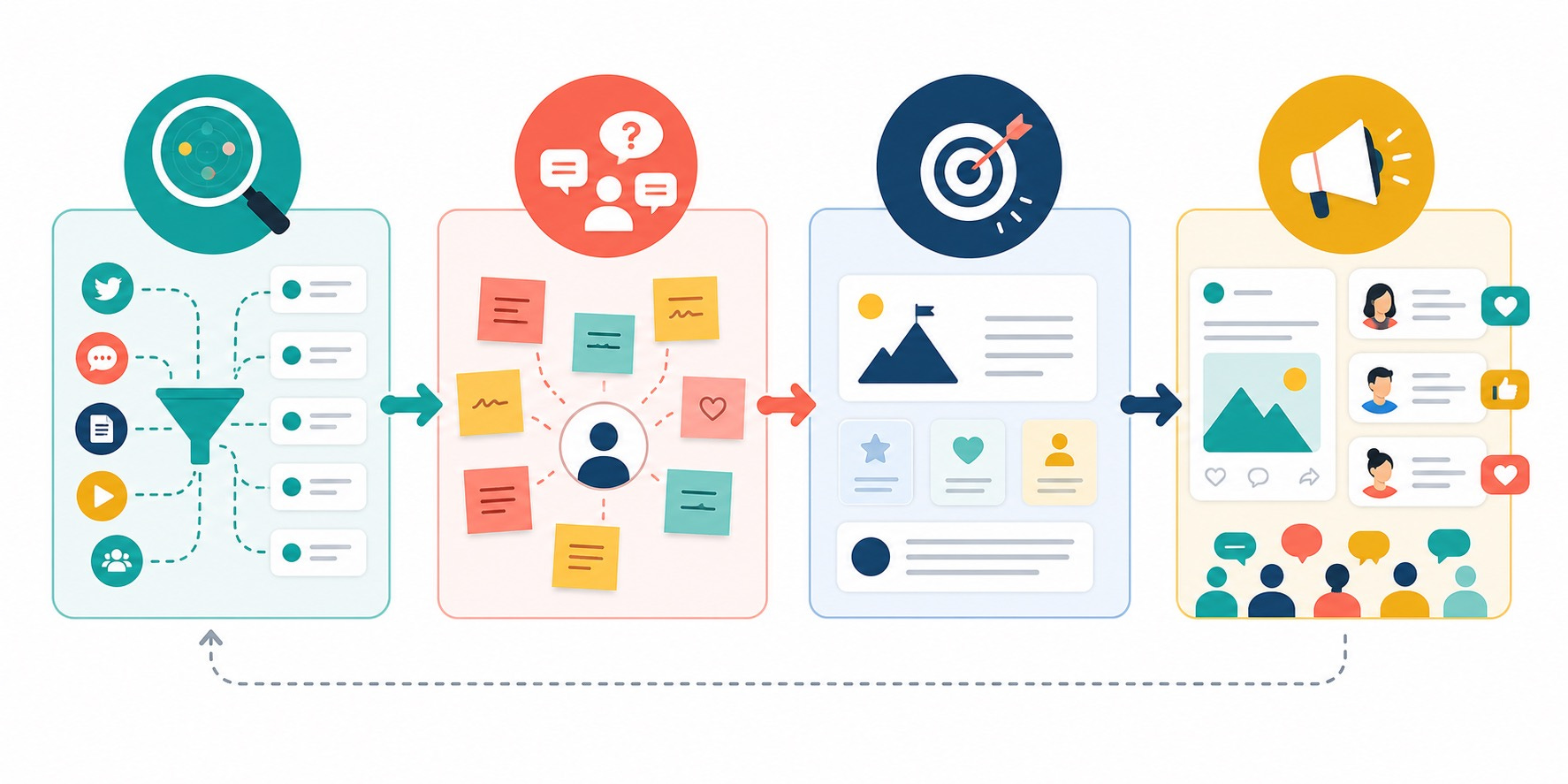
The fastest way to choose a personal brand niche is not to think harder. It is to test better. AI can help you design small experiments that reveal whether a niche creates recognition.
Run three niche tests over two weeks. For each test, publish one practical post, answer one real community question, update one profile line, and ask three trusted people what they think you are trying to be known for. Track the language people repeat back to you. That repeated language is more valuable than likes.
Good signals include saves, specific replies, DMs with context, invitations to discuss the topic, people tagging you into relevant conversations, and readers describing your idea in their own words. Weak signals include generic praise, empty impressions, and comments that could apply to any post on the internet.

Examples of Stronger AI-Assisted Niches
A founder might start with “I write about startups and AI.” Better: “I help technical founders explain complex AI products so buyers understand the risk, value, and implementation path.”
A consultant might start with “I help businesses grow.” Better: “I help service businesses turn scattered expertise into clear advisory systems clients can understand and buy.”
A job seeker might start with “I am interested in AI product management.” Better: “I document how operators can move into AI product roles by translating customer problems into practical AI workflows.”
An AI builder might start with “I build AI agents.” Better: “I build and explain AI agents for nontechnical teams that need workflow automation without losing control.”
How to Keep AI From Making Your Niche Generic
The easiest way to sound generic is to let AI remove your friction. Your strange background, constraints, objections, and hard-won opinions are often the parts that make the niche interesting. Do not ask AI to make you sound more professional if that means sanding away the evidence.
Instead, ask AI to preserve your sharp edges. Feed it stories, unpopular beliefs, moments where you changed your mind, client patterns you keep seeing, and phrases your audience actually uses. The rise of AI-assisted content has made polished language cheaper. Specific judgment is what remains scarce. Fractl’s AI search trust research found that heavy AI use has become a trust concern for many consumers, which is a useful warning for personal brands too: use AI to clarify your thinking, not to replace your presence.
A good AI-assisted niche still sounds like it came from a person with a life, not a prompt template with a headshot.
A Seven-Day Workflow to Choose Your Niche
Day one: collect raw signals: questions, notes, feedback, work samples, screenshots, and topics people associate with you.
Day two: ask AI to cluster those signals into audience-problem-proof patterns. Remove anything that sounds impressive but unsupported.
Day three: generate 10 niche bets and score each for credibility, urgency, searchability, content depth, differentiation, and flexibility.
Day four: choose three finalists and rewrite each in plain language a friend could repeat after hearing it once.
Day five: create one small public artifact for each finalist: a post, short essay, checklist, community answer, recorded insight, or profile update.
Day six: collect feedback. Look for questions, saves, thoughtful replies, referrals, and people using your language back to you.
Day seven: choose one niche to run for 30 days. Treat it as your current focus, not your forever identity. Publish, listen, and refine.
The Real Goal: Be Easier to Trust
The point of a personal brand niche is not to become smaller. It is to become easier to trust. In crowded feeds, vague experts disappear. In AI-shaped search results, unclear identities get summarized poorly. People choose the person they can understand and verify fastest.
Your niche gives them that first handle. It says, “Start here.” Once trust exists, you can expand. Without that first clear association, every post has to reintroduce you from zero.
Use AI to find the pattern. Use your judgment to choose the bet. Use public work to prove it. Then let the niche evolve as your proof gets stronger.
FAQ
What is a personal brand niche?
A personal brand niche is the specific audience, problem, and proof area you want people to associate with your name. It helps others remember what you do, understand who you help, and know when to recommend you.
Can AI choose my personal brand niche for me?
AI can suggest patterns, options, and sharper wording, but it should not make the final decision. Your niche needs lived proof, real interest, and audience feedback. AI is best used as a research and reflection partner.
How narrow should my personal brand niche be?
It should be narrow enough that a specific audience feels seen, but broad enough that you can create useful content and grow into future opportunities. If you cannot write 25 useful posts about it, it may be too narrow.
What if I have multiple interests?
Start with the overlap between your strongest proof, audience demand, and sustainable curiosity. You do not have to abandon your other interests. You only need one clear entry point so people can understand and remember you.
How do I test a personal brand niche?
Publish a few practical pieces, answer real audience questions, update one profile line, and ask trusted people what they think you are becoming known for. Watch for specific replies, saves, DMs, referrals, and repeated language.