



AI can help you publish faster. It cannot decide what you are willing to be known for. That part still has to come from you.
For professionals building a credible public identity.
There is a quiet problem inside a lot of AI personal branding advice: it teaches people how to make more content before they know what they actually believe.
That used to be merely annoying. Now it is risky. LinkedIn has started giving users a way to flag posts that seem like AI slop, while Substack is experimenting with AI-detection signals and creator transparency. Pangram’s social feed analysis found that longform professional content is especially exposed to AI sameness. Gartner has also reported rising skepticism around GenAI in public-facing content.
For a professional, this changes the personal branding game. The problem is no longer, “Can I post consistently?” The better question is, “Can someone read five things from me and understand the argument I bring to the market?”
That argument is your personal brand point of view.
What a Personal Brand Point of View Actually Is
A personal brand point of view is a specific belief, diagnosis, method, or standard that you repeat in public because it reflects how you see your work. It is not your job title. It is not your niche. It is not a list of content pillars.
“I am a product marketer for B2B SaaS” is a role. “Most B2B positioning fails because teams write for buyers who already understand the product” is a point of view.
“I help people improve their LinkedIn profiles” is a service. “A profile should prove judgment before it sells availability” is a point of view.
“I am an AI engineer” is a category. “The most valuable AI builders will be the ones who can explain tradeoffs to non-technical teams” is a point of view.
The point of view gives your personal brand a spine. It tells people what you notice, what you reject, and what kind of judgment they can expect from you. Without it, AI can still help you produce posts, bios, newsletters, and comments, but all of them will orbit generic advice.
AI is useful for expanding your thinking. It is dangerous when you let it replace your taste.
Why AI Makes This More Important
Before generative AI, a weak personal brand looked inconsistent. After generative AI, it looks synthetic.
That is a harsher standard. A founder can be smart, experienced, and honest, yet still sound like every other founder if their AI workflow starts with prompts such as “write a LinkedIn post about leadership” or “give me ten content ideas for my niche.” If your input does not contain a strong point of view, the output will borrow one from the average internet.
This is why so many AI-written posts feel polished but empty. They have rhythm, but no risk. They explain a topic, but they do not reveal how the author sees the world.
A strong personal brand point of view fixes this at the source. Instead of asking AI to invent your ideas, you use AI to pressure-test, organize, and sharpen the ideas you already have.
The Four Ingredients of a Credible Point of View
A useful point of view is not a hot take. It has to be strong enough to guide content and grounded enough to build trust. The best ones usually combine four ingredients.
1. A real tension your audience already feels
Your point of view should answer a pressure your audience recognizes. Founders want visibility without becoming full-time creators. Job seekers want to stand out without sounding desperate. Consultants need credibility before the sales call. Technical experts need to explain complex work without flattening it into buzzwords.
If the audience does not feel the tension, your point of view will sound clever but optional.
2. A specific diagnosis
The diagnosis is your answer to “Why does this keep happening?” This is where your judgment shows up.
For example: “Most professionals sound generic online because they describe their function instead of their standards” is more useful than “personal branding is important.” It gives you something to prove.
3. A better standard
A point of view should imply a better way to work. It does not need to be dramatic. It needs to be clear.
“Publish fewer opinions, but make each one traceable to a real project, decision, or lesson” is a standard. “Be authentic” is not. “Make your expertise inspectable before asking for trust” is a standard. “Build authority” is not.
4. Proof you can point to
Proof keeps the point of view from becoming a slogan. It might be a client pattern, a failed experiment, a project artifact, a public teardown, a lesson from managing a team, or a repeated question from buyers or recruiters.
The more proof you have, the less your brand depends on performance.
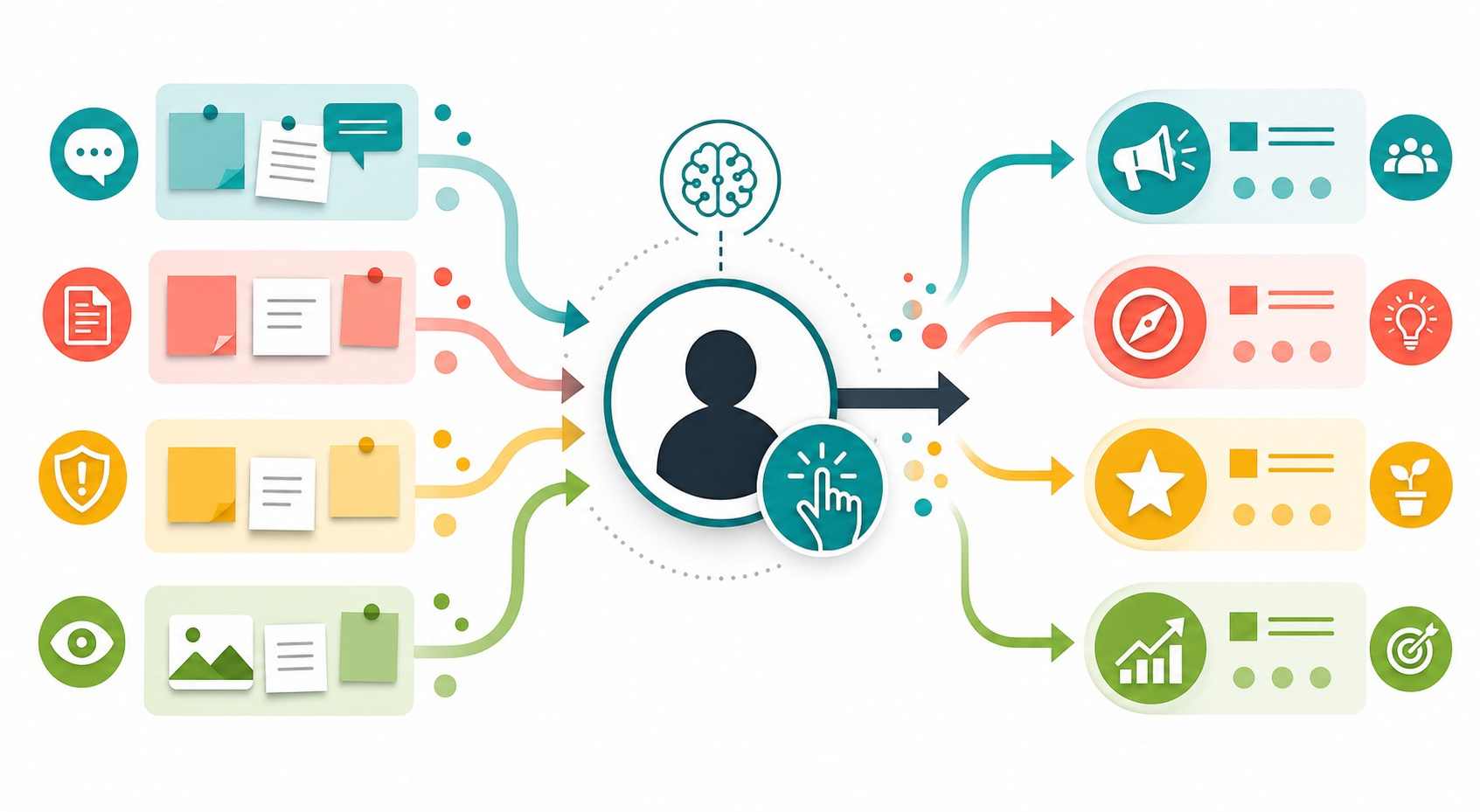
An AI Workflow for Finding Your Point of View
The mistake most people make is asking AI to create their personal brand from scratch. A better workflow uses AI like a structured interviewer, analyst, and editor.
Step 1: Collect raw material before you prompt
Start with material that came from your actual work. Do not begin with a blank prompt box. Gather:
Five questions people repeatedly ask you
Five mistakes you see in your industry
Three beliefs you have that peers may not fully agree with
Three moments where your judgment changed after experience
Three examples of work you are proud of
Three things you refuse to do, even if they are common practice
This is the difference between AI-assisted personal branding and AI-generated personal branding. You are feeding the model lived signals.
Step 2: Ask AI to find the repeated tension
Paste your raw material into your AI tool of choice and ask:
Analyze these notes. What tensions, frustrations, standards, or repeated beliefs show up across them? Do not write content yet. Group the patterns by audience pain, industry mistake, personal standard, and proof I can use.
The instruction “do not write content yet” matters. You are still extracting the argument.
Step 3: Turn patterns into point-of-view candidates
Next, ask for sharper versions:
Turn the strongest patterns into ten possible personal brand point-of-view statements. Each statement should include a clear belief, the audience it helps, the mistake it challenges, and the proof I would need to support it.
Most of the first answers will be too broad. Your job is to reject the vague ones.
A weak candidate sounds like this: “AI should help people be more authentic online.”
A stronger candidate sounds like this: “Professionals should use AI to capture their real standards before generating content, because generic consistency now creates suspicion instead of authority.”
The second version has an audience, a mechanism, a consequence, and tension.
Step 4: Stress-test the claim
A personal brand point of view is only useful if you can defend it. Ask AI to challenge you:
Act as a skeptical buyer, recruiter, editor, and peer. Challenge this point of view. Where is it too broad, unsupported, obvious, self-serving, or hard to believe? What proof would make it more credible?
This step moves the claim from “sounds good” to “can survive contact with real people.”
Step 5: Build a repeatable content map
Once you choose a point of view, turn it into a map. A good point of view can produce several types of content without becoming repetitive:
The belief: what you think and why
The mistake: what people commonly get wrong
The story: when you learned this the hard way
The proof: an example, artifact, result, or observation
The method: how someone can apply it
The boundary: when your advice does not apply
The response: how you answer objections
That is seven posts, newsletter sections, podcast answers, or profile updates from one real idea. You are using AI to explore a belief from useful angles, not generate filler.
Examples for Different Professionals
A founder’s point of view might be: “Early-stage companies should make founder judgment visible before they scale marketing, because buyers trust a clear operator before they trust a polished brand.” That can become posts about product decisions, hiring tradeoffs, customer conversations, and mistakes to avoid.
A consultant’s point of view might be: “The best strategy work should reduce decisions, not create a bigger slide deck.” That can become teardown posts, client education, and a sharper services page.
A job seeker’s point of view might be: “Early-career professionals should show how they think, not just list tools they have used.” That can become project notes, learning logs, and interview stories.
An AI builder’s point of view might be: “The next advantage in AI products will come from workflow taste, not model access.” That can become product teardowns, build logs, and opinionated comparisons.
An executive’s point of view might be: “Leadership communication should make tradeoffs visible, because teams lose trust when every update sounds perfectly certain.” That can become operating memos, decision notes, and public reflections.
How to Use Your Point of View Across Your Digital Identity
Your point of view should not live only inside posts. It should quietly shape every surface where people judge your credibility.
On LinkedIn, it can sharpen your headline, About section, Featured section, and comments. Your profile should make it obvious what argument you bring to your field.
On Substack, it can guide your publication promise. Readers should know the recurring lens they will get from you, not just the category you write about.
On your personal website, it can shape your About page, FAQ, case studies, services page, and speaking topics. A strong website does not merely list credentials. It explains how you think.
On X, Bluesky, Threads, or niche communities, it helps you decide which conversations deserve your energy. You do not need to comment on everything. You need to become useful where your argument belongs.

The Ethics: Do Not Fake Conviction
AI makes it easy to sound more certain than you are. Resist that.
A credible personal brand point of view should be honest about its limits. If you are still learning, say so. If your experience comes from a narrow context, name that context. If AI helped organize your ideas, it should not become a mask. The reader should still feel your judgment underneath the polish.
There are three ethical lines worth keeping.
First, do not claim lived experience you do not have. AI can simulate confident stories. Your reputation cannot afford simulated proof.
Second, do not borrow outrage because it performs. A contrarian point of view is only useful when it reflects a real standard, not a content tactic.
Third, do not let AI erase uncertainty. Lines like “I used to think this differently,” “this works only when,” and “I am still testing this” sound human because they are intellectually honest.
A Simple Point-of-View Template
Use this structure when you need to turn scattered thoughts into a clear personal brand point of view:
I believe [specific audience] should stop [common mistake] and start [better standard], because [consequence or opportunity]. I learned this from [proof], and I apply it by [method].
Here are a few filled-in examples:
I believe technical founders should stop explaining products only through features and start explaining the judgment behind their design choices, because trust grows when buyers understand tradeoffs.
I believe consultants should stop publishing generic expertise posts and start documenting the decisions they help clients make, because buyers remember useful judgment faster than broad advice.
I believe job seekers should stop optimizing every profile for keywords alone and start showing how they solve real problems, because AI screening may find you, but human trust still chooses you.
How to Know If Your Point of View Is Working
You do not need to measure this only by followers. A point of view is working when people start repeating your language back to you.
Watch for better signals:
People ask you more specific questions.
People tag you in conversations that match your argument.
Inbound opportunities mention a phrase, example, or belief you have repeated.
Your comments become easier to write because you know what you stand for.
Your profile, newsletter, and website sound like the same person.
You reject more content ideas because they do not fit your standard.
The last signal is underrated. A strong personal brand is not only about what you publish. It is also about what you stop publishing.
The Bottom Line
AI will keep making content easier to produce. That means production is no longer the scarce thing. Judgment is.
If your personal brand depends on volume, you will always feel pressure to post more. If it depends on a clear point of view, every post, profile section, and newsletter has a job. People begin to understand not just what you do, but how you think.
That is the brand advantage AI cannot hand you automatically.
Use AI to interview yourself. Use it to find patterns, challenge weak claims, organize proof, and turn one belief into many useful angles. But keep the belief human. The future of personal branding will belong to the people whose judgment is easiest to recognize.
FAQ
What is a personal brand point of view?
A personal brand point of view is a specific belief, standard, or argument you want to be known for. It explains how you see your work, what you challenge, and what kind of judgment people can expect from you.
How is a point of view different from a personal brand niche?
A niche defines the area you operate in. A point of view defines what you believe inside that area. For example, “AI product strategy” is a niche. “AI products fail when teams automate before they understand the workflow” is a point of view.
Can AI help me create a personal brand point of view?
Yes, but it should not invent one for you. Use AI to analyze your real notes, questions, projects, stories, and objections. Then use your own judgment to choose the claim you can honestly defend.
How do I avoid sounding like AI in my personal branding content?
Start with lived material before asking AI to write. Include specific examples, tradeoffs, mistakes, boundaries, and proof. Generic AI content often lacks context and risk; credible personal brand content shows what you have actually learned.
Should I disclose AI use in my personal brand content?
Disclose when AI materially changes how the audience would interpret the work, especially for synthetic images, avatars, or heavily generated media. For writing assistance, focus on making the final piece accurate, human, and traceable to your real judgment.