



The goal of personal branding is not to become louder. The goal is to become easier to remember, easier to trust, and easier to recommend when the right opportunity appears.
A lot of professionals are stuck in a strange new pressure loop. They feel like they should post on LinkedIn, write online, show their work, tell more stories, and build a public reputation. At the same time, they hate the version of personal branding they see around them: fake vulnerability, recycled AI posts, forced lessons from ordinary moments, and comment sections full of polished nothing.
That tension is showing up everywhere. Recent coverage from Business Insider described workers who feel pushed into a LinkedIn personal-branding arms race even when the format feels inauthentic. Reddit threads echo the same concern: founders ask whether daily posting creates tangible results, freelancers wonder if LinkedIn brings clients, and professionals ask how much cringe is acceptable before visibility damages trust.
The useful answer is not “post more.” It is also not “delete every social account and rely on word of mouth.” The better answer is to build a personal brand referral system.
A personal brand referral system helps the right people remember what you do, believe you can do it, and know how to introduce you. AI can help, but only if you use it for structure, recall, and clarity.
Your personal brand does not create referrals because people saw you once. It creates referrals when people can explain, in one sentence, why someone should talk to you.
Why Visibility Alone Does Not Create Referrals
Visibility is useful, but it is incomplete. A post can get likes from peers who will never hire you. A profile can look active while still leaving people unclear about what you are best at. A newsletter can impress strangers but fail to give past clients a simple way to recommend you.
Most personal branding advice optimizes for audience growth. Referrals work differently. They depend on memory, relevance, timing, and trust transfer. Someone has to think, “I know who you should talk to,” and feel comfortable putting their name beside yours.
That is why a referral system needs different questions than a content system:
What problem should people associate with your name?
What proof makes the referral feel low-risk?
Who already trusts you enough to make an introduction?
What kind of opportunity should they send your way?
How will you stay top of mind without pestering them?
AI is useful here because most professionals have scattered evidence. Your best stories may be buried in old emails, project notes, proposals, performance reviews, podcast transcripts, Slack praise, client updates, or half-written posts. A good AI workflow helps you turn that scattered material into a clear referral memory.
The Five-Part Referral System
The system is simple enough to run in a notes app, spreadsheet, CRM, or AI workspace. It has five parts: memory, proof, context, ask, and loop.
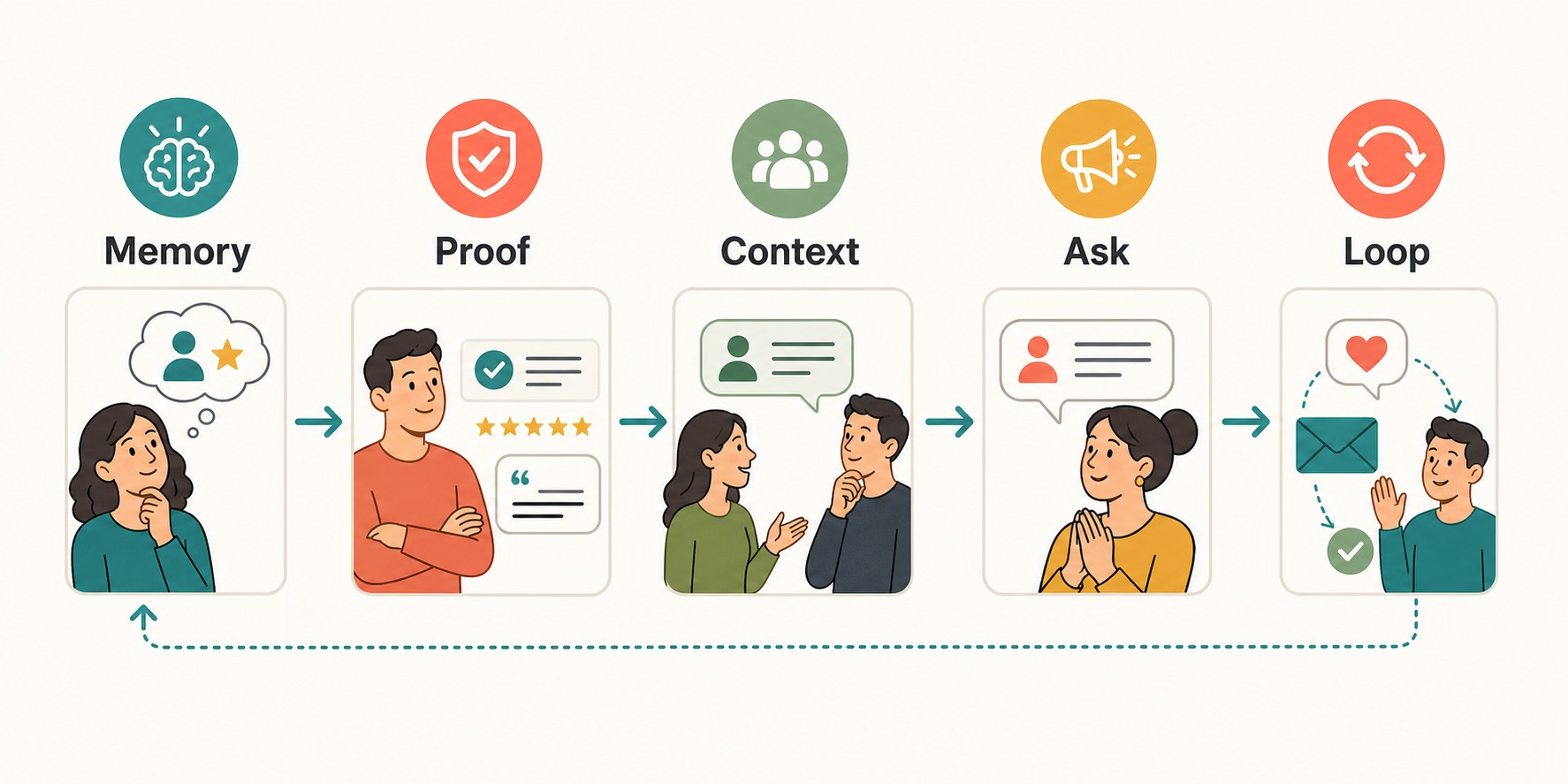
A useful referral system makes your expertise easier to remember and easier to introduce.
1. Memory: Decide What You Are Referable For
People do not refer general competence. They refer a specific fit. “She is smart” is admiration. “She helps B2B SaaS teams turn messy onboarding data into retention experiments” is referable.
Start by asking AI to compress your experience into referral phrases. Paste a rough summary of your work, ideal clients, strongest projects, and preferred problems. Then use this prompt:
Prompt: “Act as a skeptical referral partner. Based on the information below, write ten one-sentence descriptions of what I am easy to refer for. Each sentence should name the audience, the problem, the outcome, and the situation where someone should introduce me. Avoid buzzwords. Make each option specific enough that a past colleague could remember it.”
Do not accept the first output. Delete anything that sounds impressive but vague. Keep the lines that create immediate recognition. The best version usually has an audience, a painful situation, and a concrete result.
Weak: “I help leaders build better brands.”
Referable: “I help technical founders explain complex products clearly enough that sales, hiring, and investor conversations move faster.”
This single sentence becomes the center of your personal brand referral system. It can shape your headline, bio, intro blurb, and the way you explain yourself in conversations.
2. Proof: Make the Referral Feel Low-Risk
Referrals carry social risk. When someone introduces you, they are spending a little bit of their reputation. Make that decision easy.
Create a small proof packet for each kind of opportunity you want. This is not a huge portfolio. It is a concise set of evidence that answers, “Why should I trust this person?”
For a consultant, a proof packet might include one client outcome, one short explanation of the method, one testimonial, and one public post that shows the same point of view. For a job seeker, it might include a project summary, a GitHub repo or writing sample, a short recommendation, and a clear target role. For a founder, it might include a customer insight, product traction, a sharp market opinion, and a link to a thoughtful public explanation.
Use AI to sort proof by referral situation:
Prompt: “Sort these proof points into referral packets for five situations: potential client, hiring manager, investor, podcast host, and collaborator. For each packet, choose the three strongest proof points, explain why they reduce risk, and write a two-sentence intro someone else could forward.”
You are not asking people to remember your entire career. You are giving them a small, trustworthy explanation they can pass along.
3. Context: Know Who Can Actually Refer You
A referral system does not mean blasting your network with asks. It means understanding who already has enough context to help.
Build a simple relationship map with four groups:
Past clients, managers, colleagues, classmates, or collaborators who have seen your work directly.
Peers who serve the same audience but solve a different problem.
Community operators, event hosts, writers, podcasters, recruiters, or investors who connect people often.
Warm supporters who engage with your work and understand your point of view.
Then add context. What do they know you for? When did you last interact? What would make a referral useful to them, not just useful to you? Do they have audiences, clients, candidates, customers, or collaborators who match your target?
AI can help here, but be careful with privacy. Do not paste sensitive client details, private emails, or confidential conversations into tools you do not control. Keep the inputs brief and sanitized.
Prompt: “Help me organize this relationship list for respectful referral outreach. For each person, infer what they likely remember me for, what type of opportunity they could realistically refer, whether I should reconnect before asking, and what value I can offer first.”
The “offer first” part matters. Referral systems become extractive when every interaction is a hidden ask. The healthier rhythm is to share useful context, make introductions yourself, amplify other people’s work, send relevant resources, and ask only when the relationship has enough goodwill.
Turn Content Into Memory Aids, Not Performances
The fastest way to make personal branding feel cringe is to treat every post like a miniature TED Talk about yourself. A referral-focused brand has a different standard. Each piece of content should make one useful association easier to remember.
Instead of asking, “Will this go viral?” ask, “Would this help the right person introduce me?”
That changes the content mix. You still share ideas, but the goal is referral clarity:
A short teardown shows how you diagnose problems.
A before-and-after explains the transformation you create.
A client-safe lesson shows your judgment without exposing private details.
A strong opinion filters for people who agree with your standards.
A useful checklist gives referral partners language they can repeat.
AI can turn real work into memory aids. After a project, paste sanitized notes and ask:
Prompt: “Turn these project notes into five personal-brand posts designed for referral clarity. Each post should help a specific audience remember one thing I am good at. Include a plain-language hook, the real work insight, a practical takeaway, and a soft line that clarifies who this is for. Avoid hype, fake vulnerability, and generic AI phrasing.”
The phrase “who this is for” trains your audience to categorize you. That categorization is what creates referrals.
Ask Without Sounding Transactional
Many professionals avoid referral asks because they do not want to sound needy or manipulative. That instinct is healthy. The fix is not to become more aggressive. The fix is to make the ask specific, optional, and easy to decline.

A strong referral ask has four parts:
A reason for reaching out.
A specific problem or audience you are focused on.
A low-pressure request.
A short proof point they can forward if useful.
Here is a simple script:
“I am focusing more intentionally on helping [specific audience] solve [specific problem]. You have seen how I work, so I wanted to ask: if someone in your network mentions this problem, would you feel comfortable pointing them my way? No pressure at all. To make it easy, here is a two-sentence description of what I do and one example of a recent result.”
That message works because it respects the relationship. It gives them language, context, and an easy out.
AI can help you write these messages, but the facts and tone have to come from you. A referral ask should sound like a real person with a clear focus, not a sequenced campaign.
Build a Referral Page You Can Send Privately
You do not need a public landing page for every relationship. Often, a private referral note is enough. Create a one-page document with:
One sentence on what you are referable for.
Three signs someone is a good fit.
Three signs they are not a good fit.
Two proof points.
One short intro paragraph someone can forward.
Your preferred contact route.
This page is not a sales brochure. It is a translation layer for people who already trust you but may not know how to explain you. Ask AI to draft it from your positioning, proof, fit criteria, and one short introduction paragraph.
The “when not to refer me” section prevents bad-fit calls and helps referral partners trust that you are not trying to grab every possible lead.
Use AI to Follow Up Without Turning Robotic
The follow-up loop is where most referral systems fail. People ask once, feel awkward, and disappear. Or they overcorrect and send too many reminders.
A better loop is lightweight:
After an introduction, thank the person who made it.
After the first conversation, share a brief update.
If the opportunity becomes real, tell the referrer what happened.
If it was not a fit, protect the relationship and say why politely.
Every few months, send a useful update that refreshes what you are focused on.
AI can summarize this history so you do not lose track. Keep a simple log of introductions, outcomes, useful context, and promised follow-ups. Then ask it to separate next steps into thank-you notes, outcome updates, reconnect messages, and value-first messages.
The goal is not automation for its own sake. The goal is reliability. If someone takes the risk to introduce you, your follow-up should make them feel good about that decision.
What To Measure
A referral-focused personal brand needs different metrics than a creator account. Followers can matter, but they are not the main scoreboard.
Track these instead:
How many people can clearly describe what you do.
How many warm introductions you receive per month or quarter.
How many referrals are actually good-fit.
Which proof points appear to make people confident.
Which content creates useful conversations, not just likes.
How often past clients, peers, or colleagues reappear with opportunities.
Public referral data supports the strategy. Summaries from sources like Referral Factory and Extole point to the same pattern: recommendations carry more trust than cold promotion, and referred customers often convert and retain better. For an individual professional, the lesson is to respect the human mechanism underneath: trust moves faster when transferred by someone credible.
The Anti-Cringe Rule
If your personal brand makes you feel like you are pretending, your referral system will be weak. People refer the version of you they trust. If your public identity feels disconnected from how you actually work, they will hesitate.
Use this rule: never publish a personal-brand claim you would feel awkward having a respected former colleague read out loud in a room.
That one test catches most weak branding. It removes inflated titles, fake urgency, empty thought leadership, and AI-written confidence that your actual work cannot support. It also gives you permission to be simpler. You do not need to sound like a category king. You need to be useful, specific, and easy to trust.
The strongest personal brand referral system is quiet in the right way. It makes your expertise legible. It gives people proof. It helps relationships remember you. It asks clearly without pressure. It follows up with care. AI can reduce the friction, but the reputation has to be real.
That is the practical version of personal branding now: less performance, more referability.
FAQ
What is a personal brand referral system?
A personal brand referral system is a repeatable way to help trusted people remember what you do, understand who you help, and introduce you to the right opportunities. It combines clear positioning, proof, relationship context, referral asks, and follow-up.
How can AI help with warm referrals?
AI can summarize your experience, identify patterns in your proof, draft referral language, organize relationship notes, and create follow-up drafts. It should support clarity and consistency, not replace real relationships or pretend to be you.
Is LinkedIn necessary for referral-based personal branding?
LinkedIn is useful because many professionals check it before making introductions, but it is not the whole system. Referrals can also come from email, communities, alumni groups, Slack groups, podcasts, events, newsletters, past clients, and private conversations.
How do I ask for referrals without sounding desperate?
Make the ask specific, optional, and easy to decline. Explain the exact audience or problem you are focused on, provide a short forwardable description, and avoid demanding names. A good referral ask respects the relationship first.
What should I include in a personal brand proof packet?
Include a concise result, a short explanation of your method, one trust signal such as a testimonial or recommendation, and a relevant public artifact like a case study, article, project, or talk. Keep it small enough for someone else to forward.