



Your old digital identity does not disappear when your ambition changes. AI, search, LinkedIn, newsletters, podcasts, and human memory keep stitching together the version of you they can find. The work is not to erase the past. The work is to make the next version easier to understand.
For founders, consultants, creators, freelancers, executives, students, job seekers, AI builders, and professionals rebuilding public credibility.
Most personal branding advice is written for people starting from zero. That advice misses the harder case: you already have a public identity, but it no longer fits.
Maybe you were known as a designer and now you lead AI product strategy. Maybe your online presence still says student, but you are building toward founder credibility. Maybe your LinkedIn profile, old posts, podcast bio, GitHub profile, and search results all point in different directions. It is stale and confusing.
This is where repositioning matters. It is the process of changing what people associate with your name without pretending your past never happened.
The timing is not accidental. Recent reporting shows platforms are tightening how they treat low-quality AI-generated content, including stricter signals around repetitive, inauthentic, and spam-like publishing. Business Insider recently covered this broader platform shift, and the message for professionals is clear: volume alone is getting weaker. Trust, specificity, and recognizable human judgment are getting stronger.
At the same time, career volatility is pushing people to treat visibility as career insurance. Business Insider described the rise of proactive career-building, where workers keep skills, networks, and public proof warm before they urgently need them. That is not only job-search behavior. It is reputation maintenance.
If your story changed, your public identity has to catch up. AI can help you do that faster, but only if you use it as a strategist, researcher, editor, and consistency checker. If you use it as a content machine, you will simply produce more material around a confused identity.
What Personal Brand Repositioning Actually Means
Personal brand repositioning is not a new headshot, a stronger LinkedIn headline, or a burst of motivational posts. Those can help, but they are surface changes.
Repositioning means deliberately changing the answer people give when they hear your name.
Old association: “She writes about marketing.” New association: “She helps technical founders turn complex products into trusted buyer narratives.”
The change affects what opportunities people bring you, who trusts you, what search results feel relevant, and how AI tools summarize your expertise. Classic career advice has long treated personal rebranding as a way to create new opportunities, from Harvard Business Review’s “Reinventing Your Personal Brand” to job-site guides on how to rebrand yourself professionally. The AI-era difference is that old positioning is easier to retrieve and repeat.
Why Existing Online Personas Are Hard to Outgrow
An online persona becomes sticky because it is distributed across LinkedIn profiles and comments, podcast pages, webinar bios, author pages, alumni profiles, search snippets, AI summaries, GitHub READMEs, public projects, and newsletter archives. People rarely inspect all of those surfaces. AI tools often do. If the public evidence around you is inconsistent, the summary will be inconsistent too.
That is why personal brand repositioning should begin with evidence, not self-expression. Before you write anything new, you need to know what your existing signals already say.
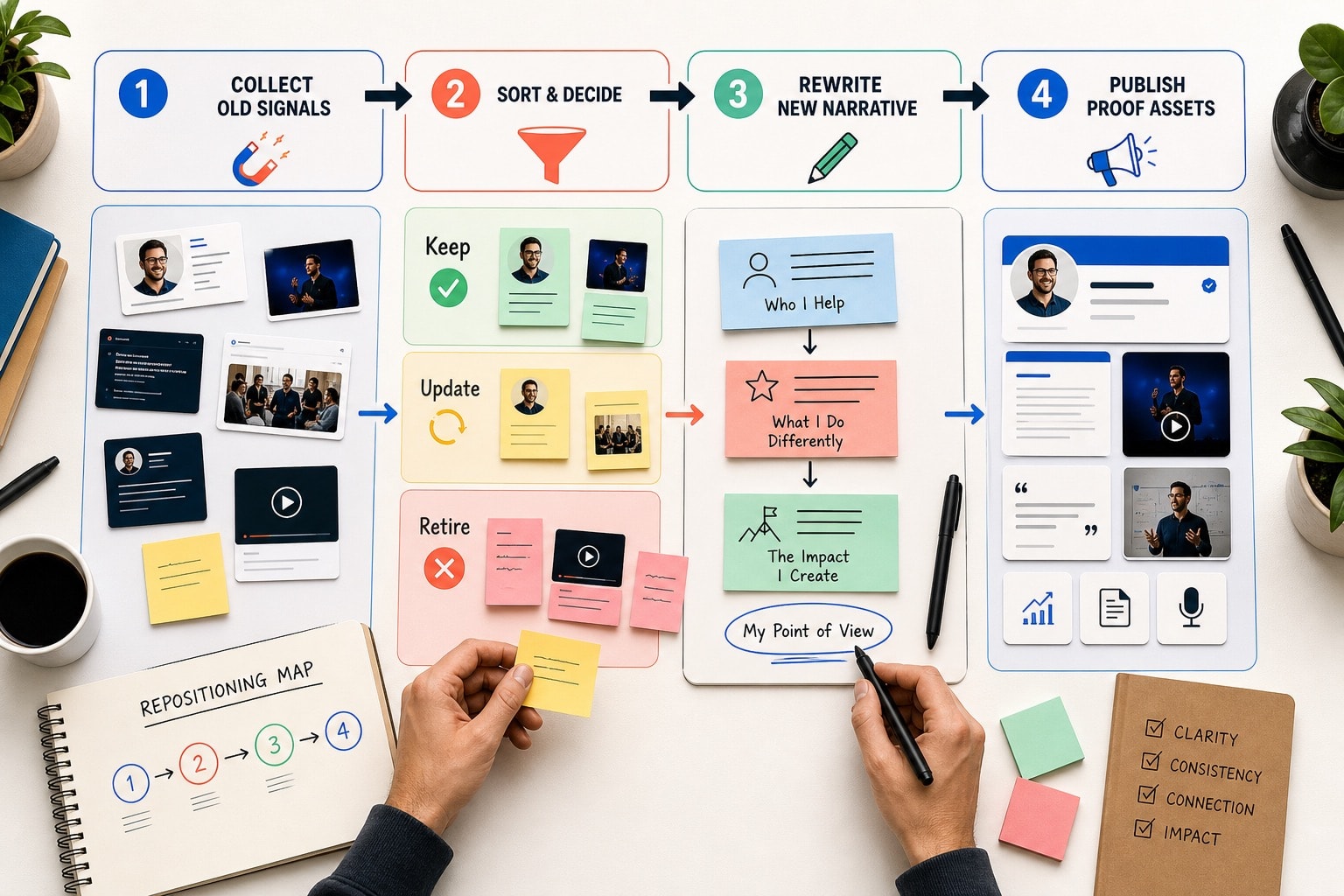
The AI Repositioning Audit: Keep, Update, Retire, Prove
Start with a simple audit. Do not ask AI to “build my personal brand.” Give it source material and force it to compare the old identity with the future one. Collect 15 to 30 public artifacts: your LinkedIn profile, old posts, website bio, speaker bio, comments people responded to, project pages, case studies, and prominent search results. If privacy matters, remove sensitive names and numbers first.
Then use this prompt:
AI prompt: “Act as a personal brand strategist. I am repositioning from [old association] to [new association]. Review the public identity signals below. Sort each signal into Keep, Update, Retire, or Prove. Keep means it supports the new positioning. Update means it can be reframed. Retire means it distracts from the new direction. Prove means I need a stronger artifact before making the claim publicly. Return specific reasons and recommended edits.”
The categories matter because people either delete too much and look like they appeared from nowhere, or keep everything and make the new direction hard to believe. Keep the parts of your past that create trust. Update transferable skills. Retire assets that attract the wrong audience. Prove claims that are currently just ambition.
Find the Bridge Between the Old You and the New You
A good repositioning does not say, “Forget everything I used to do.” It says, “Here is how my past gives me an unfair lens on the work I do now.”
The bridge is the part of your story that makes the change believable. A teacher moving into learning design for AI tools might say, “I understand how people actually learn, not just how software demos well.” A recruiter moving into talent intelligence might say, “I have seen the gap between hiring signals and actual performance.”
AI is useful here because it can compare patterns across your work faster than you can. Try this:
AI prompt: “Here are examples from my past work and the direction I want to move toward. Identify five credible bridges between them. For each bridge, explain what experience supports it, what audience would care, what claim would be too strong, and what proof asset would make it more believable.”
Do not accept the first polished answer. Look for the bridge that feels both true and commercially useful. It should explain why your past is not a detour.
Rewrite Your Positioning Around Three Signals
Once you know the bridge, rewrite your positioning around three signals: audience, outcome, and proof.
1. Audience: Who should now remember you?
Repositioning fails when the audience stays vague. “Professionals,” “founders,” “creators,” and “leaders” are useful planning categories, but weak positioning. Define the audience by situation: technical founders who need buyers to understand complex products faster, operators moving into strategy roles, consultants with strong client work but weak public proof, AI builders who need credibility beyond demo screenshots, or students who want to be known for useful projects before graduation.
2. Outcome: What should people trust you to help with?
Your outcome should be concrete enough that a reader can imagine the before and after. Avoid “helping people grow,” “building better brands,” or “unlocking potential.”
Better outcomes sound like this: turn technical expertise into buyer-ready explanations, make confidential work credible without naming the client, translate operational experience into executive-ready thought leadership, build a public proof system before a career pivot, or make AI-assisted content sound like a person with lived judgment.
3. Proof: What evidence makes the new claim believable?
This is where AI personal branding often goes wrong. People ask AI for a better claim before they build better evidence.
Your proof can be small: a before-and-after teardown, short case note, public project, recorded walkthrough, curated reading list, workshop recap, GitHub repository, client-safe lesson, thoughtful comment thread, podcast appearance, three-part essay series, or useful template. It does not need to be dramatic. It needs to be specific.
Build a 30-Day Repositioning Plan
You do not need to announce a grand rebrand. A better approach is to update the public evidence in a sequence.
Days 1-5: Update your identity anchors
Rewrite the places people inspect first: your LinkedIn headline, About section, website intro, Substack bio, X bio, speaker bio, and pinned profile links. Make them consistent, but not identical. Each surface should answer the same core question in the language of that platform.
Use AI to compare them:
AI prompt: “Compare these profile bios. Do they describe the same professional identity? Identify contradictions, vague claims, missing proof, and phrases that sound generic. Rewrite each bio so it fits the platform while preserving one clear positioning idea.”
Days 6-12: Publish bridge content
Bridge content helps existing contacts understand why your new direction makes sense. Useful formats include “what my old role taught me about my new focus,” “the problem I kept seeing before I had language for it,” “the through-line across my last three projects,” and “why I am narrowing my work around this specific audience.”
Days 13-20: Create proof assets
Now make the new position visible. Choose two proof assets you can finish quickly. A proof asset should answer one question: “Why should someone believe this person can help with this?”
For a founder, that might be a teardown of the market narrative your startup is challenging. For a consultant, it might be a client-safe case note. For a job seeker, it might be a project write-up that shows how you think. For an AI builder, it might be a short technical explainer that reveals tradeoffs, not just outputs.
Ask AI to pressure-test your proof:
AI prompt: “I want to be known for [new positioning]. Here is a draft proof asset. What claim does it support? What claim does it not yet support? What would a skeptical recruiter, buyer, investor, or collaborator still need to see?”
Days 21-30: Reintroduce yourself through useful repetition
Repositioning requires repetition, but not the same announcement everywhere. Make the new association show up in multiple useful contexts: a LinkedIn post explaining the shift, a Substack essay with the deeper argument, a short comment on a related discussion, a profile update linking to proof, and a note to warm contacts explaining what you now focus on.

How to Use AI Without Making the Rebrand Feel Fake
The danger in AI-assisted repositioning is not that AI helps. The danger is that AI sands off the evidence that makes you believable.
Use AI for diagnosis, comparison, compression, and editing. Be careful with AI for voice, emotion, values, and personal narrative. A simple rule works well: AI can draft the structure, but you must supply the scars. That means the specific experiences that made your point of view costly enough to trust: the project that failed, the client objection you had to solve, the role that taught you what outsiders miss, or the pattern you noticed before it became fashionable.
Before publishing any AI-assisted content, run this humanization check: could ten other people in my field publish this exact paragraph, does it include a concrete moment or tradeoff, would someone who knows me recognize my judgment, does the claim match the proof, and am I making the new direction clearer rather than merely sounding impressive?
If the answer is uncomfortable, revise. Discomfort is often where the better sentence is hiding.
The Repositioning Mistakes That Break Trust
The first mistake is overclaiming. People borrow the language of the field they want to enter before there is enough public evidence. Use smaller, truer claims. “I am documenting my move into AI product strategy through weekly teardown essays” is more credible than “I am an AI transformation leader” if your proof is still emerging.
The second mistake is changing visuals before changing meaning. A new photo, color palette, or banner may feel fresh, but if your examples, proof, and language still point to the old identity, the new look becomes decoration. The third mistake is deleting or hiding too much. Usually you only need to unpin, archive, rewrite, redirect, or add context so the hierarchy becomes obvious: this is where I came from, this is what I learned, this is what I do now, and this is the proof.
A Simple Personal Brand Repositioning Template
Use this compact structure when rewriting your public identity:
Old base: “My background is in [old field or role].”
Observed pattern: “Across that work, I kept seeing [specific problem].”
New focus: “Now I help / study / build / teach [audience] with [specific outcome].”
Method: “My approach combines [past strength], [new capability], and [proof habit].”
Evidence: “You can see that through [projects, essays, case notes, talks, tools, client-safe examples].”
I started in customer support, where I learned how confused users describe product problems before teams have clean data. Now I help early-stage SaaS founders turn messy user feedback into clearer product narratives through teardown notes, lightweight research systems, and examples of how language changes buyer trust.
How to Know the Repositioning Is Working
Do not measure repositioning only by likes, follower growth, or impressions. Better signals are qualitative: people describe your work using the language you intended, inbound opportunities match the audience you now want, search results and AI summaries show fewer contradictions, warm contacts understand the shift faster, and your content ideas become easier because the frame is clearer.
Every two weeks, ask an AI tool and a human who knows your field to summarize your public presence. If both summaries point to your new positioning, the repositioning is taking hold.
The Point Is Not Reinvention. It Is Coherence.
You do not need to become a different person to reposition your personal brand. You need to make the through-line visible.
AI can help you find patterns, audit inconsistencies, rewrite outdated profiles, test audience clarity, and turn scattered proof into a more coherent public identity. But the strongest repositioning still comes from human judgment. What did you learn? What do you now see that others miss? What are you willing to be known for? What proof are you prepared to keep showing?
Your old online persona is not the enemy. It is raw material. Treat it carefully, update it honestly, and build enough new evidence that people and AI systems can understand the person you are becoming.
FAQ
What is personal brand repositioning?
Personal brand repositioning is the process of changing what people associate with your name, expertise, and public identity. It is useful when your work, audience, goals, or market have changed but your online presence still reflects an older version of you.
How can I use AI to rebrand myself professionally?
Use AI to audit your existing public signals, identify contradictions, translate old experience into new positioning, draft platform-specific bios, pressure-test claims, and build a content plan around proof. Do not rely on AI to invent your voice or exaggerate your authority.
Should I delete old posts when repositioning my personal brand?
Usually, no. Delete only material that is inaccurate, harmful, or seriously misaligned. In most cases, it is better to unpin, archive, update, or add context so your past supports the new direction instead of confusing people.
How long does a professional rebrand take?
A light repositioning can start showing clarity within 30 days if you update your core profiles and publish new proof. A deeper reputation shift often takes several months because people need repeated, credible signals before they remember you differently.
How do I reposition my personal brand during a career pivot?
Find the bridge between your old work and your new direction. Show transferable patterns, publish proof of the new capability, and explain the shift through practical examples. The strongest career pivot personal brand does not abandon the past. It translates it.