


When AI makes it easy to publish everywhere, consistency becomes a competitive advantage. A personal brand style guide gives your LinkedIn, Substack, website, and social posts one recognizable voice without turning you into a content machine.
For founders, consultants, executives, creators, freelancers, job seekers, and AI builders who want a stronger public identity without sounding generic.
Most people do not have a content problem. They have a translation problem.
They know what they do. They know who they help. They may even have strong ideas. But their LinkedIn headline sounds like one person, their website sounds like another, their Substack intro sounds outsourced, and their social posts drift between polished and generic. Once AI enters the workflow, that inconsistency gets worse fast. The machine can help you publish, but it will happily amplify a fuzzy identity.
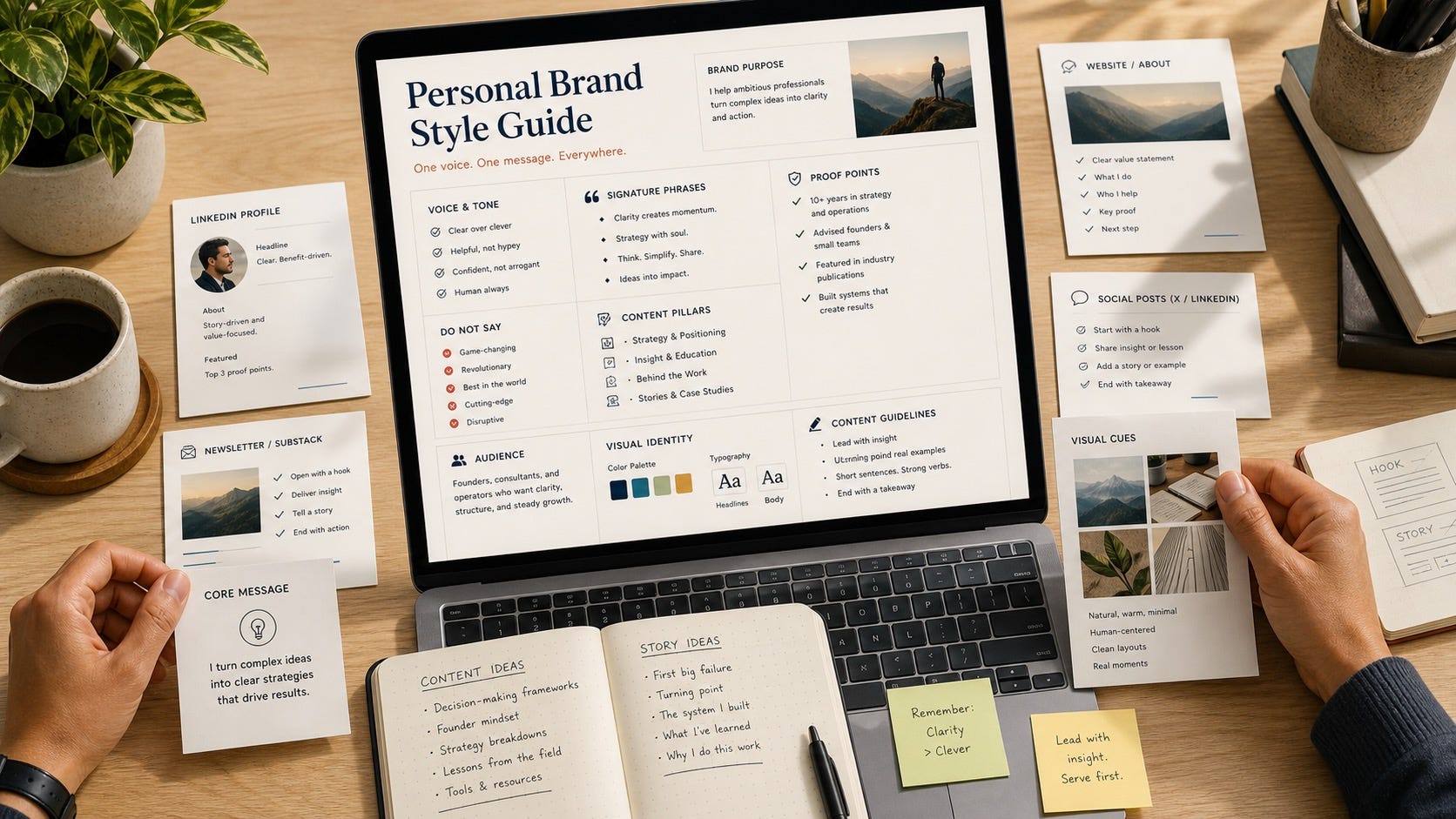
That is why a personal brand style guide matters now. It is not a corporate brand book. It is a one-page operating system for how you should sound, what you should emphasize, what proof you should repeat, and what you should never let AI invent on your behalf.
If you build it well, every channel starts feeling connected. People do not just read one good post. They begin to recognize your judgment.
What a personal brand style guide actually is
A personal brand style guide is a compact reference file that keeps your public identity coherent across channels. Think of it as the source document that tells both you and your AI tools:
What you are known for
Who you want to attract
How you sound when you are at your best
Which proof points show credibility
What topics deserve repetition
What language weakens trust
This matters because audience trust is pattern recognition. People trust you faster when your message sounds stable across touchpoints. A strong personal brand does not feel repetitive. It feels clear.
The core shift: stop asking AI to “write something about me” and start asking it to “work from my style guide, proof points, audience, and constraints.”
Why AI makes this more important, not less
AI lowered the cost of content production. It also lowered the cost of sounding like everyone else.
That is why generic prompts produce generic positioning. If your inputs are vague, AI fills the gaps with smooth, forgettable phrases: “passionate leader,” “results-driven strategist,” “helping businesses grow,” “unlock potential,” and other dead language readers skip instantly.
A personal brand style guide fixes that by giving the model constraints. Good constraints create memorable output. They tell AI to favor your lived proof over abstract claims, your real vocabulary over bloated business clichés, and your actual audience over a fake attempt to speak to everyone.
This is especially useful if you publish across multiple surfaces:
LinkedIn needs short, sharp credibility signals.
Substack needs a clear point of view and stronger narrative rhythm.
Your website needs clarity, proof, and conversion-friendly structure.
X rewards distinct phrasing and fast pattern recognition.
Podcast bios and guest materials need fast-fit positioning.
Without a style guide, AI treats each task like a new identity. With one, every channel becomes a variation of the same recognizable person.
The seven parts of a useful personal brand style guide
You do not need a 40-page document. You need one page that is specific enough to guide decisions.
1. Positioning statement
Write one sentence that answers: who do you help, what problem do you solve, and how are you different? This is your anchor. If the sentence is weak, every downstream asset gets weaker.
2. Audience definition
Name the people you actually want to attract. Be concrete. “Founders” is broad. “Bootstrapped SaaS founders who need clearer positioning” is useful. AI performs better when the audience is not blurry.
3. Proof library
List your strongest trust signals. Case studies. Wins. credentials. Years of experience. Publications. Clients. Systems you built. Real proof gives AI something better than hype to work with.
4. Voice and tone rules
Describe how you naturally sound. Direct or reflective? Sharp or warm? Technical or plainspoken? Include a short “do not sound like this” list too. Negative examples are often more useful than positive ones.
5. Signature phrases
These are the lines, contrasts, and concepts that readers start associating with you. Maybe you often say “clarity beats cleverness,” “proof before promotion,” or “show the work, then make the ask.” Signature phrasing makes your output recognizable.
6. Content pillars
Define the three to five recurring themes you want to own. This helps AI generate ideas that reinforce your authority instead of scattering your message.
7. Platform rules and AI guardrails
Add light channel guidance: ideal length, preferred structure, where to use stories, where to stay concise, and what claims need fact-checking. Then add your red lines. No fake case studies. No inflated titles. No invented metrics. No borrowed conviction.
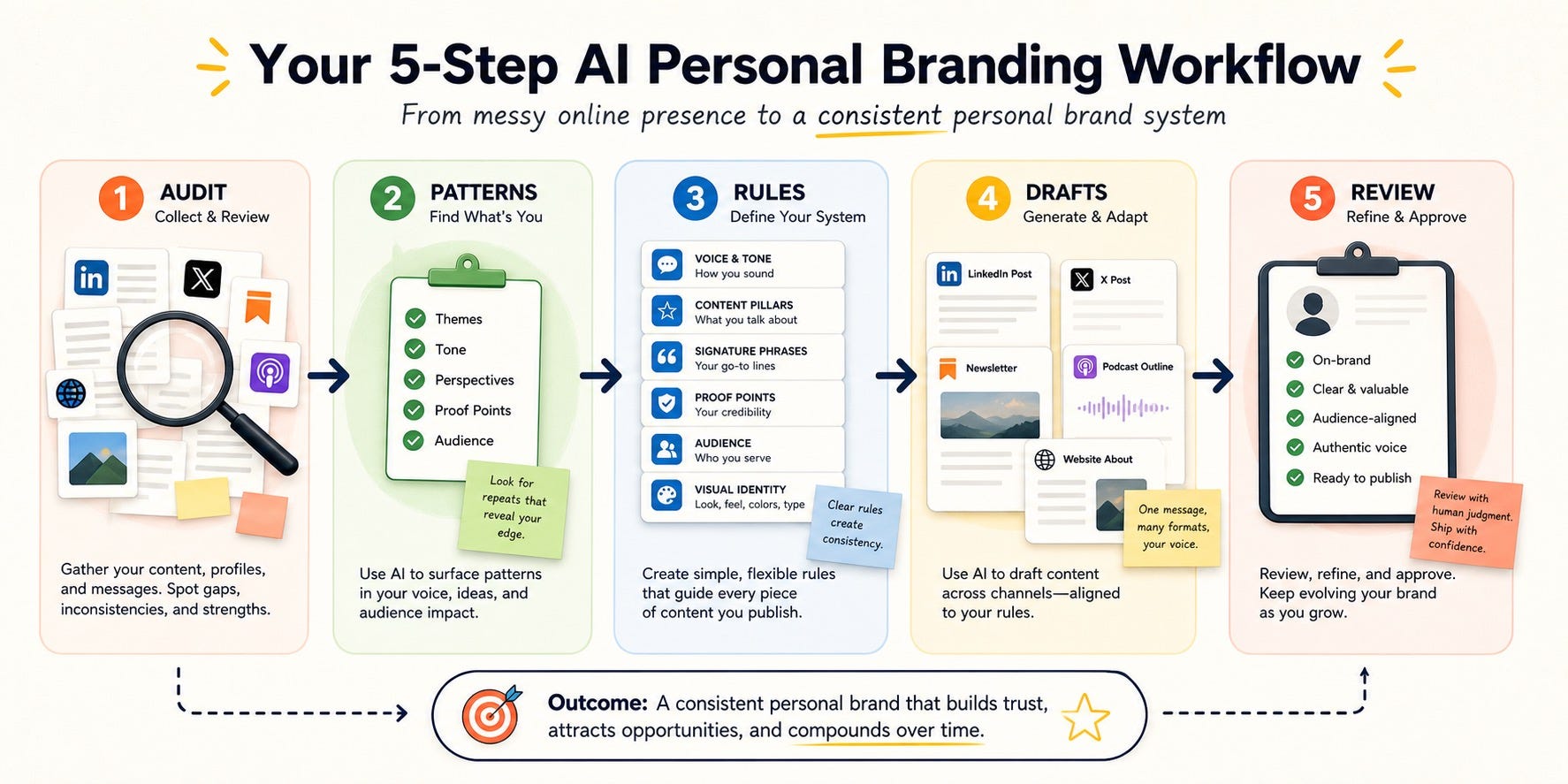
A 30-minute workflow to build your guide with AI
You can draft the first version in one focused session.
Step 1: Audit your existing signals
Open your LinkedIn profile, website bio, best-performing posts, speaker intro, and any recent newsletter issues. Drop the text into one document. You are looking for repeated ideas, not polished prose. Mark:
phrases you repeat naturally
examples people respond to
proof points you underuse
places where your message drifts
Step 2: Ask AI to extract patterns, not write copy yet
This is where many people go wrong. They ask for output too early. Start with analysis first. Use a prompt like this:
Review the text below and identify recurring themes, tone patterns, audience clues, proof points, signature contrasts, and weak generic language. Then suggest a one-page personal brand style guide with sections for positioning, audience, proof, voice, signature phrases, content pillars, and platform rules. Do not write polished marketing copy yet.
Step 3: Edit the guide manually
AI can cluster patterns, but you need to choose what is true. Cut anything aspirational that you cannot defend publicly. Keep what matches your real work, your actual audience, and the opportunities you want more of.
Step 4: Add a “do not say” list
This may be the highest-leverage part of the whole system. If you always hate the same types of phrasing, document them. Examples:
empty motivation language
overclaiming expertise
startup cliché words
generic AI transitions and filler
Step 5: Use the guide to generate channel-specific drafts
Now you can ask AI for outputs with much better control. For example:
Use my personal brand style guide below to draft: a LinkedIn about section, three Substack post ideas, a website hero statement, and two short X posts. Stay within my voice rules. Use only proof points I provided. Avoid any phrase from my do-not-say list. Make each format native to its platform.
The difference is subtle but important. You are no longer asking AI to invent your brand. You are asking it to adapt your brand.
How this improves LinkedIn, Substack, and your website
The practical payoff is not just consistency. It is speed with integrity.
On LinkedIn, the style guide helps you write a headline, About section, Featured blurbs, and post hooks that sound connected. On Substack, it sharpens your point of view so your newsletter feels authored, not assembled. On your website, it keeps the copy specific enough to build trust instead of reading like a vague online brochure.
It also makes repurposing cleaner. A good Substack paragraph can become a LinkedIn post because both are drawn from the same brand logic. A website bio can become a speaker intro because the proof hierarchy is already defined. Instead of reinventing your voice every time, you keep translating the same identity.
Common mistakes that make the guide useless
Most weak style guides fail for one of four reasons.
They are too broad. If your guide could apply to a hundred consultants, it will not protect your voice.
They are built from aspiration, not evidence. Write from your strongest real work, not the persona you wish you already had.
They ignore proof. Voice matters, but credibility compounds when proof points are built into the system.
They stop at tone. Your brand is not just how you sound. It is also what you repeatedly help people understand.
The trust test for AI-generated personal branding
Before publishing anything created with AI, run a quick review. Ask:
Would someone who knows me believe I wrote this?
Does this include real proof or only polished claims?
Is the language more specific than generic?
Did AI exaggerate my certainty, authority, or results?
Would I say this out loud in a client call, interview, or on stage?
If the answer to any of those is no, the content is not ready. The job is not to sound optimized. The job is to sound recognizable and credible.
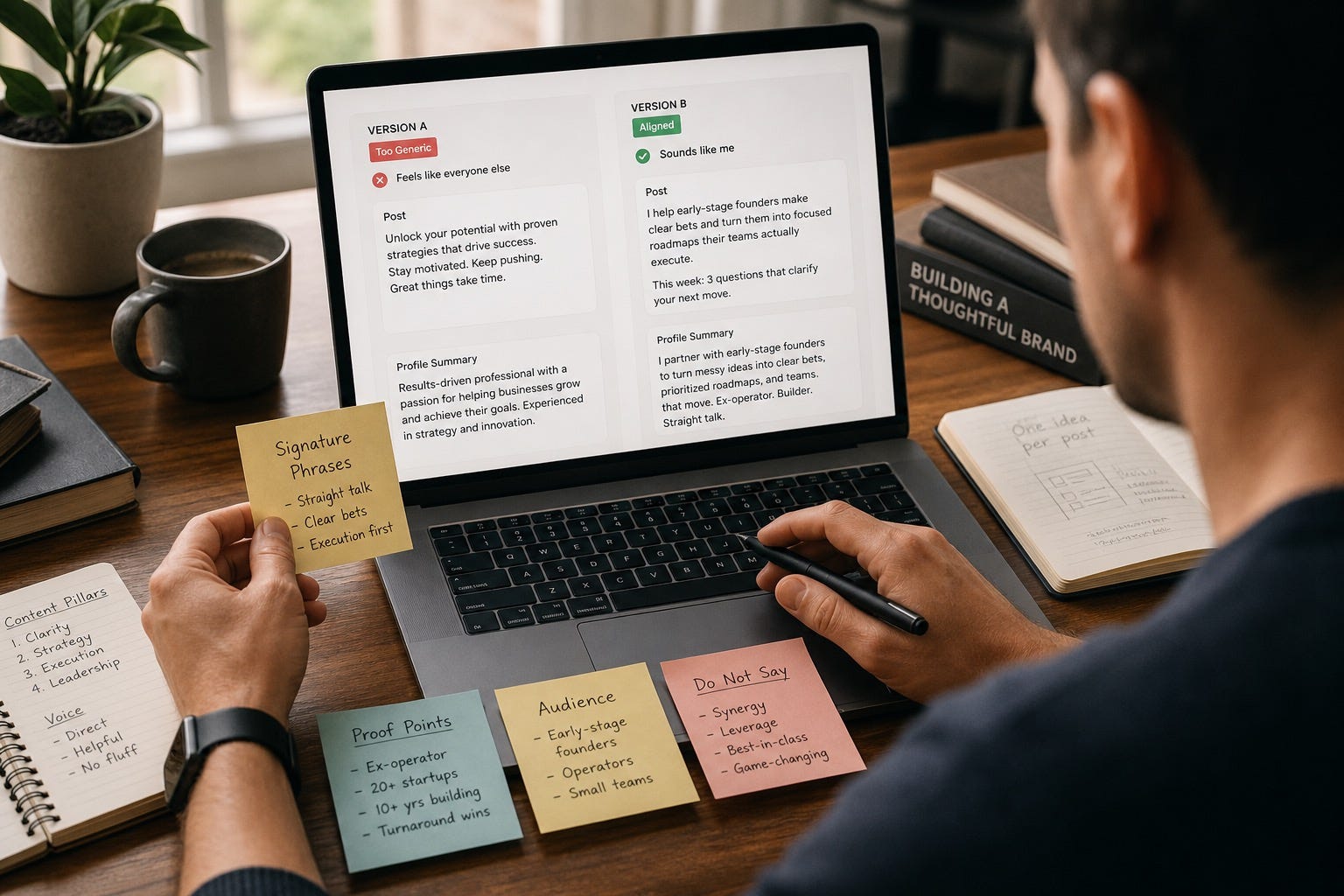
The strongest AI personal branding systems do not automate identity. They document it, protect it, and help it scale without flattening it.
A simple template you can steal
If you want to move faster, build your first style guide with this structure and keep each section short:
Positioning: I help [audience] achieve [result] by doing [method].
Audience: primary buyer, reader, listener, or hiring context.
Proof: three to five facts that make your claims believable.
Voice: three adjectives that describe how you sound when you are strong.
Do not say: five phrases or styles that instantly make you sound generic.
Content pillars: three to five themes you can return to for months.
Signature phrases: contrasts, catch-lines, or recurring ideas that feel native to you.
Platform notes: what changes between LinkedIn, Substack, website copy, podcasts, and short-form posts.
That template is enough to produce better AI drafts immediately. It also helps if more than one person touches your content. A founder, assistant, ghostwriter, or AI tool can all work from the same source document instead of making brand decisions from scratch.
What good channel adaptation looks like
One idea should not become the same post everywhere. Your style guide keeps the identity stable while the format changes.
For example, if your core belief is that “proof builds trust faster than performance,” LinkedIn might turn that into a short post with one client lesson, Substack might turn it into a longer argument with a narrative opening, and your website might turn it into a value statement backed by case studies. Same worldview. Different packaging.
That is the real benefit of AI here. It can help you adapt a message without diluting it. But only if your source material is strong enough to resist the platform’s default tone. Otherwise every version starts sounding like polished filler.
What to do next
If your online presence feels scattered, do not start by publishing more. Start by building the document that tells every future post, bio, profile, and AI draft what “on brand” actually means.
Create one page. Keep it concrete. Update it as your work evolves. Then feed that guide into every AI workflow you use for LinkedIn, Substack, website copy, speaker materials, podcast outreach, and social content.
That is how you get the upside of AI without giving up the thing that makes people remember you: a clear point of view, visible proof, and a voice that feels like a real person.
FAQ
What is a personal brand style guide?
A personal brand style guide is a short internal document that defines your positioning, audience, proof points, voice, signature phrases, content pillars, and platform rules so your public presence stays consistent across channels.
How do I use AI for personal branding without sounding generic?
Give AI constraints before asking for content. Use a style guide that includes your real proof, tone rules, audience, preferred phrasing, and banned clichés. Then review the output for specificity and authenticity before publishing.
What should be in a one-page personal brand style guide?
The most useful one-page version includes a positioning statement, audience definition, proof library, voice and tone rules, signature phrases, content pillars, visual cues, platform rules, and AI guardrails.
Can a personal brand style guide help with LinkedIn and Substack?
Yes. It helps LinkedIn profiles and posts feel sharper while giving Substack writing a clearer point of view. The same guide can also improve your website bio, podcast materials, and short-form social posts.
How often should I update my personal brand style guide?
Update it whenever your positioning changes, you gain stronger proof points, or you notice your content drifting. A quick review every quarter is usually enough for most professionals.
Is a personal brand style guide only for creators?
No. It is especially useful for founders, executives, consultants, freelancers, job seekers, and technical professionals who want a more coherent public identity without becoming full-time content creators.