



A practical workflow for founders, consultants, creators, job seekers, and experts who want a public identity that feels specific, credible, and human.
Most weak personal brands do not fail because the person has nothing to say. They fail because the public version feels too easy to ignore.
The headline could belong to anyone. The bio says “passionate about innovation.” The posts sound polished but empty. The proof is hidden. The reader has to guess what the person is known for, who they help, and why they should believe them.
That is a bigger problem now because audiences are getting sharper at spotting generic AI content. LinkedIn recently added a “Seems like AI slop” feedback option, and The Verge reported that more than one million people had clicked it. Business Insider reported that LinkedIn said members were seeing 40% fewer views on content the platform classifies as AI slop.
The lesson is not “never use AI.” If your personal brand sounds like a machine pretending to be impressive, people now have language for that feeling.
A personal brand teardown helps you catch that problem before your audience does. Instead of asking AI to create more content, you ask it to inspect the profile, posts, and proof you have. Then you fix the weak parts with your real experience.
What a Personal Brand Teardown Actually Is
A teardown is a structured review of how your public identity lands in the mind of a stranger. It is not a vibe check, a full rebrand, or advice to “post more consistently” while ignoring whether your profile deserves attention.
A useful teardown asks five questions:
Can a stranger understand what you do in ten seconds?
Can they tell who you help and what problems you understand?
Is there proof behind your claims?
Does your voice sound like a person with judgment?
Is there a next step that makes sense for the reader?
That is why the teardown format works so well with AI. AI can compare your headline, About section, website copy, posts, bios, case studies, and comments against a clear standard. It can spot repetition, vagueness, missing context, unsupported claims, and confusing positioning. But it cannot decide what is true about your work. That part still belongs to you.
Your goal is not to make your personal brand sound more optimized. Your goal is to make it easier to believe.
Why Your Brand Feels Generic Even When You Are Experienced
Experienced people often sound generic online because they compress their work too aggressively. They remove the messy details that would make them credible. They say “strategic leader” instead of showing the decision they made under pressure. They say “AI consultant” instead of naming the workflow they helped a team adopt.
AI can make this worse. If you give a model a thin prompt like “write my LinkedIn bio,” it will usually smooth the edges. It will make you sound competent, upbeat, and forgettable. The result may be grammatically clean, but clean is not the same as trusted.
1. The identity is too broad
“I help businesses grow” is not a personal brand. It is a fog machine. A stronger identity names a field, audience, problem, or unfair advantage.
2. The proof is invisible
Many professionals have proof, but it lives in private folders, old projects, client messages, internal decks, or memory. Public readers cannot trust what they cannot see. A teardown should ask where each claim is supported by a project, result, testimonial, artifact, process, or lesson learned.
3. The voice is too frictionless
Generic AI writing avoids risk. Human expertise has texture. It includes judgment, tradeoffs, limits, examples, and the occasional sentence only you would write.
4. The audience path is unclear
A reader may like you and still leave because they do not know what to do next. A personal brand teardown checks whether each public surface gives the right next step for that context.
The AI Teardown Workflow
Do not start by rewriting. Start by collecting evidence. The prompt is only as strong as the material you give it.
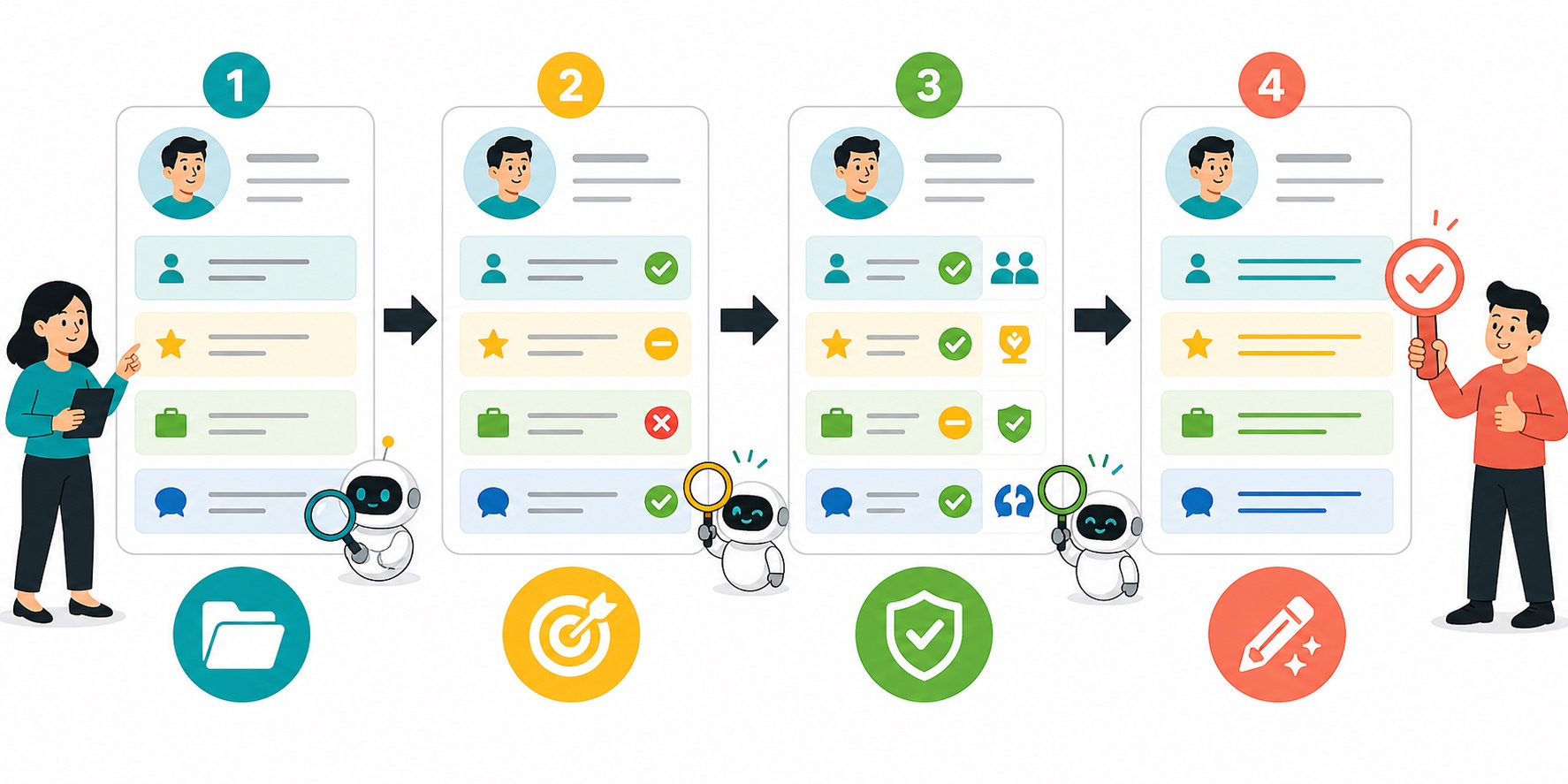
Step 1: Gather your public surfaces
Copy your LinkedIn headline, About section, Featured items, recent posts, website bio, speaker bio, newsletter description, X bio, GitHub profile, portfolio intro, or any other surface where people decide what to think about you. Start with the three places that matter most.
Then add a short private note with context AI cannot infer:
Who you want to be known by
What opportunities you want more of
What work you no longer want
Three real wins or projects you can discuss publicly
Any topics, claims, or personal details that are off limits
Step 2: Ask AI for a stranger-read review
Paste the material into your AI tool and ask it to review, not rewrite. You want diagnosis first.
Prompt: “Act like a skeptical but fair reader who just found my public profile. Based only on the material below, tell me what you think I do, who I help, what proof you see, what sounds generic, what feels credible, and what questions remain unanswered. Do not rewrite anything yet. Give me the top five trust leaks and the top five clarity leaks.”
This prompt is useful because it forces the model to separate what is visible from what you intended. That gap is where most personal branding problems live.
Step 3: Run the generic-language scan
Next, ask AI to mark every phrase that could appear on a thousand other profiles: innovative, passionate, results-driven, dynamic, strategic, proven, growth-minded, visionary, expert. None is illegal. The problem is that they ask the reader to believe you without giving them a reason.
Use this prompt:
Prompt: “Highlight every phrase in my profile or content that sounds generic, inflated, AI-written, or unsupported. For each phrase, explain why it weakens trust and suggest what kind of real evidence would make it stronger. Do not invent claims.”
The last sentence is important. If you let AI invent evidence, you have not improved your brand. You have built a credibility debt.
Step 4: Map each claim to proof
Make a two-column list in your notes. On the left, write every major claim your public brand makes. On the right, write the proof that supports it. If you claim you help founders clarify messaging, the proof might be before-and-after positioning work, a case study, testimonials, a teardown thread, a workshop clip, or a short explanation of your method.
If a claim has no proof, you have three choices. Remove it, soften it, or create the proof asset. Most people choose a fourth option: keep the claim and hope nobody notices. That is the weakest option.
Step 5: Rewrite only the weak parts
Once the diagnosis is clear, rewrite with constraints. Ask AI for options, but require your evidence, your vocabulary, and your boundaries.
Prompt: “Rewrite the weak sections using only the facts and proof I provided. Keep the tone direct, specific, and human. Avoid hype, vague adjectives, guru language, and claims that cannot be checked. Give me three versions: concise, warm, and sharper.”
Do not publish the first output. Read it out loud. Cut any sentence you would be embarrassed to say to a smart peer. Add one concrete detail from your real work. Replace any grand claim with a precise observation.
The Five-Part Personal Brand Teardown Checklist
You can run this checklist across LinkedIn, Substack, your website, your bio, or your portfolio. The order matters because surface-level polish is useless when the positioning underneath is unclear.
1. Positioning
Ask: “What would a reader say I am known for after ten seconds?” If the answer is a job title, you are probably too vague. If the answer is a market problem, an expertise lane, or a recognizable point of view, you are closer.
Weak: “Marketing leader helping brands grow.”
Stronger: “I help cybersecurity startups turn technical product value into sales messaging buyers understand.”
2. Proof
Ask: “Where can a reader see that I have done the work?” Proof does not always mean numbers. It can be a screenshot, teardown, method, project, client quote, open-source contribution, published essay, talk, template, or decision story. The best proof is specific enough that it feels difficult to fake.
3. Voice
Ask: “Does this sound like me on a clear day, or like a polished stranger?” Your voice does not need slang or oversharing. It needs recognizable judgment. Add sentences that reveal how you think: “I do not trust content calendars until the proof library exists.” “A founder story without customer pain is usually autobiography, not positioning.” Those lines create memory.
4. Audience fit
Ask: “Would my target reader feel seen, or just marketed to?” Generic personal brands describe the owner. Strong personal brands make the right reader feel, “This person understands my problem.” Mine comments, DMs, sales calls, reviews, and community questions. Then translate those patterns into public copy without exposing people.
5. Friction and next step
Ask: “What should the right person do next?” A job seeker may want recruiters to understand role fit. A consultant may want qualified prospects to start a conversation. A founder may want investors, hires, customers, or partners to trust the mission. A creator may want subscribers to follow the thinking. Your profile should not push every reader to the same action.
How to Use AI Without Becoming More Generic
AI is useful in a teardown because it can be blunt without being socially awkward. It can say, “This sounds unsupported.” It can say, “Your About section promises outcomes but never names the audience.” That feedback is valuable.
But AI becomes dangerous when you ask it to replace the discomfort of thinking. A personal brand gets stronger when you make clearer decisions. It gets weaker when you outsource those decisions to the average of the internet.
Use AI to find vague claims, repeated phrases, audience mismatch, weak proof, and unclear next steps. Keep the human work where it belongs: deciding what you want to be known for, choosing honest proof, setting boundaries, making strong claims, and approving anything that affects your reputation.
If a sentence could create trust, risk, money, or misunderstanding, a human should approve it.
A Mini Teardown Example
Imagine a consultant has this LinkedIn headline:
“Helping businesses unlock growth through strategy, innovation, and AI.”
It sounds professional, but it does not tell us much. What kind of businesses? What kind of growth? What kind of strategy? What kind of AI? Why this person?
A teardown might identify three clarity leaks: the audience is too broad, the outcome is vague, and the proof is absent. The rewrite should not simply add stronger adjectives. It should add specificity.
Better:
“I help B2B service firms turn messy client delivery into repeatable AI-assisted workflows, training, and sales enablement.”
That version is not perfect for everyone, which is the point. A good personal brand excludes the wrong reader faster. It gives the right reader a reason to continue.
Now the About section can support it with proof: a short story about the delivery mess, a clear method, two outcomes, and a soft invitation for people facing that problem. The profile becomes a coherent asset instead of a collection of impressive nouns.

When to Run a Personal Brand Teardown
Run a teardown before you scale content. Posting more often will not fix a weak profile. It will just send more people to a page that does not explain you well.
Run one when you change your offer, niche, role, audience, or point of view. Run one before a launch, job search, conference, fundraising season, podcast push, consulting sprint, or public writing streak. A monthly review catches structural drift; a pre-publish review catches avoidable mistakes.
What to Fix First
If the teardown produces twenty problems, do not fix all twenty. Start with the surface that gets the most qualified attention: a job seeker’s LinkedIn profile, a consultant’s proof assets, a founder’s pinned story, or a creator’s newsletter promise.
Fix in this order:
Clarify what you want to be known for.
Replace vague claims with specific proof.
Remove phrases that sound inflated or machine-written.
Add one human point of view readers can remember.
Make the next step obvious but not desperate.
That order protects you from cosmetic optimization. A better banner will not save a confusing message. A sharper headline will not save unsupported claims.
The Point Is Not Perfection
A personal brand teardown is not meant to make you flawless. Flawless often reads fake. The goal is to make your public identity accurate enough, specific enough, and useful enough that the right people can trust it faster.
AI can help you see the weak spots, but the strongest repairs come from your actual work: the clients you helped, the systems you built, the mistakes that changed your judgment, the ideas you can defend, and the details only you would know.
The internet does not need more polished profiles. It needs more people whose public presence makes their real expertise easier to find, understand, and believe.
Run the teardown. Keep what is true. Cut what is generic. Add the proof. Then publish like someone who knows the difference between visibility and credibility.
FAQ
What is a personal brand teardown?
A personal brand teardown is a structured review of your public identity across profiles, bios, websites, posts, and proof assets. The goal is to find what feels unclear, generic, unsupported, or misaligned, then fix the specific weak points.
How can AI help with a personal brand teardown?
AI can review your public materials like a skeptical reader, flag vague claims, identify missing proof, compare your intended audience with your actual message, and suggest clearer rewrites. It should diagnose and draft options, not invent your expertise.
Is a personal brand teardown the same as a personal brand audit?
They overlap, but a teardown is more repair-focused. An audit often measures the whole brand. A teardown looks at the live public experience and asks, “Where does belief break, and what should we fix first?”
How often should I run a teardown on my LinkedIn profile or website?
Run a light teardown before important launches, job searches, speaking pushes, or content campaigns. Run a deeper teardown monthly or whenever your offer, role, niche, or audience changes.
What should I include in an AI prompt for profile feedback?
Include your current profile text, target audience, desired opportunities, real proof, boundaries, and what you do not want to sound like. Ask for diagnosis first. Request rewrites only after you understand the clarity and trust leaks.
How do I avoid making my personal brand sound AI-generated?
Use AI to find weak language, then replace generic claims with real details, proof, examples, tradeoffs, and personal judgment. Read every final line out loud and remove anything you would not say to a smart person in your field.