


In an internet full of polished bios and AI-assisted posts, the fastest way to feel credible is often simple: let other people describe what it is like to trust you.
AI made self-description cheap. Almost anyone can generate a clean LinkedIn summary, a polished website bio, and a respectable-looking post in minutes. That is useful, but it also means the average professional profile now makes the same mistake: it tells, but does not prove.
That is why personal brand testimonials matter more now than they did a few years ago. LinkedIn itself has leaned harder into authenticity and proof. In June 2026, the company said posts and comments should reflect your real voice and perspective, while dialing back generic AI content. It has also kept expanding verification and skills proof, and has said verified members see stronger profile visibility and engagement. The message is clear: polished claims are easy; trusted evidence is harder.
If you are a founder, consultant, freelancer, executive, job seeker, or technical professional, testimonials give your personal brand something AI cannot fake well at scale: specific third-party context. They show how people experienced your judgment, communication, reliability, and results. They answer the quiet question every serious buyer, recruiter, collaborator, or reader asks: why should I trust this person?
This article will show you how to build a testimonial system with AI. Not a cheesy wall of praise. A trust layer you can use across LinkedIn, your website, proposals, speaking bios, and newsletters.
Why testimonials matter more in the AI personal branding era
The old personal branding playbook rewarded repetition. Post often. Share hot takes. Keep reminding people you exist. That approach still works for some creators, but for most professionals the bigger problem is not awareness. It is belief.
People do not hire a consultant because the consultant sounds confident. They hire because the consultant sounds credible. They do not invite a founder onto a podcast because the founder has a clever headline. They do it because there are signs that the founder has real thinking, real work, and real outcomes behind the headline.
Testimonials create that bridge between visibility and belief. They move your brand from self-assertion to outside confirmation. One well-placed testimonial can do the work of ten generic authority posts because it gives the reader a concrete mental shortcut: someone like me trusted this person and got a result.
The core shift: the most effective personal brands are no longer trying to look impressive in every sentence. They are trying to reduce doubt at every touchpoint.
This matters even more if you do not want to become an influencer. Recent Reddit discussions about personal branding keep returning to the same theme: people want opportunities without having to perform online every day. The strongest answers point back to proof, reputation, and visible trust signals, not audience size. Testimonials are one of the cleanest ways to build that kind of quiet authority.
What counts as a personal brand testimonial now
Most people think a testimonial has to be a formal paragraph written for a website. That is too narrow. If you only wait for polished testimonials, you will ignore most of the proof already sitting in your inbox.
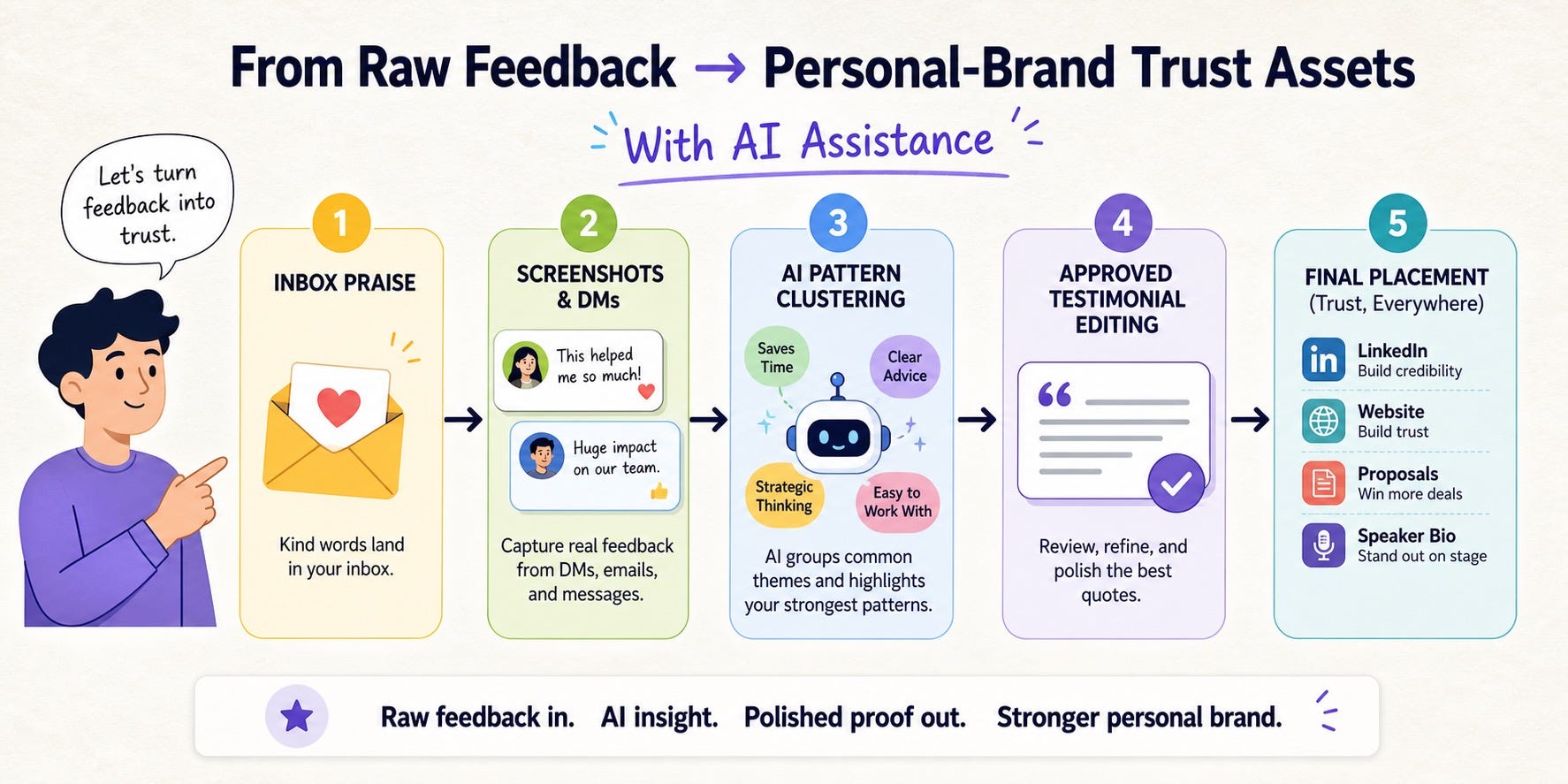
Your raw testimonial material can include:
LinkedIn recommendations
client emails thanking you for a result
Slack or Teams messages praising your clarity or speed
DMs after a talk, workshop, post, or podcast appearance
manager or peer feedback from reviews
screenshots from project wrap-ups
short comments from collaborators, students, or community members
public praise in comment sections, testimonials, and review platforms
Not every piece of praise deserves public use. But many of them contain valuable language patterns. One person might say you “made a messy problem feel manageable.” Another might say you “brought calm to a chaotic launch.” A third might say you “cut through noise faster than anyone else.” That is positioning data.
When you collect enough of it, you stop guessing what your reputation sounds like. You can see it.
Build an AI-assisted testimonial pipeline
The goal is not to let AI invent proof. The goal is to use AI to organize, compress, and surface the proof you already earned.
1. Create a raw proof folder
Start with one simple place where you dump everything. Create a folder, note, or spreadsheet called Proof Library. Save screenshots, copy email snippets, export LinkedIn recommendations, and paste short notes from calls or reviews. Add the source, date, audience type, and context.
Think like an editor, not a collector. The job is not to save compliments. The job is to save evidence about how you create value.
2. Ask AI to extract patterns, not write fake praise
Once you have ten to twenty snippets, use AI to identify repeated strengths. Good prompts focus on classification and synthesis, not invention.

Review these feedback snippets and group them into repeated trust signals.
For each cluster, identify:
1. the exact strength being described
2. the clearest supporting quote
3. the audience this proof matters most to
4. the best format for using it: website, LinkedIn, proposal, speaker bio, newsletter, or pitch
Do not invent or exaggerate anything. Preserve the original meaning and flag vague praise that is not specific enough to use.
This gives you something far more useful than a pile of compliments. It gives you a map. You can see whether people trust you for speed, judgment, calm leadership, technical depth, client communication, or strategic clarity. That helps you decide what your personal brand should reinforce.
3. Turn raw praise into multiple proof formats
A strong testimonial rarely stays in one format. One detailed client note can become:
a two-line website testimonial
a shorter LinkedIn Featured caption
a one-line credibility sentence in a speaker bio
a quote block inside a proposal
a screenshot in a newsletter or case study
a short “what clients say” block in your About page
This is where AI saves time. Ask it to create multiple shortened versions of the same approved quote for different surfaces. The rule is simple: compress, do not distort.
4. Match each testimonial to a buying question
The smartest use of personal brand testimonials is not “put them everywhere.” It is “place the right proof where doubt is highest.”
If someone is wondering whether you can handle complexity, show a quote about clarity under pressure. If they are wondering whether you are worth premium pricing, show a quote about outcomes or stakeholder trust. If they are wondering whether you are just another AI-assisted content machine, show a quote about insight, judgment, or lived experience.
The best testimonial is not the nicest one. It is the one that removes the most important doubt.
How to ask for better testimonials without sounding awkward
Most people ask too late, too vaguely, or too apologetically. That is why they get weak testimonials like “great to work with” or “highly recommend.” Pleasant, but forgettable.
A better approach is to ask close to the moment of value and give the other person a light frame. You are not scripting them. You are helping them be specific.
Try something like this:
Thanks again for the project. I am putting together a few proof points for my profile and site, and I wanted to ask whether you would be open to a short testimonial.
If helpful, the most useful angle would be one or two lines on:
- what problem we were solving
- what felt different about working with me
- what outcome or shift you noticed
Happy to keep it short, and I will always send the final wording for approval before using it anywhere.
That framing works because it respects the other person’s time and makes specificity easier. It also signals that you care about consent and accuracy, which matters even more in an AI-assisted workflow.
If someone prefers not to write anything formal, ask whether you can adapt a message they already sent and send it back for approval. Many strong testimonials start as a Slack line, a follow-up email, or a sentence from a project retrospective.
Where to place testimonials in your personal brand
Testimonials are most powerful when they show up where decisions happen. That is usually not one single page. It is the path people take while deciding whether you are credible.
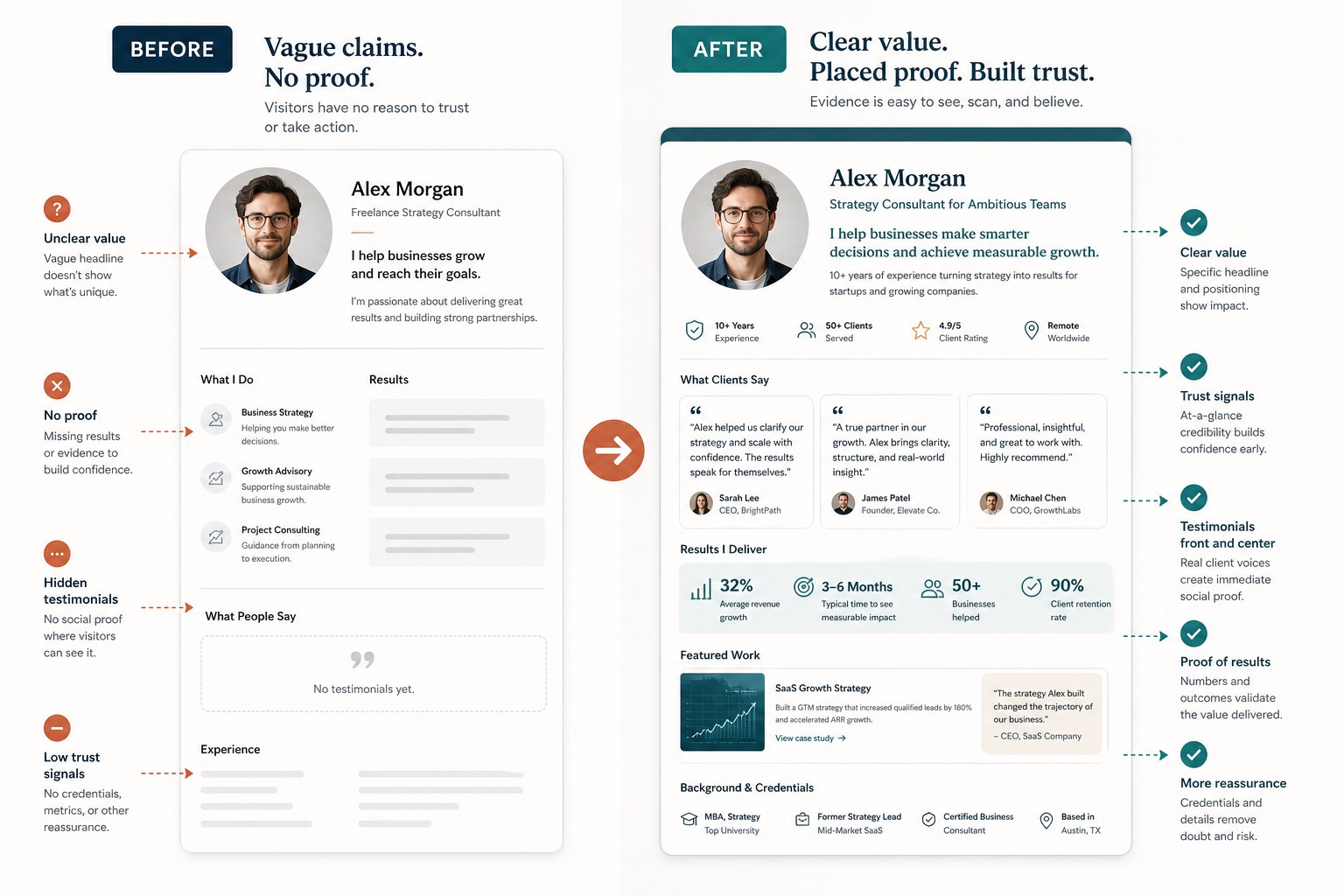
LinkedIn
Use testimonials in more places than the recommendations tab. Pull a short line into your About section, add a proof-driven caption to a Featured item, or reference a specific client outcome in the description of a project, talk, or post. The point is not to repeat praise everywhere. The point is to let real evidence interrupt generic language.
Your website
Your homepage should not carry a random dump of testimonials. Curate a small set based on your strongest positioning. Your About page can hold character and communication proof. Service or speaking pages can carry outcome-focused proof. A separate proof or case-study section can hold longer quotes.
Proposals and outreach
This is one of the most underused placements. If you send proposals, workshop one-sheets, or warm outreach emails, include one short testimonial that matches the exact concern of that buyer. Personal brands win when proof feels relevant, not merely impressive.
Speaker bios, guest pitches, and media intros
If you want podcast invitations, press mentions, or speaking opportunities, use testimonials that describe how you think, teach, or lead a room. A quote about thoughtful moderation, strategic clarity, or practical teaching can be more persuasive than another credential line.
How to keep testimonials from looking fake, inflated, or AI-polished
Trust can rise from testimonials, but it can also collapse because of them. Readers have good instincts now. If a quote sounds too smooth, too broad, or too dramatic, they tune out.
Use these rules:
Prefer specificity over adjectives. “Clarified a messy decision in two meetings” beats “amazing strategist.”
Preserve the original tone. Do not rewrite a calm message into hype.
Get approval for edited versions.
Use real names, roles, or context when permission allows.
Leave some texture in the language so it still sounds human.
Mix outcome proof with character proof. Results matter, but so does how people experienced working with you.
Also be careful with AI-generated testimonial formatting. If every quote card looks identical, every line is reduced to one polished slogan, and every post reads like it came from the same prompt, you lose the very thing testimonials are supposed to add: reality.
A 30-minute weekly testimonial system
If you want this to compound, make it routine.
Spend 10 minutes collecting fresh proof from the week: emails, DMs, review notes, comments, and screenshots.
Spend 10 minutes asking AI to tag the strongest snippets by trust signal, audience, and placement.
Spend 10 minutes turning one approved quote into a usable asset for a real surface: your profile, site, proposal, or next post.
That is enough. Over a few months, you build a private evidence library that makes your public brand sharper, calmer, and more convincing. When you need proof for a new bio, landing page, talk, or pitch, you already have it.
The deeper advantage is strategic. When you study your testimonials, you learn how your market already describes your value. That language is often better than the language you write about yourself. It is more grounded. More believable. More useful.
Final thought
In the AI era, a personal brand does not become stronger by sounding more polished than everyone else. It becomes stronger by becoming easier to trust. Personal brand testimonials help you do that because they convert reputation into evidence.
That does not mean collecting empty praise. It means building a system that captures real experiences, uses AI to organize them responsibly, and places the best proof where your audience needs reassurance most. If your current brand sounds competent but still feels thin, this is often the missing layer.
FAQ
What is the difference between personal brand testimonials and LinkedIn recommendations?
LinkedIn recommendations are one source of testimonial proof, but personal brand testimonials are broader. They can include emails, review comments, client notes, event feedback, and any approved third-party description of your value.
Can I use AI to write testimonials for my personal brand?
You should not use AI to invent testimonials. You can use AI to organize raw feedback, shorten approved wording, group repeated themes, and adapt real quotes for different placements without changing their meaning.
How many testimonials does a strong personal brand need?
You do not need dozens. A small set of specific, relevant testimonials usually works better than a large pile of generic praise. Start with three to five strong quotes tied to different strengths or use cases.
What makes a testimonial feel credible instead of salesy?
Specificity, context, and restraint. Quotes feel credible when they describe a real problem, a real behavior, or a real result in language that sounds like the person who said it, not like your marketing copy.
Are testimonials useful for job seekers or only for founders and consultants?
They are useful for both. Job seekers can use peer feedback, manager comments, project praise, and recommendation lines to show how they work, not just what role they held. That often creates stronger trust than title-based positioning alone.