



The next personal branding advantage is not posting more. It is making your credibility easier to verify when everyone else sounds polished, automated, and strangely similar.
People are not tired of personal brands. They are tired of personal brands that ask for trust without showing evidence.
That difference matters now. LinkedIn has been pushing back on generic AI-generated content, and The Verge reported that more than one million people had already used LinkedIn’s “Seems like AI slop” button within weeks of its launch. Whether every flagged post deserves the label is not the point. The signal is clear: professionals are becoming more sensitive to content that feels mass-produced.
If you use AI for personal branding, this is not a reason to panic. It is a reason to upgrade your system. AI can still help you research, organize, draft, edit, repurpose, and stay consistent. But it should not be the thing your audience is asked to believe. Your proof should be.
A strong personal brand now needs trust signals: public clues that help a person, recruiter, buyer, collaborator, or AI search system understand what you know, where you have used it, who has seen it work, and why your voice is yours.
What Personal Brand Trust Signals Actually Are
Personal brand trust signals are the visible proof points that make your reputation believable. They are not the same as design polish, follower count, or daily posting. Those can help distribution, but they do not prove much by themselves.
A trust signal answers one of five questions:
Is this person real?
Do they have relevant experience?
Can I verify the claims they make?
Do other credible people trust them?
Does their public presence tell one clear story?
For a founder, trust signals might include customer lessons, product decisions, public demos, and market takes. For a consultant, they might include anonymized case studies, client language, frameworks, and before-and-after examples. For a job seeker, they might include project writeups, GitHub work, recommendations, and examples of collaboration.
The common pattern is evidence. A weak personal brand says, “I am strategic.” A stronger one shows the tradeoff, the messy context, the result, and what you would do differently next time.
In an AI-saturated feed, the most credible people are not always the loudest. They are the easiest to verify.
Why Trust Signals Matter More in the AI-Slop Era
AI has made it cheap to sound competent. That creates a strange problem for people who actually are competent: your words now compete with thousands of polished imitations.
Before generative AI, a polished essay, professional bio, or thoughtful LinkedIn post carried some effort signal. Someone had to think, write, edit, and publish. Today, polish alone is weaker evidence. A person can generate a clean post about leadership, growth, product strategy, career change, or marketing in seconds.
This is why credibility is shifting from “Does this sound good?” to “Can I see the source behind it?”
Business marketers have already started talking about AI trust signals: consistent information, useful content, third-party mentions, structured data, and reputation patterns. For companies, the public web needs to confirm the same story in multiple places. For individuals, the idea is similar but more personal. Your profiles, content, portfolio, recommendations, interviews, posts, and proof assets should reinforce the same professional identity.
If your LinkedIn headline says you are an AI operations consultant, your posts should show real operational problems. Your website should explain your niche without vague jargon. Your testimonials should mention the outcomes you claim to create. That connected pattern builds trust faster than a larger pile of disconnected content.
The Five-Layer Trust Signal Stack
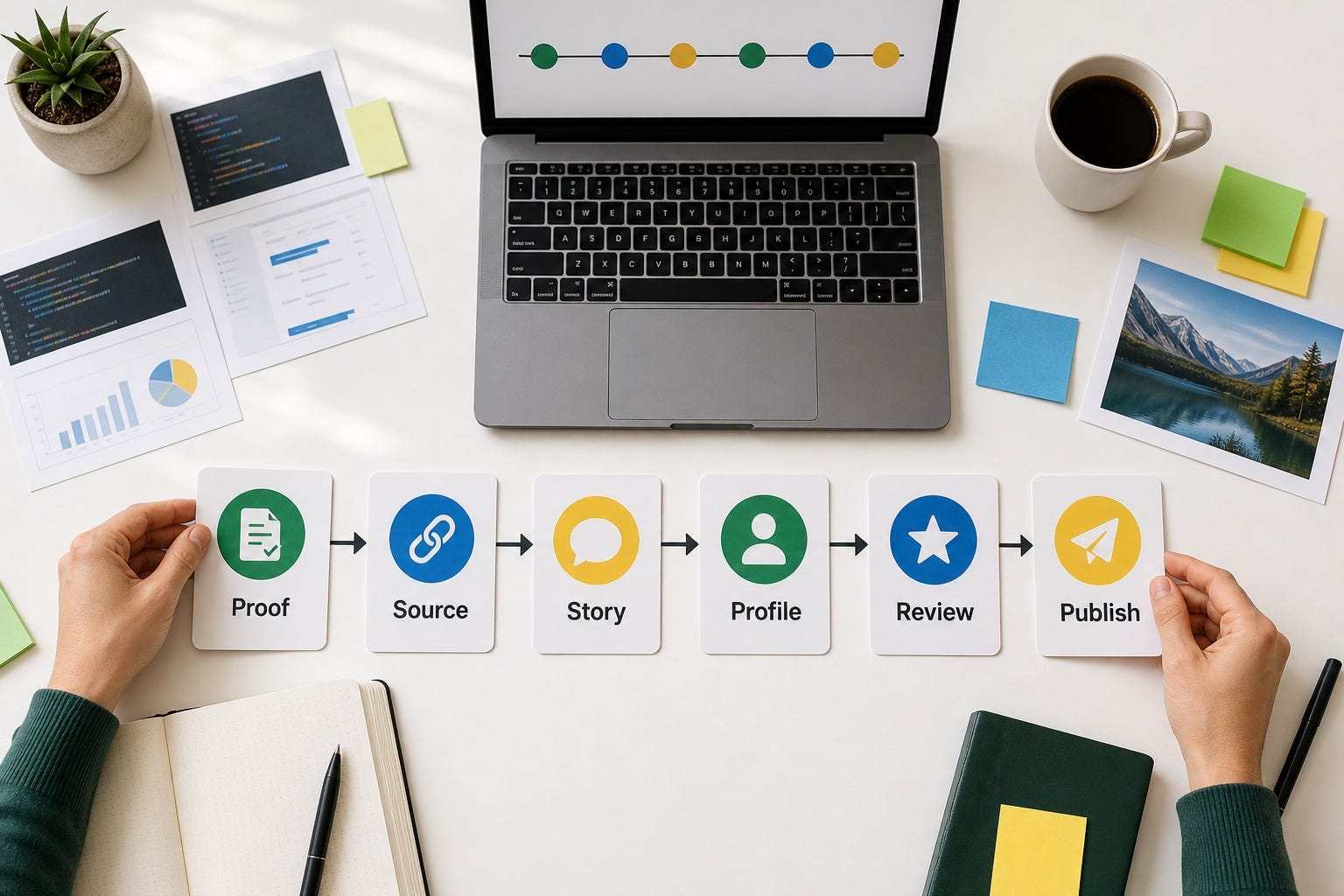
You do not need to build every asset at once. Start with five layers. Each layer makes the next one more believable.
1. Identity Signals
Identity signals prove that you are a real person with a coherent professional presence. They include a clear name, consistent photo or visual identity, aligned bios, verified profiles where appropriate, and a simple way to understand what you do.
AI can help here by comparing your public profiles and finding contradictions. Ask it to review your LinkedIn bio, website bio, Substack profile, speaker bio, and short email intro. Then ask: “What would a stranger think I do? Where does the story become confusing? Which claims sound unsupported?”
Do not let AI rewrite everything into a bland universal bio. Use it as a mirror. The goal is recognizable consistency.
2. Expertise Signals
Expertise signals show what you understand. These include essays, posts, talks, guides, teardowns, code, analyses, workshops, and frameworks.
The mistake is publishing generic advice and hoping people infer expertise. “Be authentic on LinkedIn” is not an expertise signal. “Here is how I decide whether a founder should post a customer story, a product lesson, or a market point of view” shows judgment.
Use AI to turn messy experience into sharper expertise signals. Feed it raw notes from calls, projects, experiments, or lessons learned. Ask it to extract the decisions, tradeoffs, mistakes, frameworks, and repeatable patterns. Then choose one point you can explain with real context.
3. Proof Signals
Proof signals show that your expertise has touched reality. They include project screenshots, metrics, case studies, before-and-after examples, public work, client quotes, shipped artifacts, event photos, demos, testimonials, and work samples.
This layer is where brands are weakest. People make claims because proof feels awkward, confidential, or scattered. AI can help package proof without exposing sensitive details.
Try this prompt: “Turn these project notes into three proof-safe examples. Remove confidential details. Keep the problem, constraint, action, result, and lesson.”
Then review it carefully. AI may overstate the result or smooth over uncertainty. Your job is to keep the proof honest.
4. Social Proof Signals
Social proof signals show that other people have experienced your work. These include recommendations, testimonials, podcast appearances, newsletter mentions, customer quotes, collaborator notes, community replies, and referrals.
Weak social proof says, “Great to work with.” Strong social proof names the behavior: “She made a confusing executive story easier to explain to investors,” or “He helped our team cut through vague positioning and choose a sharper market narrative.”
Use AI to draft better testimonial requests, not fake testimonials. Give it the project context and ask for three short questions you can send to a client or collaborator. Good questions make specific feedback easier:
What was unclear before we worked together?
What changed because of the work?
What would you tell someone considering working with me?
Specific feedback becomes reusable proof across your profile, website, bios, proposals, and content.
5. Consistency Signals
Consistency signals show that your reputation is not a one-post performance. They come from repeated public behavior: the topics you return to, the language you use, the questions you answer, the people you help, and the standards you keep.
This does not mean posting every day. It means creating a pattern people can remember. A founder might become known for clear lessons about enterprise sales. A designer might become known for thoughtful teardown threads. A student might become known for learning in public through small technical projects. A consultant might become known for practical frameworks around a narrow business problem.
AI is useful for spotting the pattern. Once a month, paste your recent posts, notes, and profile copy into a private workspace. Ask: “What am I becoming known for? Which ideas repeat in a good way? Which posts feel off-brand? What proof is missing?”
Then make one correction. Personal branding compounds through small corrections, not dramatic reinventions.
How to Run a Personal Brand Trust Audit With AI
A trust audit is a simple exercise: you look at your public presence through the eyes of someone who does not know you yet.
Start by collecting your main surfaces. Include your LinkedIn profile, website, Substack or blog, portfolio, GitHub, speaker page, X profile, short bio, and two or three recent posts. If you do not have all of these, use what you have. The point is not to create more accounts. The point is to understand the reputation picture that already exists.
Then ask AI to review the material against these questions:
What does this person appear to be known for?
What claims are repeated but not proven?
What proof points are strongest?
What would make this person easier to trust?
Where does the voice sound generic or AI-assisted?
What should be clarified for a recruiter, buyer, collaborator, or investor?
Do not accept the output as truth. AI is good at pattern recognition, but it does not know your full context. Treat the response like a first-pass editor. Keep the parts that sting because they are accurate. Ignore the parts that misunderstand you. Then create a short repair list.
Your repair list should be concrete. Not “improve LinkedIn.” Instead: “Add one featured case study,” “rewrite headline around audience and outcome,” “turn three client wins into anonymized proof examples,” or “publish one post explaining my strongest point of view.”
The Trust Signal Prompt Library
Here are practical prompts you can use without turning your voice over to the machine.
Prompt 1: Find Unsupported Claims
“Review this profile and recent content. List every claim that needs proof. For each claim, suggest one trust signal that would make it more believable: example, metric, testimonial, project artifact, screenshot, story, or third-party mention.”
Prompt 2: Turn Experience Into Evidence
“Here are rough notes from my work. Extract ten possible proof points. For each one, identify the audience who would care, the claim it supports, and the safest public format for sharing it.”
Prompt 3: Reduce AI Sameness
“Review this draft for generic AI language. Replace broad claims with sharper, experience-based sentences. Keep my point of view. Do not add facts, results, or stories I did not provide.”
Prompt 4: Create a Cross-Profile Consistency Check
“Compare these bios and profile sections. Where do they disagree about my audience, expertise, tone, or offer? Suggest a clearer shared positioning line and list what should stay different by platform.”
Prompt 5: Build a Proof-First Content Idea List
“Generate content ideas only from the proof points below. Each idea must include the real evidence it uses, the reader problem it solves, and the trust signal it strengthens.”
The rule behind all five prompts is simple: AI may help shape the material, but the raw material must come from your work.
What Not to Automate
Some parts of trust should stay human. Do not automate testimonials. Do not invent metrics. Do not use AI to impersonate your lived experience. Do not publish a dramatic founder story that did not happen. Do not turn every comment into a polished networking script. People can feel when there is no friction, risk, memory, or judgment behind the words.
You can automate collection, organization, editing, formatting, and reminders. You can use AI to find gaps, draft options, simplify explanations, and repurpose one real insight into multiple formats. But approval should stay with you, especially when a post makes a claim about results, clients, values, or expertise.
A useful standard is the “source test.” Before publishing, ask: “What is the source of this claim?” If the answer is a real project, a direct observation, a documented result, a client quote, a personal lesson, or a credible external source, you have something to work with. If the answer is “AI suggested it,” cut it or rewrite it from evidence.

A Simple Seven-Day Trust Signal Sprint
If your personal brand feels vague, do not start by making a 90-day content calendar. Start with one week of proof cleanup.
Day 1: Collect your public surfaces in one document: links, bios, screenshots, and recent content.
Day 2: Run the unsupported-claims prompt. Circle the five claims that matter most.
Day 3: Match each claim with one proof point. Use project notes, examples, testimonials, artifacts, or lessons.
Day 4: Rewrite your main bio so it connects audience, problem, proof, and point of view.
Day 5: Publish one proof-first post. Explain the situation, the decision, and the lesson.
Day 6: Ask one credible person for specific feedback. Make the request easy to answer.
Day 7: Review the full picture. What is clearer? What still feels unsupported?
This sprint shifts attention from performance to evidence. You are making your real value easier to see.
The Real Goal: Become Easier to Trust
Personal branding advice often pushes people toward more visibility: more posts, comments, hooks, and distribution. Those things can help, but they are not the core problem for many professionals.
The deeper problem is that their public identity is hard to verify. Their profile says one thing, their content says another, their proof is hidden, their best work is scattered, and their AI-assisted writing sounds like it could belong to anyone.
Trust signals fix that. They make your reputation legible. They help humans keep reading, AI systems connect your name with the right expertise, and buyers, recruiters, investors, and peers see more than a polished claim.
Use AI for pattern finding, drafting, sorting, summarizing, comparing, and turning material into options. Keep the judgment, proof, and final responsibility human.
The people who win in an automated content environment will not be the ones who sound the most optimized. They will be the ones whose public presence makes a simple promise and backs it up: here is what I know, here is where I learned it, and here is why you can believe me.
FAQ
What are personal brand trust signals?
Personal brand trust signals are public proof points that make your reputation believable. Examples include clear bios, consistent profiles, project examples, testimonials, published work, recommendations, case studies, public artifacts, and specific content based on real experience.
How can AI help with personal brand trust signals?
AI can audit profiles, find unsupported claims, organize proof points, compare bios, and rewrite generic language. It should support your evidence, not invent it.
What is the difference between personal branding and trust signals?
Personal branding is the broader practice of shaping how people understand your expertise and reputation. Trust signals are the evidence inside that brand. Without trust signals, personal branding can feel like self-promotion. With them, it feels more credible and useful.
Can AI-generated content hurt a personal brand?
Yes, especially when it sounds generic, makes unsupported claims, or replaces real judgment with polished filler. AI-assisted content is safer when it starts from your work, your examples, your point of view, and your proof.
Which trust signal should I build first?
Start with the claim most important to your next opportunity. If you want clients, build a proof-safe case example. If you want a new role, publish a project writeup. If you want speaking opportunities, create a concise bio with proof.
How often should I update my personal brand trust signals?
Review them monthly if you are actively building visibility, and quarterly if your work changes slowly. Update proof when you complete a meaningful project, receive useful feedback, publish a strong piece, or change your positioning.