


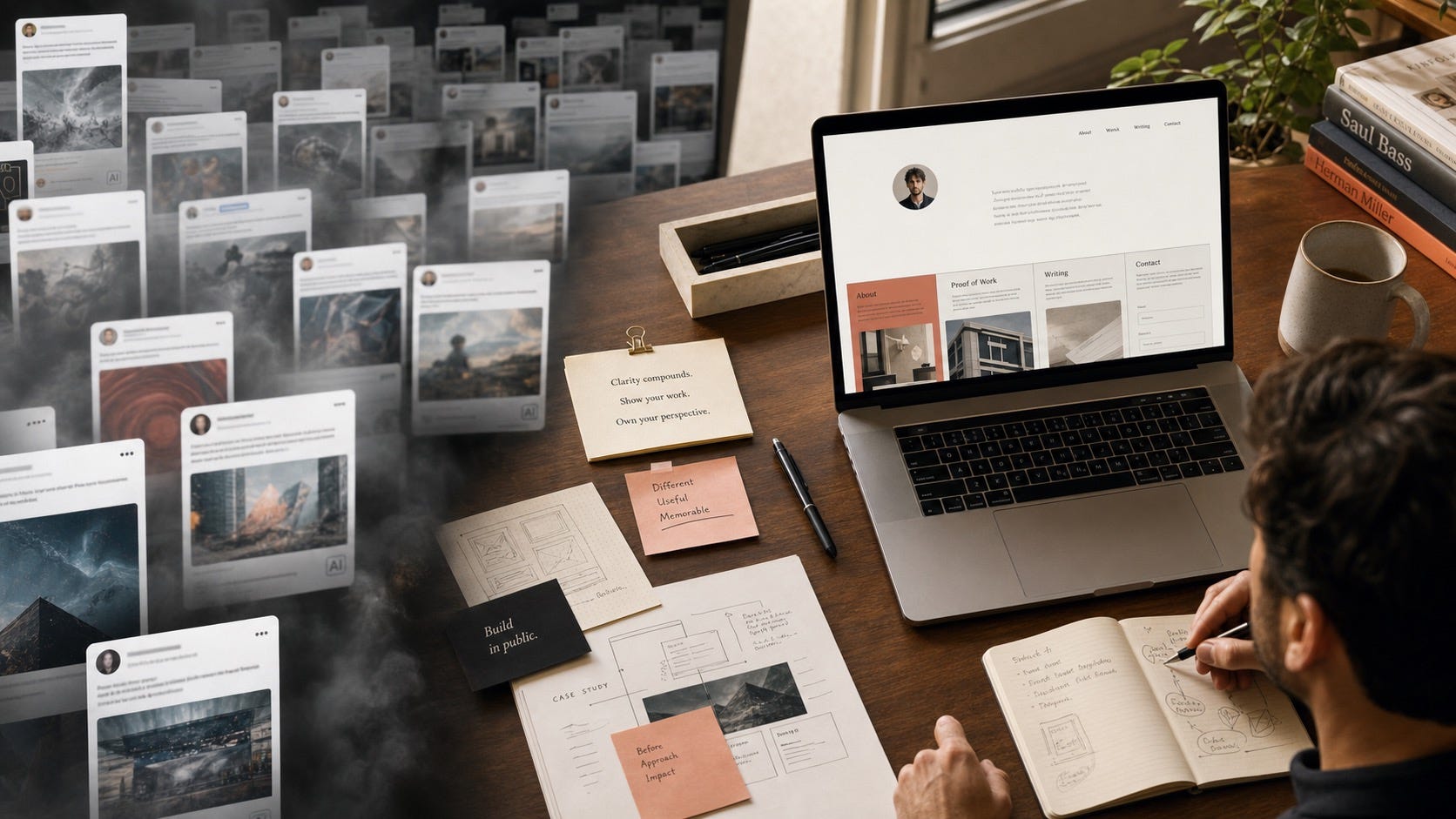
If AI makes everyone easier to publish, the advantage shifts to people who are easier to verify. A personal brand website gives your work context, your reputation structure, and your audience a cleaner place to decide whether they trust you.
For founders, consultants, creators, executives, freelancers, and job seekersSearch intent: strategy + implementation
Most professionals still treat personal branding like a posting problem. They ask what to publish on LinkedIn, how often to post, whether to start a newsletter, or how to use AI without sounding like a bot. Those are useful questions, but they are not the first question anymore.
The first question is this: when someone searches your name after seeing your post, hearing you on a podcast, getting your referral, or receiving your resume, where do they land?
That second-step moment matters more than most people think. In a feed, you can borrow attention. In a search result, you have to earn trust.
That is why the personal brand website is becoming important again. Not because everyone suddenly needs a complicated online portfolio. Not because social platforms stopped mattering. And not because owning a domain is trendy. It matters because AI has made digital sameness cheap, while context, proof, and point of view have become more valuable.
The new personal branding advantage is not louder visibility. It is cleaner evidence. A personal brand website helps you collect that evidence in one place.
Why This Question Matters Right Now
Three shifts are happening at the same time.
First, professional feeds are getting noisier. LinkedIn is still useful, but the quality bar has changed. In May 2026, LinkedIn said it was suppressing generic AI-generated posts and comments from recommendations. That matters because it signals a platform-level shift: polished but empty content is becoming less useful for reach and worse for trust.
Second, search behavior is fragmenting. People still use Google, but they also ask ChatGPT, Gemini, Claude, and other systems to summarize who someone is, what a company does, or whether an expert seems credible. In March 2026, Axios reported that owned media is rising in importance as AI systems increasingly rely on structured, self-published material. If your website helps explain your expertise clearly, you are giving both humans and machines a better version of you to work with.
Third, professionals are tiring of rented identity. Feeds are great for discovery, but weak for depth. A post can spark attention, yet it rarely explains how you think, what you have built, what you believe, or why your work should be trusted. Your personal brand website can do that quietly, permanently, and without waiting for an algorithm.
What a Personal Brand Website Does That LinkedIn Cannot
LinkedIn is useful because it provides a social graph, easy distribution, job-title signaling, and a familiar professional format. Keep it. But do not confuse a strong profile with a strong digital home.
A personal brand website does four jobs that a profile usually cannot do well.
1. It gives your work an order
Profiles are reverse-chronological. Websites are intentional. You decide what visitors see first, what examples support your positioning, and what proof should sit next to your bio instead of three screens later.
2. It gives your expertise context
Job titles are weak shortcuts. A website lets you explain your actual focus. If you are a founder, you can show the ideas shaping your company. If you are a consultant, you can show your framework, your case studies, and the kinds of problems you solve. If you are job searching, you can connect your experience to live work samples instead of hoping a headline does all the work.
3. It turns attention into proof
Someone may discover you on a post. They trust you after seeing evidence. A site can hold case studies, before-and-after work, writing archives, speaking clips, press mentions, research notes, testimonials, and links to substantial projects. That is what makes a personal brand feel real instead of performative.
4. It gives you an owned reputation layer
Your personal brand website is one of the few places where you control the narrative, the design, the navigation, the contact path, and the archive. That matters when platforms change rules, feeds shift tone, or AI systems compress people into summaries.
What Should a Personal Brand Website Actually Include?
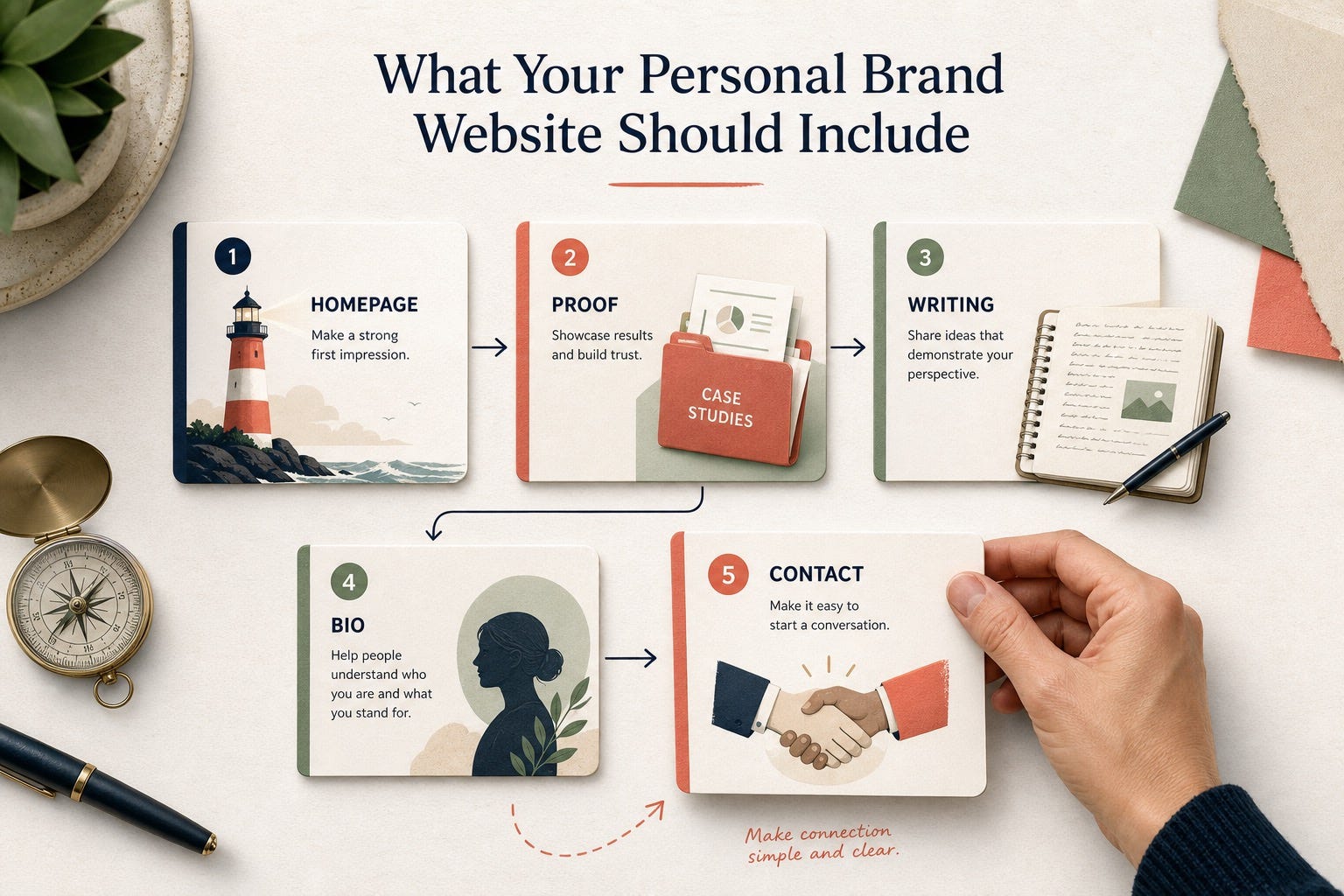
This is where many people overbuild. They imagine a huge personal brand site with twenty sections, weekly blogging, polished animations, and a giant archive before they even know what matters. That is usually a mistake. Better to build a smaller site with sharper trust signals.
For most professionals, five parts are enough.
A clear homepage
Your homepage should answer three questions fast: who are you, what do you help with, and why should someone care? Avoid vague language like builder, storyteller, growth hacker, creative thinker, or AI native operator unless you immediately explain what that means in practice.
A proof section
This is the core of the site. Show selected evidence, not everything you have ever done. Use case studies, project writeups, writing samples, product launches, talks, interviews, client outcomes, or public artifacts that show your judgment. The goal is not volume. The goal is belief.
A writing or insights section
This can be a blog, an essays page, a note archive, or a curated list of your best posts and articles. It exists to show how you think, not just that you are active online.
An about page that sounds like a person
Most bios are too broad, too polished, or too interchangeable. A strong about page explains what shaped your point of view, what kinds of problems you are known for, and what environments you work best in.
A contact path with a real next step
Do not make visitors guess. If you want consulting inquiries, say so. If you are open to speaking, say so. If you want hiring conversations, referrals, or collaborations, separate those paths clearly.
How to Use AI to Build the Site Without Making It Generic
AI is useful here, but only if you use it as a structuring partner, not a substitute for judgment. The mistake is asking a model to “write my personal brand website” and pasting whatever comes back. That usually produces inflated language, empty confidence, and a bio that could belong to anyone.
Use AI for extraction, organization, and iteration instead.
Dump raw materials first. Feed AI your LinkedIn profile, resume, best posts, essays, project notes, testimonials, client feedback, podcast summaries, and a rough list of work you are proud of.
Ask for patterns, not polished copy. Prompt for recurring themes, repeated strengths, real proof points, and areas where your positioning sounds generic.
Build a claim-and-proof map. For every claim you want to make, ask AI to match it with visible evidence. If you say you help teams simplify complex launches, what project, article, or outcome proves that?
Generate options, then rewrite in your own voice. AI can give you page structures, headline options, and section drafts. Your job is to remove fluff, add specifics, and keep the parts that sound like you when you are being clear, not impressive.
Turn long material into modular assets. A long article can become a homepage line, a case-study summary, three FAQ answers, and a short bio. AI is strong at controlled repackaging when the source material is already good.
A useful test is simple: if someone copied your homepage and swapped your name, would the site still mostly work for them? If yes, the copy is too generic.
Make the Site Useful for Both Humans and AI Systems
AI-ready personal branding does not mean stuffing pages with robotic keywords. It means making your expertise legible.
That starts with clean structure. Use page titles that say what the page is. Use headlines that explain real topics. Add FAQs when a page solves a practical decision. Put your name, role, focus, and proof in plain language. Name your case studies clearly. Add dates where helpful. Use a real author voice. Keep updating the pages that matter.
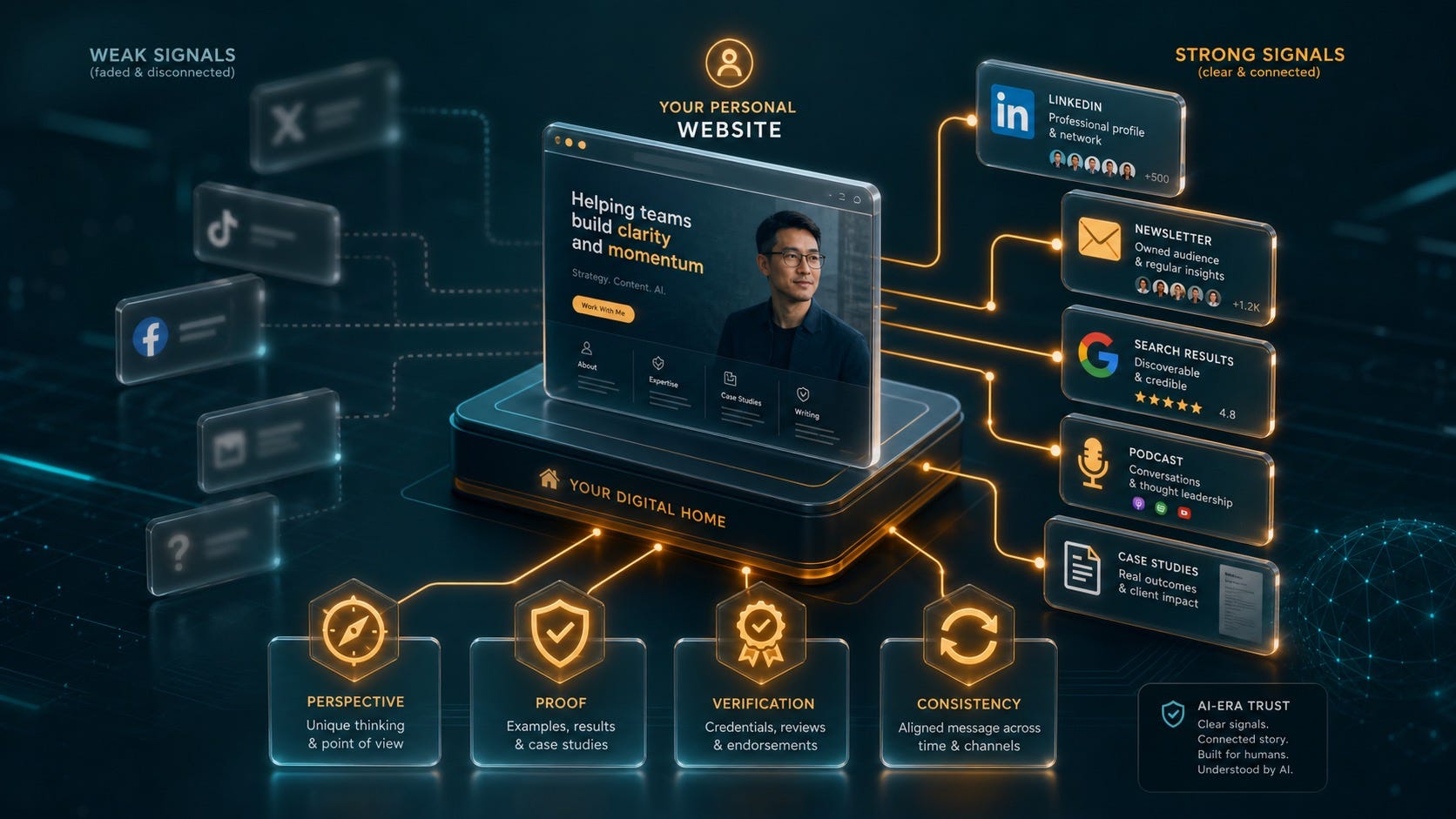
Think of your website as a source of truth. LinkedIn can show your current title. Your Substack can show your evolving ideas. Your X account can show what you react to in public. But your personal brand website should be the place that ties those signals together.
That also makes your site more useful when someone Googles you, asks an AI assistant about you, or lands on your page after hearing your name once. They should not have to piece together who you are from scattered fragments.
A Simple 30-Day Build Plan
If this still feels heavy, reduce the scope. You do not need a perfect site. You need a believable one.
Week 1: Audit what already exists
Google your name. Check what appears in search results. Read your LinkedIn profile like a stranger would. Open your last ten posts, articles, or project notes. Pull out your best proof, not your broadest claims.
Week 2: Define the narrative
Write one sentence for who you help, one sentence for what you are known for, and one sentence for what proof backs it up. Then draft the homepage structure around those three lines.
Week 3: Build the core pages
Create the homepage, about page, proof section, and contact page. Add one writing or insights page if you already have useful material. Do not wait for a full archive.
Week 4: Sharpen and connect
Link your website from LinkedIn, your Substack bio, your email signature, and relevant social profiles. Add one FAQ section. Rewrite the weakest copy by removing adjectives and replacing them with examples.
That final step matters more than people think. Many personal brand websites fail because they sound aspirational instead of evidenced. Less “I am passionate about empowering innovation.” More “I help SaaS founders turn complex product changes into simpler stories customers actually understand.”
Mistakes That Make a Personal Brand Website Less Trustworthy
Writing like a pitch deck. If every sentence sounds optimized for applause, visitors will look for what is being hidden.
Listing claims without receipts. Strategy, leadership, creativity, and innovation are not proof. They are categories. Show the work.
Publishing too much generic AI copy. One sharp case study beats ten soft essays.
Hiding the next step. If someone wants to hire, invite, refer, or contact you, the path should be obvious.
Trying to impress instead of clarify. A personal brand website is not a performance stage. It is a decision aid.
The Better Way to Think About It
Do not build a personal brand website because someone on the internet told you to own your audience. Build it because modern trust is assembled from fragments, and you need one place to assemble them well.
Your LinkedIn profile can still matter. Your newsletter can still matter. Your public comments, talks, podcast appearances, and social posts can still matter. But the website is what helps all of those surfaces add up to a coherent identity instead of a scattered digital trail.
In the AI slop era, that coherence is a competitive advantage. People are not only asking who publishes the most. They are asking who sounds real, who explains clearly, and who can back up what they say.
A personal brand website is one of the simplest ways to answer those questions before anyone ever talks to you.
FAQ
Do I need a personal brand website if my LinkedIn profile is already strong?
Usually yes, if you want a better second-step destination. LinkedIn is strong for discovery and network signaling, but weaker for depth, structure, and proof. A website gives you more control over context and credibility.
What if I am not a creator and do not want to post constantly?
That is exactly why a website can help. You do not need a daily content habit. You need a small number of durable assets that explain what you do well and make your work easier to trust.
What should job seekers put on a personal brand website?
Job seekers should focus on a clear homepage, a concise bio, selected proof of work, project writeups, relevant writing or presentations, and a simple contact path. The goal is not to look like an influencer. The goal is to reduce doubt.
Can AI write my whole personal website for me?
It can draft it, but it should not own the final voice. Use AI to organize your materials, surface patterns, and generate page options. Then rewrite with specifics, evidence, and language that sounds like your real thinking.
How often do I need to update a personal brand website?
Less often than social media, but more often than a resume. A good baseline is a quick monthly check and a deeper refresh whenever your focus, proof, offers, or public work changes meaningfully.
A strong personal brand website does not replace your social presence. It gives it somewhere durable to land.