


You do not need a big title, viral posts, or a perfect portfolio to start building a credible personal brand. You need a better way to show the work you are already doing.

The strongest student personal brands are built from real evidence, not exaggerated claims.
Most students get bad personal branding advice. They are told to post more, optimize their LinkedIn headline, pick a niche, and sound confident before they have enough experience to feel confident.
That advice skips the real problem. A student does not usually lack ambition. A student lacks visible proof.
If someone searches your name, clicks your profile, or asks what you are interested in, they should not have to guess. They should find small but concrete signs of how you think, what you are learning, what you have tried, and where you are becoming useful.
That is where AI can help. Not by pretending you are more experienced than you are. Not by writing loud posts about leadership lessons you have not lived. AI is useful because it can help you collect messy evidence, find patterns in your projects, write clearer explanations, and turn ordinary student work into career proof.
This is the practical version of student personal branding: build a public evidence system before you need it.
Why Student Personal Branding Feels So Awkward
Personal branding can feel fake when you think it means acting like an expert. Most students are still exploring, testing interests, joining clubs, building small projects, and figuring out what kind of work they actually enjoy.
That is not weakness. It is the material.
The problem is that most early-career profiles hide the material. A recruiter sees a list of coursework. A founder sees “aspiring product manager.” A professor sees a student who did fine in class. A potential collaborator sees a blank LinkedIn profile and moves on.
A better student personal brand answers three questions quickly:
What are you curious enough to keep learning?
What have you already tried, built, researched, or improved?
How do you explain your thinking when the work is not perfect yet?
Notice what is missing from that list: pretending, bragging, daily posting, and fake authority.
Your personal brand is not the polished version of your future self. It is the evidence trail of your current direction.
The AI Shift: Small Work Can Now Become Clear Proof Faster
Before AI tools became common, many students had useful work trapped in forgotten folders: class presentations, design drafts, research notes, code experiments, volunteer plans, internship reflections, club documents, survey findings, and half-finished ideas.
Those fragments rarely made it into a public profile because packaging them took too much time. Writing a case study felt serious. Building a website felt like a project by itself. Posting on LinkedIn felt exposed.
AI reduces the packaging cost. You can give it raw notes and ask for a clearer summary, a list of demonstrated skills, a portfolio-card draft, and a challenge pass that flags missing proof.
That does not mean AI should invent the story. It should help you show the real story more clearly, because early opportunities often go to people who are easier to understand.
Start With a Proof Inventory, Not a Personal Brand Statement
Many guides begin with “define your personal brand.” That can freeze a student immediately. If you are still exploring, a grand statement can feel dishonest.
Start with inventory instead.
Open a document and list every small thing you have done that might show useful ability. Include class assignments, group projects, hackathon attempts, volunteer work, event planning, tutoring, research summaries, part-time work, open-source contributions, design experiments, personal essays, data analysis, no-code builds, campus leadership, and independent learning.
Then use this prompt:
Prompt: “Act as a practical career mentor. Review this list of student projects and experiences. Group them into 3-5 themes based on skills, interests, and proof of follow-through. For each theme, identify what kind of opportunity it could support and what evidence is still missing.”
Treat the output as pattern detection. You are looking for the strongest thread that already exists in your work. For example, three activities might all point to community operations: organizing a campus event, writing a volunteer onboarding guide, and building a simple attendance tracker.
That pattern becomes the start of your brand. Not a slogan. A direction with evidence.
Build the Student Proof Stack
A student personal brand becomes stronger when it has layers. You do not need every layer at once. Start with the minimum stack that makes you easier to trust.
1. A clear profile headline
Your headline should say what you are learning, building, or trying to become useful at. Avoid inflated titles. “Aspiring AI product manager” is weaker than “Student exploring AI product workflows through small research and prototype projects.”
Use AI to generate options, but force specificity:
Prompt: “Write 10 LinkedIn headline options for a student. Avoid hype, vague leadership language, and fake expertise. Use only this evidence: [paste projects]. Make each option specific, humble, and opportunity-friendly.”
2. Three proof cards
A proof card is a short, public explanation of one project. It can live on a simple portfolio page, Notion page, GitHub README, LinkedIn Featured item, Substack post, or personal site.
Each proof card should include:
The problem or question you worked on
What you made, tested, researched, organized, or improved
Your specific role
One artifact, screenshot, file, demo, chart, or lesson
What you would improve next
The final bullet is important. Students often think unfinished work looks weak. In reality, a thoughtful “what I would improve next” shows judgment. It proves you can reflect, not just decorate.

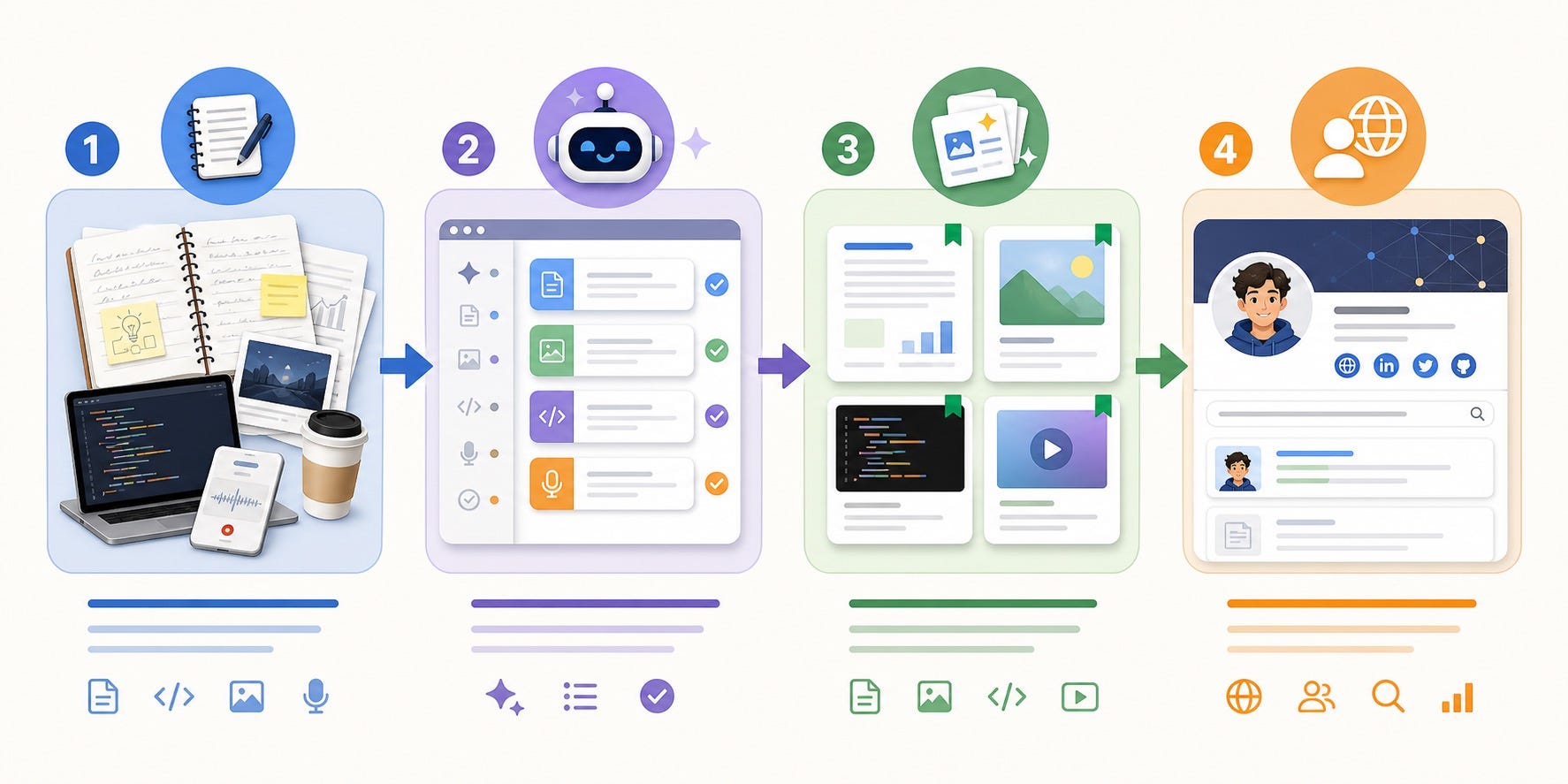
A simple proof workflow: gather raw work, let AI organize it, publish the clearest evidence, then connect it to your profile.
3. A searchable bio
Your bio should help humans and search systems understand your direction. It does not need to be dramatic. It needs to be clear.
A useful student bio might follow this structure:
I am studying or learning [field].
I am especially interested in [specific problem, audience, or tool area].
Recent proof: [project, research, build, volunteer work, or published note].
I am looking for [internships, collaborators, mentors, research roles, freelance projects, or early-career opportunities].
4. One public learning loop
A public learning loop is a simple habit: once or twice a month, share something you learned from real work. Not a viral thread. Not a motivational essay. A short update with evidence.
Examples:
“I compared three onboarding flows for student finance apps. The biggest difference was how each one explained risk.”
“I rebuilt a class dashboard in a cleaner layout and learned that the hard part was not charts. It was choosing what to remove.”
“I tested AI summaries on five research papers. The tool was helpful for structure, but weak at identifying methodological limits.”
How to Use AI Without Making Your Brand Look Fake
Students have to be extra careful with AI because trust is fragile at the beginning of a career. If your public presence sounds too polished, too broad, or too confident for your actual experience, people notice.
Use AI for structure, not identity. Use it for clarity, not authority. Use it to ask better questions, not to manufacture a personality.
A simple rule helps: AI can help package proof, but it should not become the proof.
Good uses of AI include:
Summarizing messy project notes into a cleaner outline
Identifying skills demonstrated by a project
Rewriting a description for different audiences
Creating a checklist for what evidence to add
Suggesting questions a recruiter or mentor might ask
Risky uses of AI include:
Inventing outcomes, metrics, roles, or skills
Writing confident claims you cannot defend in conversation
Copying generic thought leadership posts
Using AI-generated images or avatars that make your identity unclear
Publishing schoolwork in ways that violate academic rules or team privacy
Ethical AI use is also a brand issue. If your proof looks inflated now, people will be less likely to trust your growth later.
The Small Project Case Study Formula
The fastest way to build career proof is to turn one small project into a case study. It does not need to be a client project. It can be a class assignment, a research comparison, a campus problem, a personal experiment, or a tiny tool.
Use this structure:
Context
What was the situation? Keep it short. “For a data visualization class, I analyzed public transit delay data to understand where students lose the most time commuting.”
Question
What did you try to learn or solve? “I wanted to know whether route delays were random or concentrated around a few repeat bottlenecks.”
Process
What did you do? Mention the tools, steps, and decisions. This is where AI can help you reconstruct your own process from notes.
Result
What came out of it? Use honest outcomes. A failed prototype can still show research quality. A small chart can still show analytical thinking.
Reflection
What would you do next? Reflection turns a student project into a professional signal because it shows maturity.
Here is a useful AI prompt:
Prompt: “Turn these raw notes into a 300-word student project case study. Keep the tone humble and specific. Do not exaggerate impact. Separate context, question, process, result, and reflection. Flag any claim that needs evidence before publishing.”
That last sentence matters. Make AI act as a claim checker before it acts as a copywriter.
What Students Should Publish First
If you are starting from zero, do not build a complex content calendar. Build a small proof shelf.
Publish these five assets in order:
A clean LinkedIn profile with a specific student headline and a short bio.
One proof card for your strongest project.
One short post explaining what you learned from that project.
One pinned or featured link that sends people to the proof card.
One simple “now exploring” note that names the kinds of roles, problems, or collaborations you want.
This is enough to change the way people read your profile. Instead of “student looking for opportunity,” you become “student already showing direction.” Over time, add more proof cards. Three is strong. Five is excellent.
How Different Students Can Use This
Business students can turn market research, case competitions, club operations, and customer interviews into proof cards. Computer science and AI students should explain the problem, tradeoffs, failure cases, and lessons instead of only posting code. Design students can show before, process, and reasoning. Research and liberal arts students can publish short explainers that prove synthesis. Students with part-time jobs or volunteer work can show reliability, communication, and judgment through real operational examples.
Generic AI content makes students sound interchangeable. Real project evidence makes them easier to remember.
The Weekly AI Workflow
Here is a simple 45-minute workflow students can repeat every week or every other week.
First, capture one raw artifact. It can be a screenshot, paragraph, sketch, GitHub commit, event plan, class note, dataset, reading summary, or mistake you learned from.
Second, ask AI to identify the proof inside it:
Prompt: “What does this artifact prove about my skills, interests, work habits, or judgment? Give me 5 possible proof angles. Be strict. Do not make claims that are not supported by the artifact.”
Third, choose one proof angle and write a short note in your own words. Keep it under 150 words for a social post, or 300-500 words for a portfolio card.
Fourth, ask AI to edit for clarity without replacing your voice:
Prompt: “Edit this for clarity and flow. Keep my wording where possible. Remove hype. Keep the tone like a thoughtful student explaining real work to a mentor.”
Fifth, publish or store it. A private proof library still helps with interviews, applications, networking messages, and future posts.
Common Mistakes to Avoid
Do not wait for an internship, award, or impressive title. Do not copy adult influencer behavior. Do not make “I use AI” the center of your brand. Do not publish private classmate, client, professor, or organization details without consent. Most of all, do not try to look finished. Early-career credibility comes from direction, effort, and reflection.
A Simple 30-Day Plan
Week one: create your proof inventory. List 20 artifacts from school, work, volunteering, clubs, hobbies, and independent learning. Use AI to group them into themes.
Week two: choose your strongest theme and write your profile headline, bio, and first proof card. Keep everything specific and humble.
Week three: publish one learning note connected to the proof card. Ask a professor, mentor, classmate, or working professional whether the proof is clear.
Week four: add a second proof card and update your profile links. Then write a short outreach message to someone in your field that references one real project and one honest question.
By the end of 30 days, you will have something more useful than a vague profile: a public identity that gives people a reason to take you seriously.
Final Thought
Personal branding for students should not be about acting older, louder, or more successful than you are. AI can help you make real work easier to see, but the trust still comes from your projects, judgment, reflection, ethics, and willingness to show what you are learning before it is perfect.
FAQ
What is personal branding for students?
Personal branding for students is the process of making your interests, skills, values, projects, and learning direction visible to people who may offer internships, jobs, mentorship, collaborations, or recommendations.
How can students use AI for personal branding?
Students can use AI to organize project notes, find themes in their experience, draft portfolio summaries, improve LinkedIn bios, create content ideas from real work, and check whether public claims are supported by evidence.
Should students post on LinkedIn to build a personal brand?
LinkedIn can help, but posting is not the whole strategy. A student should first build proof assets such as project summaries, portfolio cards, GitHub READMEs, writing samples, or learning notes. Posts work better when they point to real evidence.
What if I do not have internship experience yet?
You can still build a credible student personal brand with class projects, volunteer work, club roles, research notes, independent learning, part-time jobs, experiments, and thoughtful reflections. The key is to show what each experience proves.
How do I avoid sounding fake when using AI?
Use AI for structure and editing, not invention. Do not publish claims, metrics, roles, or results that are not true. Keep your tone humble, include specific artifacts, and make sure you can explain every public claim in a conversation.
What should a student portfolio include?
A strong student portfolio can include three to five proof cards, each with a project question, your role, process, artifact, result, and reflection. It can also include a short bio, contact link, LinkedIn profile, GitHub or writing links, and a note about what you are exploring next.