


A lot of smart professionals lose podcast opportunities for a simple reason: their expertise is real, but it is hard to place fast. A podcast guest one sheet fixes that by turning scattered proof into a host-ready credibility asset.
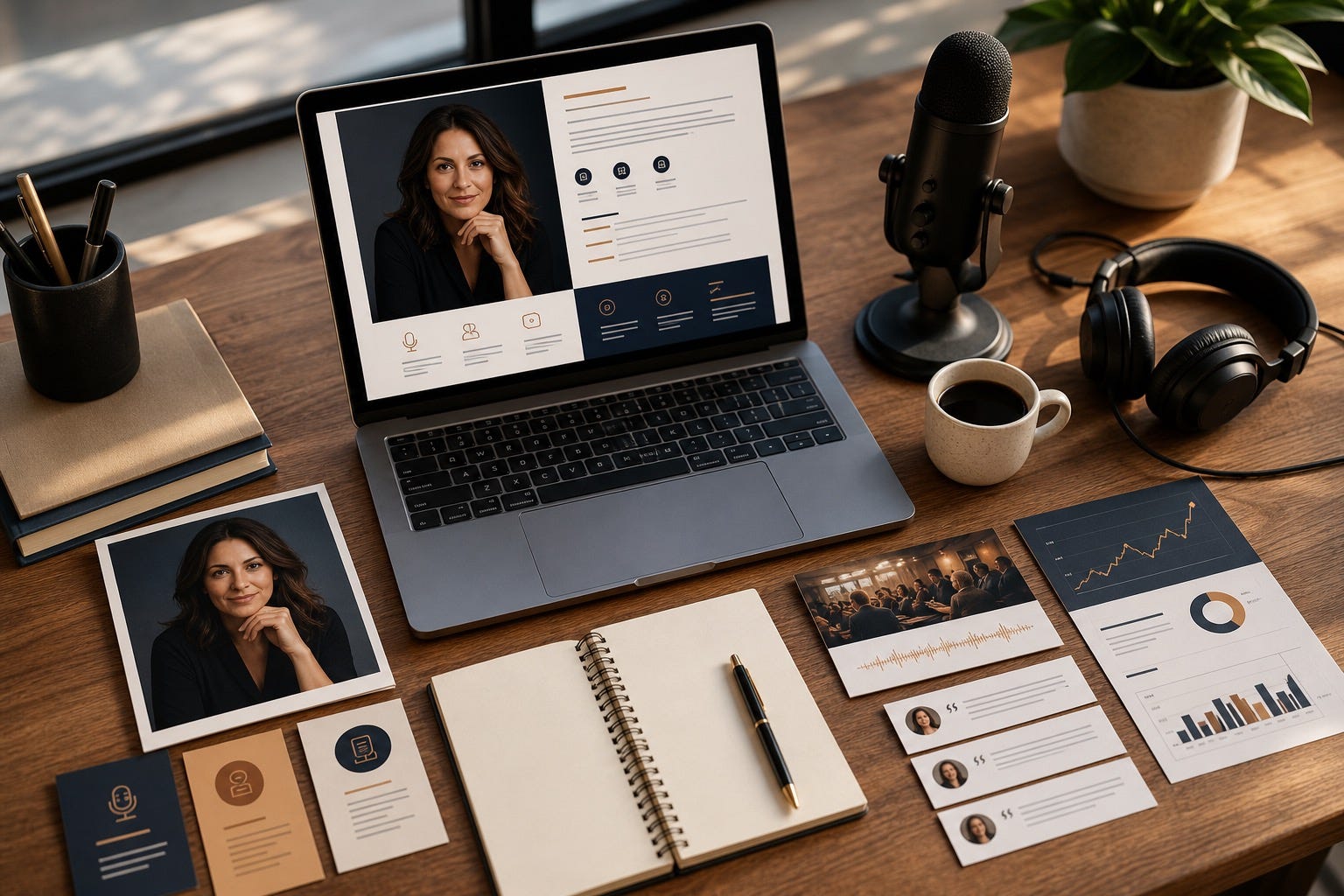
This matters because podcast guesting has become one of the strongest personal branding channels for founders, consultants, creators, executives, freelancers, and technical experts who do not want to live on the content treadmill. One good conversation can create clips, social proof, search visibility, introductions, and a clearer market position. But before any of that happens, a host or producer needs to understand who you are, what you talk about, and why their audience should care.
That is where most people fail. They send a generic bio, a messy LinkedIn profile, three unrelated links, and a vague promise that they can “talk about AI, startups, leadership, growth, and the future of work.” That is not a pitch. It is homework for the host.
A podcast guest one sheet is not a vanity document. It is a trust shortcut. It helps a host see your fit, your proof, and your angle before they spend time figuring it out themselves.
In personal branding terms, this is important because it turns your reputation into a reusable asset. Instead of hoping people infer your value from scattered content, you make your expertise easy to book, quote, recommend, and remember. Used well, AI can speed up that packaging process without turning your identity into another polished generic profile.
This guide will show you how to create a podcast guest one sheet with AI, what to include, how to make it trust-first, and how to use it to strengthen your personal brand without sounding scripted or overproduced.
What a podcast guest one sheet actually does
A podcast guest one sheet is a single-page summary that helps a host quickly decide whether you belong on the show. Think of it as a booking asset, not a design exercise. It should answer the host’s next five questions before they ask them.
Who is this person?
Why are they credible on this subject?
What can they talk about that is specific and useful?
Will this conversation be interesting for my audience?
Do I trust them enough to move forward?
That is why this topic belongs inside the modern personal branding conversation. Your personal brand is not just your profile. It is the total ease with which other people can understand and place your value. A guest one sheet increases that ease. It reduces ambiguity. It gives your expertise a clear edge.
It is also different from a broader media kit. A media kit can support many use cases: press, speaking, partnerships, events, clients. A podcast guest one sheet is narrower and more tactical. It is built around one job: helping a host say yes faster.
Why podcast guesting is such a strong personal branding channel
For many professionals, podcast guesting outperforms more performative channels because it rewards substance. You do not need to post every day. You need a clear point of view, real stories, and useful insights. A good podcast appearance compresses all three.
It also gives you trust signals that travel well. A strong guest appearance can feed your website, LinkedIn profile, speaker page, newsletter, pitch deck, and follow-up outreach. Hosts become references. Clips become proof. Show notes become search assets. Even one appearance can clarify your public positioning more effectively than a month of generic short-form posting.
The catch is that hosts are filtering dozens of pitches, introductions, and suggestions. If your expertise is too broad, your bio is too abstract, or your proof is too scattered, you are easy to skip. That is why the one sheet matters. It turns a fuzzy “interesting person” into a clear booking choice.
What to include in a trust-first podcast guest one sheet
The best one sheets are compact. They do not try to tell your whole life story. They simply make you easy to place.
1. A sharp positioning line
Open with one sentence that says who you help, what kind of problems you solve, and the lens you bring. Avoid broad labels like “thought leader” or “growth expert.” A host needs a usable angle, not self-branding fog.
2. A short bio
Keep this tighter than your website bio. Focus on the part of your story that makes you relevant to the kinds of shows you want. The goal is not completeness. The goal is fit.
3. Three to five strong conversation topics
Make these concrete. “AI strategy” is weak. “How mid-market teams stop treating AI as a side project” is stronger. Good topics lower prep work for the host and signal that you will not wander.
4. Proof and credibility markers
Include results, case-study snapshots, recognizable outcomes, audience context, relevant roles, or public work that proves you should be behind the mic. Evidence beats adjectives every time.
5. Social proof
Add one or two testimonials, prior appearances, audience wins, or notable collaborations. Keep it believable. If a metric needs too much explanation, it is probably not the right proof for this page.
6. Assets a host can reuse
Give them a good headshot, one approved short bio, links to your site or profiles, and any prior episode examples if you have them. Your one sheet should make it easy to brief the producer, write show notes, and publish a guest page.
How to use AI to build the one sheet without sounding synthetic
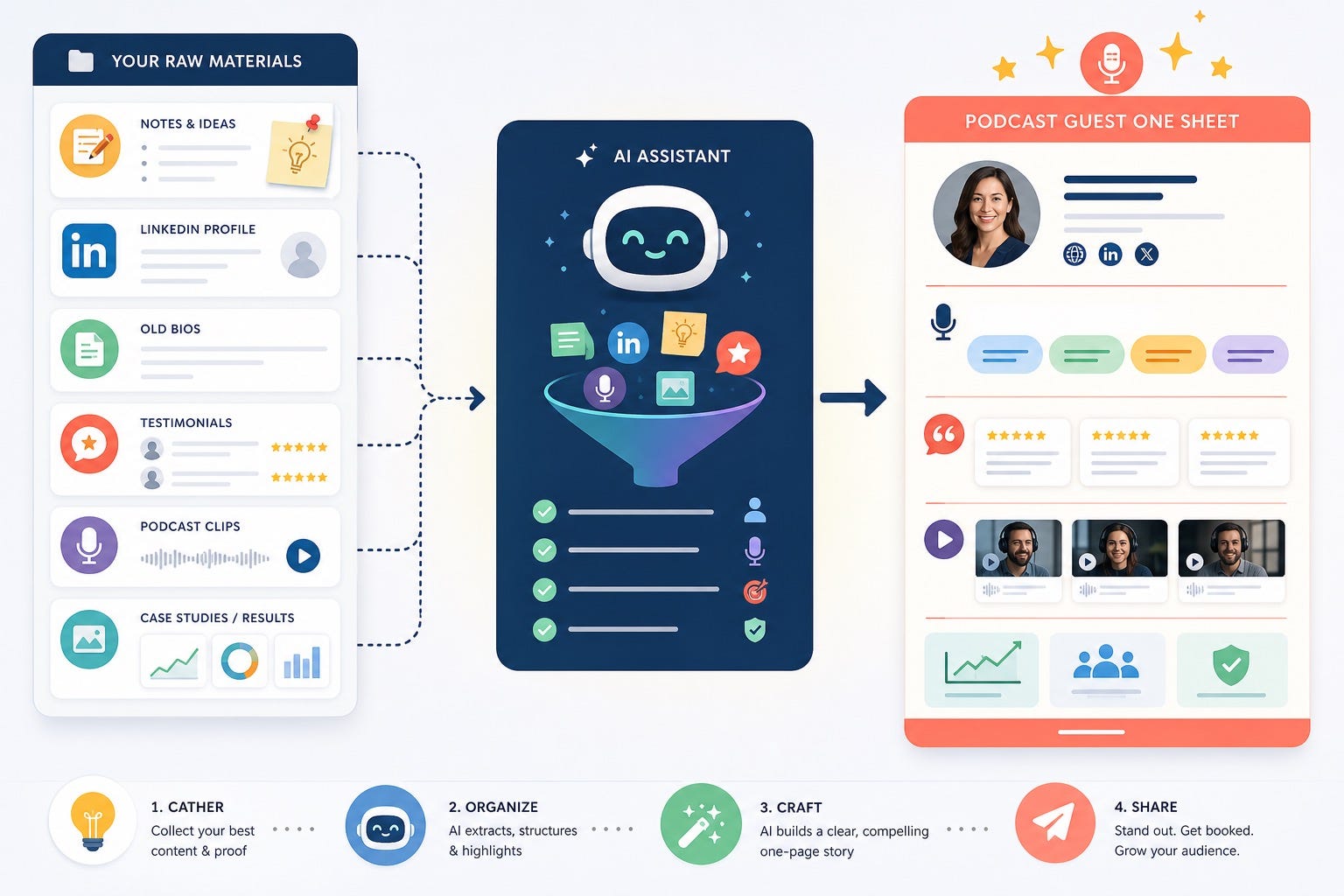
The right AI workflow does not invent expertise. It helps you compress what is already true. That is the core discipline. If you let the model make you sound “more impressive,” you will usually end up less trustworthy.
Step 1: Gather raw inputs
Collect your current bio, LinkedIn profile, website copy, testimonials, speaking topics, good email intros, podcast clips, customer results, screenshots, and any proof that shows audience fit. If you already have a media kit or speaker page, use that as raw material too.
Step 2: Ask AI to find the strongest recurring themes
Instead of asking AI to write your pitch immediately, ask it to cluster your expertise. You want the model to identify what you are consistently known for, which audience problems you solve, and what proof is strongest.
Prompt:
Review the material below and identify:
1. My clearest areas of expertise
2. The most credible proof points I should use for podcast guesting
3. The audiences or show types I seem best suited for
4. The strongest recurring story lines or frameworks in my work
5. Anything that sounds too generic or too broad for a host to trust quickly
Do not write the one sheet yet. First tell me what is already true and usable.
Step 3: Generate topic options that are easy for a host to book
Now ask AI to turn your expertise into interview angles. This matters because many capable guests undersell themselves by listing bland subject areas instead of specific episodes a host can imagine.
Prompt:
Using only the evidence provided, draft:
- 5 podcast topic ideas
- 5 possible episode titles
- 3 host-intro versions
- 5 credibility bullets
Constraints:
- keep topics specific and audience-relevant
- avoid startup clichés and vague motivation language
- tie claims back to real proof
- make each angle easy to picture as a conversation
Step 4: Edit for specificity
Cut anything that sounds like it could belong to anyone. Replace category words with real nouns. Replace adjectives with outcomes. Replace “passionate about innovation” with the actual problem you solve, the system you built, or the mistake you keep seeing in the market.
Step 5: Build a page a producer can skim in under a minute
If your one sheet is visually clean but mentally dense, it still fails. Keep the structure obvious. Use short sections. Limit your topic list. Highlight the proof that matters most. Make contact and links effortless.
How to keep the one sheet personal-brand strong
A weak guest one sheet reads like a resume in disguise. A strong one sheet reads like a booking decision already half made. The difference usually comes down to positioning and evidence.
Choose one main lane, even if you can discuss several topics. Hosts book clarity faster than range.
Use your best story, not your full background. Relevance wins over completeness.
Show proof that matters to audiences, not just peers. Useful outcomes beat impressive titles.
Keep one clear human edge in the copy. A principle, contrarian insight, or operating belief makes you easier to remember.
Read the whole page out loud. If it sounds overpolished, overclaimed, or oddly smooth, pull it back.
Where to use your podcast guest one sheet
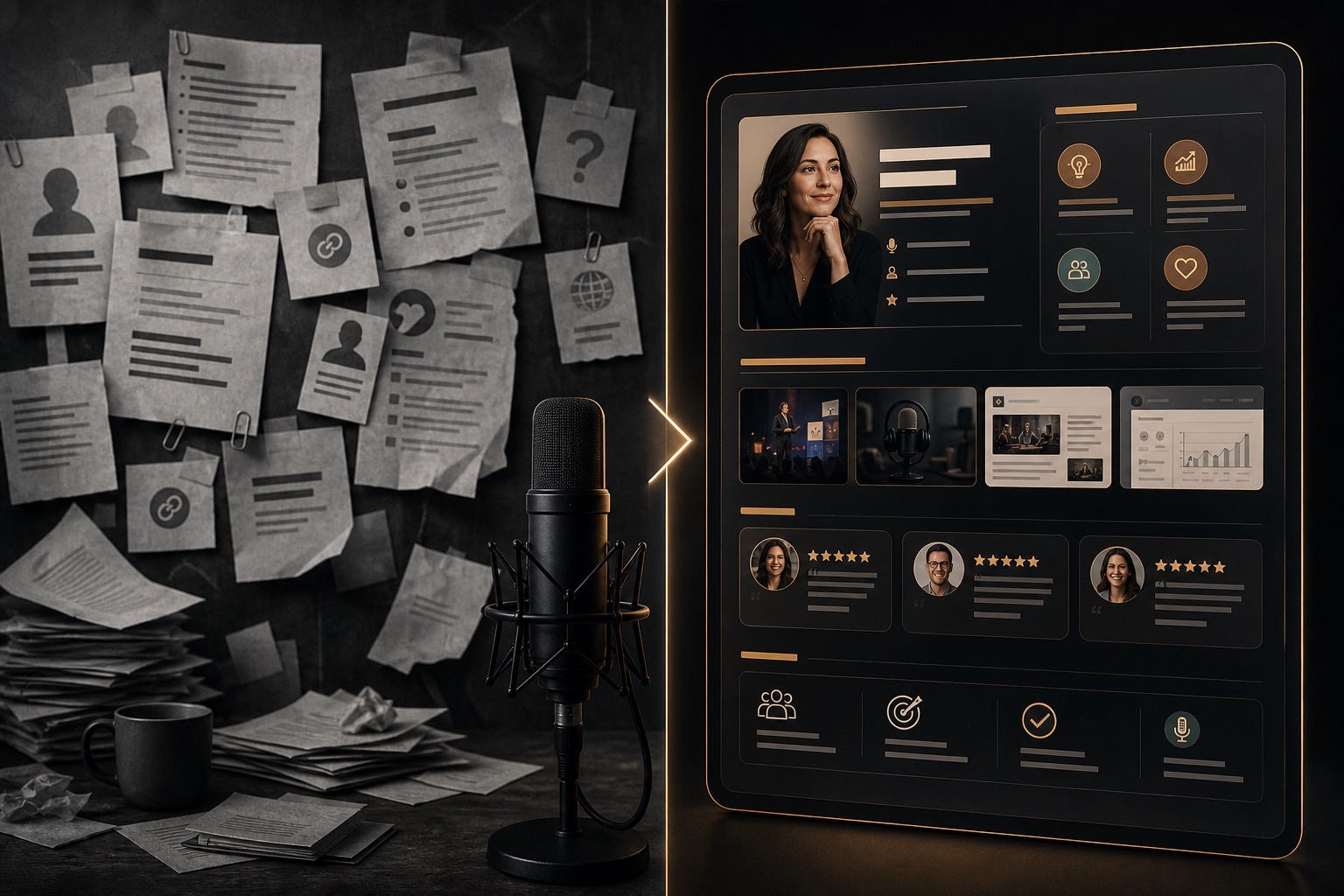
Once you build this asset, do not hide it in a folder. Put it into the places where trust and fit get evaluated quickly.
In your podcast outreach or warm intro follow-up
On your website as a guest or media page
As a resource linked from LinkedIn, your newsletter, or your bio link stack
In speaking outreach where podcast-style interviews or fireside chats are possible
As the source material for short bios, host intros, and show-note language
This is where the personal branding payoff compounds. The one sheet gives you a cleaner origin file for the rest of your public identity. Your bio improves. Your website sharpens. Your topic positioning gets more consistent. Your introductions sound less improvised. One page can quietly clean up a lot of brand drift.
A maintenance system that takes 15 minutes a month
Do not treat the one sheet as static. Good guesting assets evolve with your work. Each month, update four things:
Your strongest recent proof or result
Your best new topic angle or framework
Your freshest testimonial, audience response, or media mention
Your sample clips or relevant links
If you want this process to stay light, keep a simple “guest proof” folder. Drop screenshots, audience replies, smart questions, good intros, event photos, and episode clips into it as they happen. Then use AI to cluster and summarize those materials when it is time to refresh the page. This is how you build a personal brand that stays current without becoming performative.
FAQ
What is a podcast guest one sheet?
It is a one-page booking asset that helps a host quickly understand who you are, what you can talk about, why you are credible, and how to place you on the show.
Is a podcast guest one sheet the same as a media kit?
No. A media kit is broader and can support speaking, press, partnerships, and client inquiries. A podcast guest one sheet is narrower and focused on helping a host decide whether to book you.
Who should create a podcast guest one sheet?
Founders, consultants, executives, creators, authors, freelancers, coaches, and technical experts benefit most. If podcast appearances support your reputation or pipeline, this asset is useful.
Can AI write my guest one sheet for me?
AI can draft it, organize your proof, and generate topic angles, but you still need to choose what is true, specific, and strategically important. AI should accelerate judgment, not replace it.
What should I avoid on a podcast guest one sheet?
Avoid vague expertise claims, too many topics, inflated metrics, long biographies, weak proof, and polished language that makes you sound interchangeable.
How long should a podcast guest one sheet be?
One page is ideal. If you need more, keep the main booking sheet concise and put supporting material behind links.
What makes a host say yes faster?
Clear audience fit, specific conversation angles, believable proof, reusable assets, and low friction. The easier you make the host’s decision, the more useful your one sheet becomes.
If your expertise is real, do not let it arrive looking vague. Build the page that makes your story easy to book, let AI help with the messy packaging, and keep the final signal specific enough that trust survives first contact.