



Everyone says they are AI-native now. The stronger signal is showing how you think, judge, test, revise, and turn AI output into something useful.
Saying “I use AI” is quickly becoming one of the weakest personal brand claims on the internet. It is easy to add to a bio, easy to paste into a LinkedIn headline, and easy to sprinkle across old work experience. That is exactly why it is losing power.
The professionals who will stand out are not the ones with the loudest AI claims. They are the ones with visible proof of process. They can show how they frame a messy problem, gather context, prompt an AI tool, reject weak output, improve the result, protect private information, and ship something that helped a real person or business.
That is what a prompt portfolio does. It is not a folder of clever prompts. It is a public, curated set of workflow receipts that makes your AI judgment easier to trust.
This matters because the market is moving from AI curiosity to AI verification. Microsoft’s Work Trend Index points to rising value for quality control and critical thinking, while Coursera highlights fast growth in GenAI learning and prompt-related skills. AI language is everywhere, so proof has to get better.
Your prompt portfolio should prove one thing: you do not just ask AI for answers. You know how to direct, evaluate, and own the work.
What a Prompt Portfolio Actually Is
A prompt portfolio is a small collection of public case studies that show how you use AI in your work. Each entry explains the problem, the context you gave the tool, the prompt structure, the decisions you made, the output you improved, and the result.
The word “prompt” is slightly misleading. A strong portfolio is not about magic wording. It is about the operating method around the prompt: source material, constraints, taste, checks, edits, ethics, and final judgment.
Think of it as a proof layer for your personal brand. A consultant can show a redacted decision memo workflow. A founder can show how they used AI to turn customer calls into product messaging. A job seeker can show how they used AI to analyze a market and turn the result into a useful project.
The point is not to reveal private prompts. The point is to make your thinking visible enough that a reader can trust your capability.
Why AI Claims Are Getting Cheaper
Personal branding has always had a proof problem. People claim to be strategic, creative, data-driven, or commercially minded. Then someone has to decide whether those claims mean anything.
AI makes that problem sharper. A polished bio can be generated in seconds. A content calendar can be generated in seconds. A list of “thought leadership ideas” can be generated in seconds. When everyone has access to polished language, polished language becomes less persuasive.
This is why a prompt portfolio works: it moves your personal brand from claims to artifacts. Instead of saying “I am good with AI,” you show a work sample that answers harder questions:
Can you define the right problem before using the tool?
Can you separate useful output from confident noise?
Can you protect confidential information while still sharing proof?
Can you turn AI output into a decision, asset, prototype, or result?
Can you explain the trade-offs in plain language?
Those are the signals people actually need when deciding whether to trust you.
A Prompt Dump Is Not a Prompt Portfolio
There is a big difference between posting prompts and proving workflow skill.
A prompt dump says, “Here are 25 prompts you can copy.” It may get saves. It may help beginners. But it rarely proves that you can handle messy, specific, high-stakes work.
A prompt portfolio says, “Here is how I approached a real problem, what I asked the AI to do, what came back, where it was wrong, how I revised it, and what changed because of the work.”
That difference matters for personal branding. The internet already has more prompts than anyone can use. What it lacks is evidence of judgment.
If you want to be seen as a serious professional, do not lead with your cleverest instruction. Lead with the problem you solved. The prompt is one ingredient. Your framing, constraints, review, and final decision are the meal.
The Six Pieces Every Prompt Portfolio Entry Needs
You do not need a complex website to begin. A strong prompt portfolio entry can be a Substack post, LinkedIn article, GitHub README, Notion page, PDF, or page on your personal site. What matters is the structure.
1. The Problem
Start with the business or career problem, not the AI tool. “I used ChatGPT to write a landing page” is weak. “A solo consultant needed to explain a technical service to non-technical buyers without sounding generic” is stronger.
The problem gives the reader a reason to care. It also shows that you understand context before production. In AI-assisted work, problem framing is part of the skill.
2. The Inputs
List the source material you gave the AI. This may include customer notes, product docs, transcripts, analytics, examples, constraints, voice samples, technical docs, competitor pages, brand rules, or interview notes.
You can describe inputs without exposing private data. For example: “Three anonymized customer calls, a product FAQ, two competitor pages, and a list of legal claims we could not make.” That tells the reader you work from real evidence, not empty prompting.
3. The Prompt Structure
Show the shape of your prompt, not always the exact text. A useful structure might include role, goal, audience, source material, constraints, output format, quality bar, and review criteria.
For public examples, you can share a simplified version:
Role: act as a skeptical buyer, not a copywriter.
Goal: find unclear claims and missing proof.
Context: use the anonymized notes below.
Constraint: do not invent testimonials, metrics, or customer names.
Output: return objections, evidence gaps, and rewrite options.
This gives readers enough to understand your method without turning your edge into a free template anyone can copy.
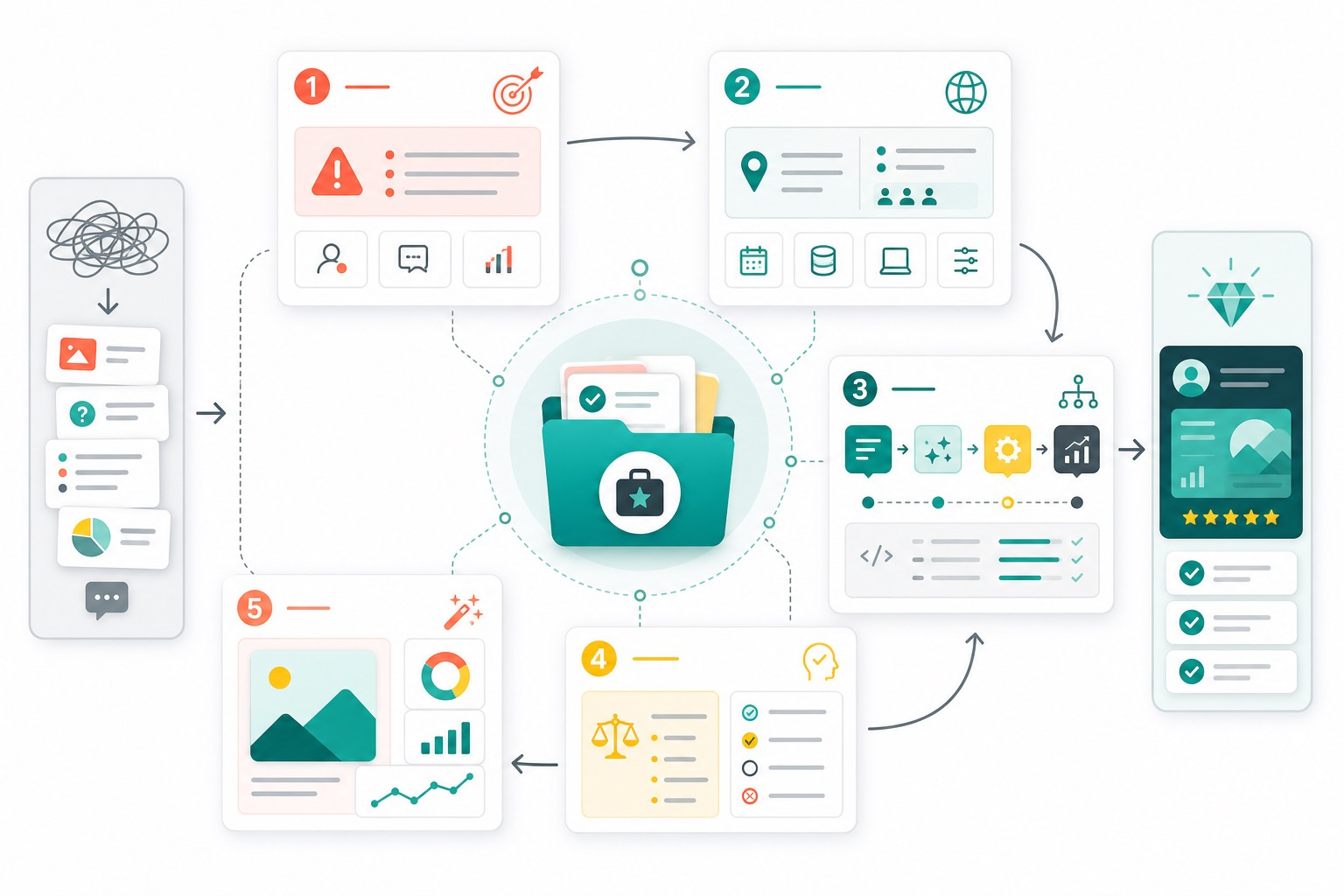
A strong prompt portfolio shows the whole evidence chain, not just the final AI output.
4. The Human Judgment
This is the most important section. Explain what the AI got wrong, what you kept, what you rejected, and why. Show the quality bar you used.
For example: “The first draft over-indexed on urgency and made the service feel more expensive than it was. I removed scarcity language, added a proof paragraph, and replaced vague outcomes with two concrete delivery steps.”
That sentence proves more than a screenshot of a beautiful output. It shows taste, responsibility, and decision-making.
5. The Final Asset
Show what came out of the process. It might be a positioning statement, product brief, research memo, website section, sales email, analytics summary, code prototype, customer FAQ, workshop plan, script, or content series.
If the final asset is private, show a redacted excerpt, a recreated sample, or a public-facing summary. The reader does not need every detail. They need enough proof to understand the quality of your work.
6. The Result
End with the outcome. Not every result has to be a dramatic revenue number. Useful outcomes include faster production, clearer decisions, fewer revisions, better stakeholder alignment, a shipped artifact, improved response quality, or a repeatable process.
Whenever possible, be specific. “Reduced a three-hour research process to 45 minutes while keeping human review on final claims” is stronger than “saved time.”
What to Publish and What to Keep Private
The biggest fear with prompt portfolios is giving too much away. That fear is reasonable. Do not publish client data, private strategy, proprietary prompts, security details, internal workflows, or anything covered by an NDA.
But privacy is not the same as invisibility. You can share the pattern without sharing the sensitive material.
Use these redaction rules:
Replace client names with role labels, such as “B2B SaaS founder” or “regional agency owner.”
Replace exact numbers with ranges when precision is sensitive.
Describe data sources by category instead of pasting raw data.
Share the prompt architecture instead of the exact private prompt.
Disclose AI involvement clearly when it affected the artifact.
A good rule: publish enough to prove judgment, not enough to expose someone else’s business.

Five Prompt Portfolio Examples You Can Build
For consultants
Create a redacted “messy client question to clear recommendation” entry. Show the original ambiguity, the research structure, the assumptions you checked, and the final recommendation format.
For founders
Publish a “customer language to positioning” entry. Show how AI helped cluster user calls, objections, support tickets, or demos while you made the positioning decision.
For job seekers and students
Build a “learned skill to applied project” entry. Pick one real problem, use AI to plan research, create a prototype or analysis, then document what you tested and learned.
For creators and writers
Show a “raw idea to published piece” workflow. Include your voice notes, the AI-generated outline you rejected, your revised thesis, and the final structure.
For AI builders and technical professionals
Document a “prompt to system” project. Show how the prompt became part of a larger workflow with retrieval, tests, evaluation criteria, or user feedback.
The AI Workflow You Can Use to Build Your First Entry
Start with one project you are allowed to discuss. A small, specific example is better than a vague impressive one.
Use this workflow:
Choose one finished piece of work where AI helped but did not replace your judgment.
Write a private rough note explaining the problem, inputs, tool, prompt structure, decisions, and result.
Ask AI to interview you about missing context, proof, constraints, and ethics.
Ask AI to turn your answers into a case study outline.
Redact anything private.
Publish a short version first, then expand the best one into a full portfolio page.
Here is a prompt you can use:
Act as a skeptical personal branding editor. Interview me about one AI-assisted work example. Your goal is to help me create a safe public prompt portfolio entry that proves judgment, context, workflow, and results. Ask one question at a time. Push me to clarify what I did, what the AI did, what I rejected, what I changed, what I learned, and what I must redact.
Do not publish the AI draft unchanged. Your edits are part of the proof. Add specific decisions, remove inflated language, and make the story sound like something a competent person would actually say.
Where a Prompt Portfolio Belongs in Your Personal Brand
You do not need to publish everything in one place. On LinkedIn, turn one entry into a short post about the problem and the decision you made. On Substack, write the full story with context and trade-offs. On your personal website, create a simple “AI workflow examples” page. On GitHub, technical professionals can explain prompt architecture, evaluation criteria, and failure modes in a README.
In proposals and interviews, use the portfolio as a proof bank. Instead of saying “I am good with AI,” show a short example of how you use AI while keeping human review on final recommendations.
The Trust Rules: Disclose, Do Not Perform
AI disclosure should be clear but not theatrical. You do not need to apologize for using AI. You do need to be honest about what happened.
A simple disclosure line is enough:
“AI was used for clustering notes, generating first-pass options, and pressure-testing assumptions. Final judgment, edits, claims, and publication decisions were mine.”
Avoid two extremes. Do not pretend you did everything manually if AI materially shaped the work. Do not over-disclose in a way that makes the tool sound like the hero. Your personal brand should make your judgment clearer, not smaller.
A Simple Seven-Day Plan
If you want to build a prompt portfolio without turning it into a huge project, use one week. Choose three possible examples and eliminate anything with privacy risk. Pick the strongest one, write the problem in plain language, document the inputs and prompt structure, then spend the most time on the human judgment section.
After that, prepare a safe final asset excerpt, add the result and disclosure, publish a short version, and save the expanded version as a reusable proof asset.
One good entry is enough to change how people perceive your AI skill. Three good entries can become a serious personal brand advantage.
The Real Edge Is Not the Prompt
The internet keeps treating prompts like secret spells. That framing is aging badly. As models improve, the value shifts toward context, taste, ethics, systems, and judgment.
Your prompt portfolio should make that visible. It should show that you can use AI without outsourcing your thinking. It should show that you can protect trust while moving faster. It should show that your value is not the tool you use, but the decisions you make around it.
That is the personal branding opportunity. While everyone else adds “AI-native” to their profile, you can publish proof.
FAQ
What is a prompt portfolio?
A prompt portfolio is a collection of public examples showing how you use AI to solve real problems. It includes the problem, inputs, prompt structure, human judgment, final asset, and result. It is stronger than a prompt list because it proves process and decision-making.
Do I need to share my exact prompts?
No. In many cases, you should not share exact prompts. You can share the structure, constraints, and reasoning behind the prompt while keeping private wording, client data, and proprietary workflows confidential.
Is a prompt portfolio useful for personal branding?
Yes. It gives buyers, recruiters, collaborators, and readers evidence of how you think with AI. That makes your personal brand more credible than a profile that only claims AI literacy.
What should I include in my first prompt portfolio entry?
Choose one safe example and include the problem, source inputs, prompt structure, what the AI got wrong, what you changed, the final output, and the result. Keep it specific and avoid private information.
Can job seekers use prompt portfolios?
Yes. Job seekers can use prompt portfolios to show applied AI skill through projects, research workflows, analysis, prototypes, or process documentation. This is more convincing than listing AI tools as keywords.
How do I disclose AI use without weakening trust?
Use a simple disclosure line that explains what AI helped with and what you owned. For example: “AI helped with first-pass clustering and option generation. Final judgment, edits, and claims were mine.”
Where should I publish a prompt portfolio?
Start where your audience already checks your credibility: LinkedIn, Substack, a personal website, GitHub, or a proposal appendix. You can reuse the same entry in shorter or longer formats across channels.
Sources used for context: Microsoft Work Trend Index, Coursera Job Skills Report, World Economic Forum Future of Jobs Report, NBER working paper summary, and public Reddit/Google SERP research.