


AI made it easier than ever to look smart online. That is exactly why audiences, recruiters, clients, and collaborators now look for receipts.
For founders, professionals, creators, consultants, students, and job seekers who want a stronger public identity without sounding generic, outsourced, or performative.

The old personal branding playbook was simple: clean up your profile, post more often, and stay top of mind. The new one is harsher. AI now makes it cheap to produce polished bios, polished headshots, polished posts, polished comments, and polished hot takes. A surface-level personal brand is no longer rare. It is the default.
That changes what people trust.
When someone checks your LinkedIn, reads your Substack, lands on your website, or sees your comments on someone else’s post, they are asking a more specific question than most people realize: can this person actually do the thing they want to be known for?
That is why proof of work personal branding matters now. Not because branding is fake, and not because content is useless, but because content without evidence is starting to read like decoration.
In the AI era, visibility gets you noticed. Proof gets you believed.
This shift is not theoretical. On March 13, 2026, LinkedIn said it was actively limiting the reach of inauthentic activity, automated comments, and suspicious engagement patterns while expanding verification signals. On January 26, 2026, LinkedIn also rolled out verified AI skills from partners like Descript, Lovable, Relay.app, and Replit, a clear signal that claimed ability is becoming less persuasive than demonstrated ability. Two days before this article, on June 2, 2026, LinkedIn published new research saying 90% of C-suite leaders are continuously building skills to keep pace with AI-led change. The market is telling you the same thing from three angles: trust matters, proof matters, and visible capability matters.
So the question is not whether you should build a personal brand. The better question is whether your current public presence makes your capability easier or harder to verify.
What Proof of Work Personal Branding Actually Means
Proof of work personal branding is the practice of making your expertise visible through evidence, not just self-description. It turns your public presence into a trail of believable signals.
Those signals can include shipped projects, before-and-after breakdowns, case studies, process notes, public explanations, credible testimonials, screenshots of outcomes, workshop materials, open-source contributions, speaking clips, client deliverables with sensitive details removed, and smart commentary that clearly comes from lived experience rather than prompt-fueled generalities.
This matters because most people still confuse three different things:
Positioning is what you want to be known for.
Content is what you publish to make that positioning visible.
Proof is the evidence that makes the first two believable.
If you only have positioning, you sound vague. If you only have content, you risk sounding generic. If you have proof, even modest visibility starts to compound.
Why Generic AI Branding Breaks Trust So Fast
Readers are better at spotting hollow authority than many marketers assume. They may not always detect exactly which line was written by AI, but they can feel when something has no weight behind it.
That is why AI slop hurts personal brands so quickly. It usually has three tells:
It says familiar things in polished language without adding new evidence, useful specificity, or actual judgment.
It performs confidence without showing where the confidence comes from.
It creates the impression that the person is using content to substitute for competence.
The opposite of AI slop is not refusing to use AI. The opposite is using AI around your expertise instead of instead of your expertise.
Simple rule: Let AI help you capture, structure, summarize, reframe, and distribute your work. Do not let it invent the work your reputation depends on.
The 7 Proof Signals That Make a Personal Brand Credible
1. Specific outcomes
Vague claims are cheap. Specific outcomes cost effort. “I help B2B founders grow” is weak. “I helped a founder turn three customer calls into a clearer landing-page message and higher demo quality” is stronger because it suggests real contact with the work.
2. Public artifacts
A public artifact is any object people can inspect: a memo, teardown, walkthrough, benchmark, slide, framework, mini case study, repo, design file, lesson thread, or annotated screenshot. Artifacts reduce the gap between what you say and what a stranger can verify.
3. Process visibility
Many professionals hide their process because it feels messy or unfinished. In reality, selective process visibility is one of the clearest credibility signals available. When you explain how you diagnose a problem, choose tradeoffs, or improve output, people see judgment, not just polish.
4. Third-party validation
Testimonials, references, mentions, interviews, guest appearances, quotes, awards, certifications, and verified skills all matter because they reduce self-reporting bias. You are not the only one saying you are credible.
5. Repeated specificity
A strong brand is not built by one lucky post. It is built when your examples keep pointing to the same domain of competence. Repeated specificity tells the market your expertise is not accidental.
6. Freshness
Proof ages. A smart thread from two years ago can still help you, but most industries now move too fast for stale proof to carry the whole load. Readers want to know you are current, not just accomplished once.
7. Identity trust
Verification, consistent bios, aligned work history, and professional surfaces that agree with each other all reduce friction. Identity trust does not replace expertise, but it makes people more willing to believe the expertise they see.

How to Build a Proof System Instead of a Posting Habit
Most people burn out on personal branding because they build it like a content treadmill. That is backward. The better system starts with work you are already doing and turns it into reusable public proof.
Step 1: Capture raw evidence every week
Create a private running document called “proof inventory.” Each week, drop in five things:
a problem you solved
a decision you made
a result you improved
a mistake you corrected
a question a client, colleague, manager, or user asked repeatedly
Most professionals think they have nothing to share because they wait for polished wins. Real proof often starts as a small fix, a sharp observation, or a practical pattern.
Step 2: Use AI to extract the useful angle
This is where AI is powerful. Give it your notes and ask it to identify what is actually interesting, what claim the evidence supports, what objections a skeptical reader would have, and what format best fits the material.
Useful prompt:
Here are my raw notes from work this week. Find the strongest proof signal, the clearest lesson, the most credible format for sharing it, and the places where my explanation still sounds generic.
Step 3: Publish the smallest believable version
You do not need to turn every insight into a full essay. One proof item can become:
a short LinkedIn post with one concrete takeaway
a screenshot-based carousel or simple visual breakdown
a Substack note with a pattern you keep seeing
a one-page case study on your site
a smart comment under someone else’s post that adds evidence, not applause
The goal is not to publish more. It is to make the signal inspectable.
Step 4: Connect every proof item back to one positioning theme
If you want to be known for product marketing, AI operations, founder storytelling, hiring systems, design research, or developer education, your proof should keep returning to that lane. The market trusts repetition when the repetition reveals depth.
Step 5: Archive your best proof on owned surfaces
Social posts decay fast. Strong proof should graduate to places you control: a website, a pinned post, a featured section, a resource page, a public memo archive, or a short “selected work” page. Otherwise your best evidence stays buried in a feed.
How AI Should Fit Into the Workflow
Used well, AI helps you run a sharper evidence system. Used badly, it creates a confidence costume.
Good uses of AI for proof-of-work personal branding:
turning raw notes into clearer outlines
finding repeated themes across your projects
rewriting dense explanations in simpler language
creating headline options for a case study
turning one proof asset into multiple channel formats
spotting where your draft overclaims or sounds generic
Bad uses of AI for proof-of-work personal branding:
inventing case studies you did not do
sounding like an expert in a domain you have not practiced
posting high-volume opinions with no underlying experience
using testimonials, screenshots, or metrics you cannot defend
If a reader asked, “How do you know this?” your public brand should have an answer.
What This Looks Like for Different Kinds of Professionals
Founders
Show the decisions behind the company, not just founder motivation. Product tradeoffs, customer pattern recognition, hiring lessons, category insights, and failed assumptions are stronger than another generic thread about resilience.
Consultants and freelancers
Make outcomes legible. Prospects want to understand how you think, what kinds of problems you solve, and whether you can explain complexity clearly. Anonymized case studies and teardown posts work well here.
Executives
Visible judgment matters more than visible volume. You do not need to post every day. You need a clear public pattern showing what you lead, how you make decisions, and how current your thinking is.
Job seekers and students
You do not need decades of experience to create proof. Document projects, learning builds, mini audits, volunteer work, experiments, class outputs, and process notes. Proof of work is often the bridge between low formal experience and high perceived capability.
AI builders and tech professionals
The field is crowded with claims. Show what you built, what failed, what changed after testing, what benchmarks mattered, and what constraints shaped your choices. Clear technical judgment is a trust multiplier.
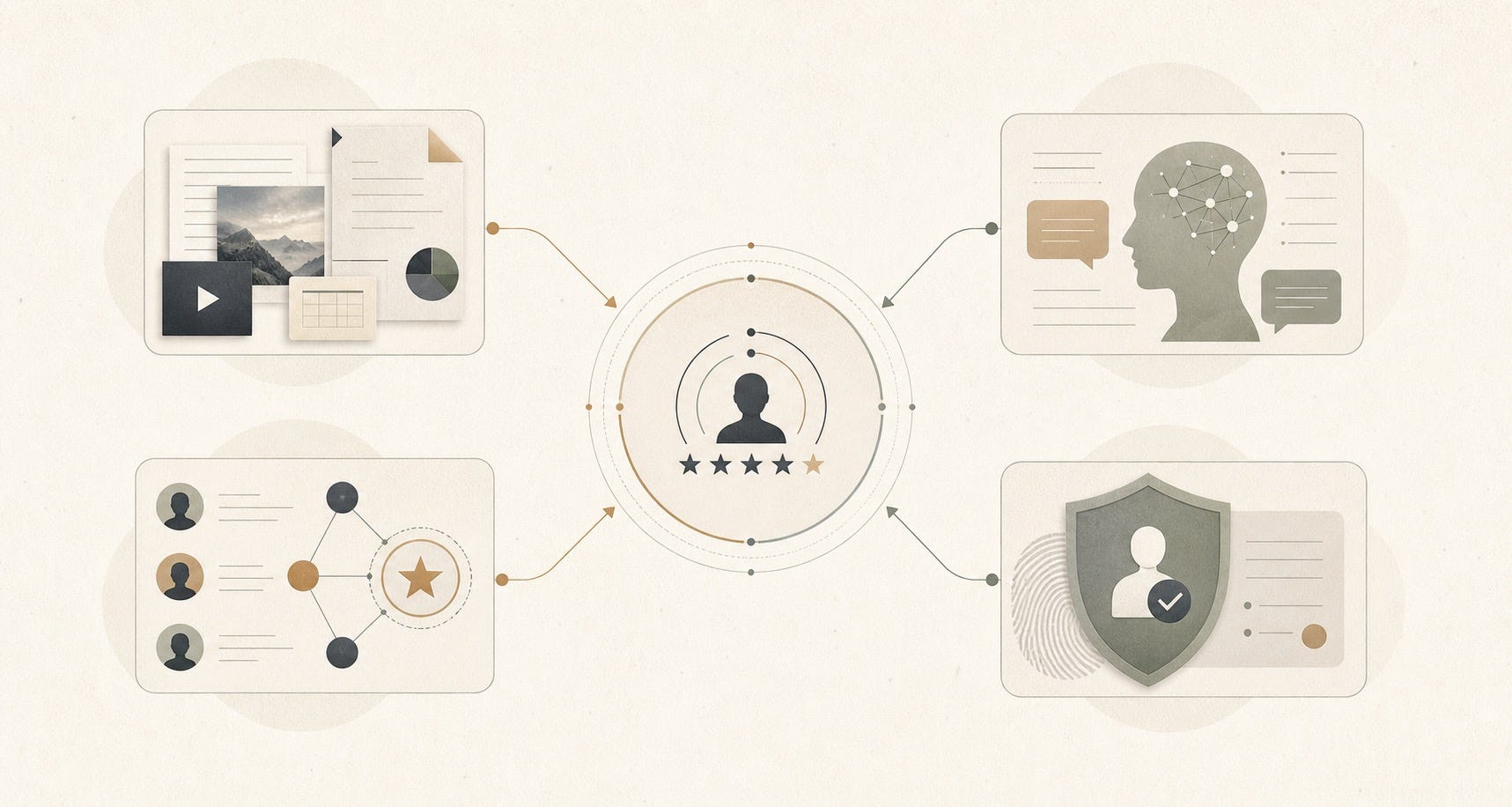
A 30-Minute Weekly Proof-of-Work Routine
Spend 10 minutes listing what you solved, learned, shipped, or clarified this week.
Spend 5 minutes asking AI which item has the strongest proof signal and best format.
Spend 10 minutes writing one small public artifact in your own words.
Spend 5 minutes saving it to an owned proof library so it compounds instead of disappearing.
If you repeat that every week, you stop relying on performance branding. You start building searchable evidence.
The Real Goal
The goal of personal branding is not to look impressive to everyone. It is to make the right people trust the right thing about you faster.
That is why proof of work personal branding is such a useful frame in the AI era. It gives you a filter for every public decision you make. Before you publish, ask:
Does this show what I know, or just that I can post?
Can a skeptical stranger tell where this insight came from?
Would this make someone more confident in hiring, referring, buying from, or collaborating with me?
If the answer is yes, keep going. If the answer is no, you probably do not need more branding. You need better proof.
FAQ
What is proof of work personal branding?
It is a personal branding approach built on visible evidence of competence, not just self-description. Instead of only saying what you do, you show work artifacts, outcomes, process, and validation that make your expertise easier to trust.
How is proof of work different from posting content?
Content is the vehicle. Proof is the substance. A post can carry proof, but a post by itself is not proof. The difference is whether the content gives a reader something concrete they can inspect, learn from, or verify.
Can I use AI for personal branding without losing credibility?
Yes, if AI helps you organize and communicate real expertise instead of fabricating it. Use AI to refine your language, structure your evidence, and repurpose work across channels. Do not use it to invent experience, inflate results, or simulate authority you have not earned.
What counts as proof of work if I am early in my career?
Projects, experiments, class work, volunteer builds, documented learning, research notes, teardown posts, mock deliverables, and practical problem-solving all count. Early-career proof does not need to be huge. It needs to be real, specific, and relevant to what you want to be known for.
Where should I publish proof-of-work content?
Use a mix of social and owned surfaces. LinkedIn helps discovery. A personal site or portfolio page helps with archiving and searchability. Substack can hold deeper memos and explanations. The best setup is the one that lets your strongest evidence stay easy to find after the feed moves on.
Do I need to become a creator to build a proof-of-work personal brand?
No. Most professionals do not need daily posting or influencer-style output. They need a believable body of public evidence that makes their expertise easier to evaluate. A few strong proof assets can outperform a large volume of generic activity.