


The work that best proves you can architect a solution is usually the work you cannot publish. Here is how to make your judgment visible anyway—without turning client calls into content or letting AI fill in the blanks.

A strong technical personal brand makes the path from constraints to judgment easier to see.
The portfolio problem for a solutions architect is not a lack of work. It is that the work that proves the most is usually the work you are least allowed to show.
You have navigated a migration nobody can name, solved an integration problem inside an NDA, or helped a skeptical executive understand why the fastest path was not the safest one. Then someone asks for your portfolio, LinkedIn content, or point of view. You are left with a list of cloud badges, a few generic diagrams, and the uneasy feeling that the real evidence is locked away.
AI makes this tension sharper. It can turn a thin prompt into a clean post in minutes. But polish is not proof. In a customer-facing technical role, an overconfident AI draft can disclose a recognizable detail, erase a crucial trade-off, or make you sound like you are claiming work you did not own.
The answer is not to post more. It is to build a decision trail: a small, repeatable record of how you frame constraints, weigh options, protect people and systems, and explain a choice. That trail becomes a client-safe source of personal-brand material. It also gives AI a much better job: organize your verified thinking instead of inventing it.
Your personal brand is not a project gallery
A developer can sometimes point to a repository. A designer can often show the work. A solutions architect works across people, platforms, budgets, risk, adoption, and time. The most valuable signal is rarely a finished diagram. It is the judgment behind it.
That is why a personal brand built around vendor features tends to blur into the feed. Anyone can summarize a product launch or generate a seven-slide architecture carousel. The rarer signal is a clear view of how you think when constraints collide.
A recent solutions-architect portfolio case study makes the same point: the hard part is not drawing boxes; it is showing the decisions, context, scope, and trade-offs while aggressively sanitizing client work. Read it as a useful prompt, not a template to copy: real-world portfolios need a different kind of proof.
Do not ask, “What customer project can I show?” Ask, “What recurring decision pattern can I teach without exposing the customer?”
For example, the public lesson is not “how we moved Acme’s data platform.” It might be: “How to decide whether a migration needs a compatibility layer before a rewrite.” The first version is confidential. The second is useful, specific, and portable.
Build a private architecture decision trail
Start privately. Your decision trail is not a shadow customer record and it is not a raw call transcript. It is a short, de-identified note written after a moment where you had to use judgment. Think of it as an architecture decision record designed for your future public teaching.
Once a week, capture one moment using five fields:
The pattern: a general problem, such as legacy-to-cloud integration, an AI pilot with sensitive data, or an executive request for a fast proof of concept.
The constraint: what made the easy answer wrong—latency, governance, a skill gap, a deadline, adoption risk, or an unclear owner.
The options: two or three approaches that were genuinely on the table.
The decision rule: the principle that helped you decide. For instance, “reversibility first when the cost of a wrong commitment is high.”
The safe lesson: what another architect can do differently on Monday morning.
Do not include account names, unannounced roadmap details, internal tools, vendor pricing, exact scale figures, personal data, security configurations, or quotes from a client. If a colleague familiar with the situation could recognize the account from the note, it is still too close to the source.
A useful test: Could this lesson be true in three different industries? If yes, you are probably sharing a decision pattern. If no, you may be retelling a customer story.
Separate the source material from the public lesson
Good technical thought leadership has two layers. The private layer contains context you owe a client, employer, or collaborator. The public layer contains a principle your audience can test in their own work. Do not let AI cross that boundary.
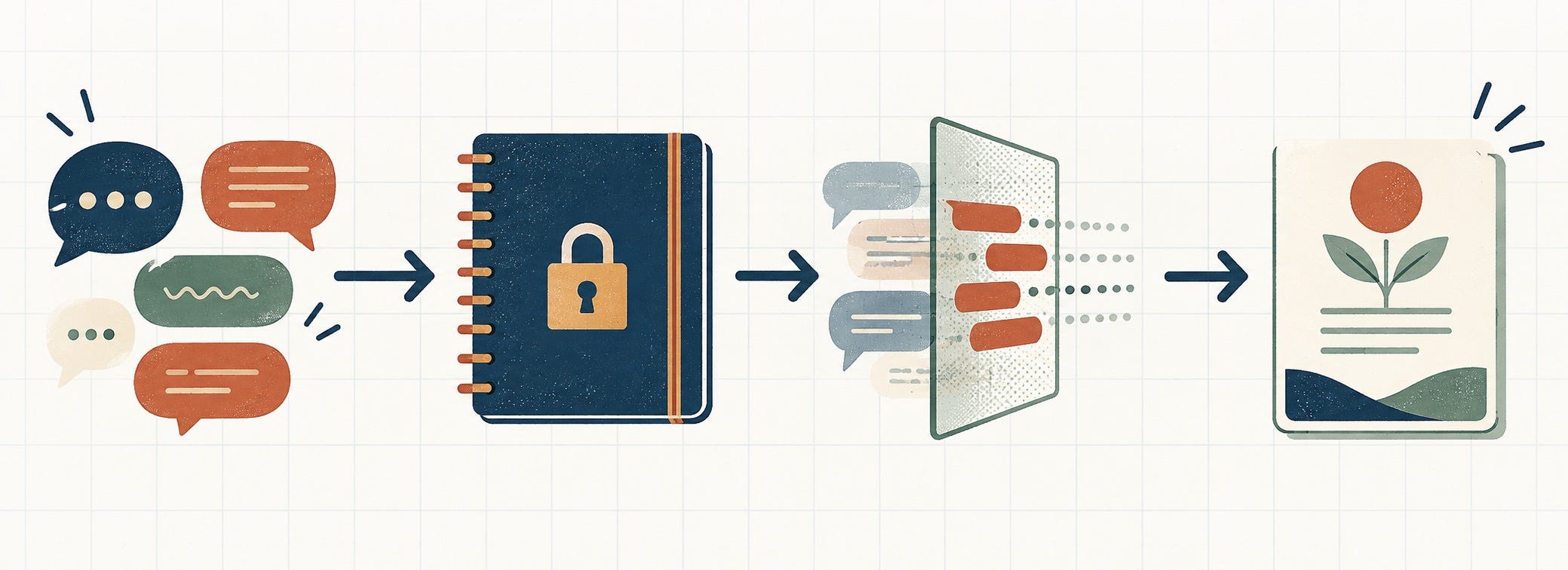
A public lesson should emerge from a privacy filter, not from a raw customer conversation.
Before you draft, create a source packet with only the public-safe elements: your de-identified pattern, a claim you can defend, an illustrative generic scenario, and any public documentation you are citing. If you want to mention a product behavior, verify it in the official docs. If you want to describe an outcome, say what you observed without attaching a number you cannot publish or substantiate.
Then run a recognizability review. Read the draft as a former client, competitor, or colleague would. Could they infer the account? Could a detail expose an environment or negotiation? Does the post accidentally imply that one architecture is universally right? This review may feel slower than asking a model for 10 hooks. It is also where trust is built.
Give AI a bounded role
AI is helpful after you have supplied the judgment. Use it for structure, alternative explanations, a jargon check, or a skeptical-reader pass. Do not use it to reconstruct customer context, generate an outcome, or impersonate technical certainty.
Try a prompt like this after you have completed your source packet:
Turn this verified, de-identified decision pattern into a 500-word LinkedIn post for technical leaders. Preserve every stated constraint and uncertainty. Do not add client names, metrics, tools, outcomes, or technical claims not provided. Include one practical checklist and end with a question that invites alternative trade-offs, not agreement.
That last instruction matters. Architects earn authority when they show where a rule applies and where it breaks. A post that says “always use event-driven architecture” may travel farther than a nuanced one. It will also make the right readers doubt you.
Use a second AI pass as an editor, not a ghostwriter: “Highlight any claim that needs evidence, any sentence that sounds universally true, and any detail that could make a customer recognizable.” You still make the call. The public responsibility is yours.
Turn one decision into several proof formats
A single safe decision pattern can do more than feed a content calendar. It can become a small body of work that makes your technical and commercial range easier to understand.
A short LinkedIn post: name the tension, explain the decision rule, and offer a question.
A one-page case note: describe the generic context, options, rule, limits, and “what I would check next.”
A workshop outline: teach the decision framework to peers, customers, or a community.
A portfolio page: group three related notes around a specialty such as AI adoption, integration reliability, or secure cloud modernization.
An interview story: use the same honest structure: context, constraints, options, decision, result you can safely state, and what you learned.
The formats reinforce each other because they come from real thinking. You do not need a different persona for every channel. You need a recognizable standard: how you reason, what you protect, and what you help people decide.
Make the invisible parts of technical leadership visible
Many solutions architects only publish the technical answer. That leaves out the work customers remember: narrowing an overlarge question, surfacing an ownership gap, explaining risk without drama, and helping two teams agree on what “done” means.
Those are not soft extras. They are part of the architecture. Write about them precisely. Instead of “communication is important,” teach a move: “Before recommending a platform, ask who will operate it at 2 a.m. and what evidence tells them it is healthy.” That sentence signals operational judgment without exposing a single client.

Technical credibility is often visible in how clearly you help a group choose—not just in the stack you recommend.
There is also a career benefit to this discipline. In a role that can be misunderstood as either “technical sales” or “senior engineering,” a decision trail shows the bridge. You demonstrate that you can go deep enough to respect implementation constraints and broad enough to connect them to adoption, cost, risk, and a customer’s actual goal.
A simple 30-minute weekly system
Consistency does not require daily commentary. It requires a small capture habit while the work is still fresh.
Five minutes: write one private decision-trail note after a workshop, design review, discovery call, or technical disagreement.
Ten minutes: strip identifying details, then state the pattern and decision rule in one sentence each.
Ten minutes: use AI to propose three structures—a post, a checklist, and a case note—using only your safe source packet.
Five minutes: perform the recognizability and claims review. Publish only if both are clean.
After four to six weeks, look for repetition. Maybe you keep writing about implementation ownership, evaluation design, or AI governance. That repetition is not boring. It is your emerging point of view. Choose one area where you have earned pattern recognition and make it easier for others to find.
What not to publish
A trust-first personal brand has boundaries. Do not publish a client’s frustration as a lesson while they are still living it. Do not use AI to summarize call recordings you do not have permission to process. Do not post an architecture diagram merely because the labels have been removed. Shape, timing, context, and a distinctive combination of services can still reveal too much.
Do not compensate for missing evidence with confidence. If a lesson came from a prototype, say it is a prototype lesson. If the trade-off remains open, say so. The people you want to work with are looking for this kind of calibration.
Your goal is not to become an online version of every customer meeting. It is to leave a reliable public trail of the way you think. That is the personal brand a title, certificate, or AI-polished post cannot replicate.
Start with the next hard choice
On your next project, listen for a moment when the room moves from “which tool?” to “what are we optimizing for?” Capture the pattern privately. Remove the identifying details. Write the rule that made the next step clearer. Then teach that rule in a form another architect can use.
That is a durable kind of visibility. It respects the work, protects the people who trusted you with it, and makes your technical judgment easier to recognize long before someone opens your résumé.
Frequently asked questions
How do I build a personal brand as a solutions architect?
Start with repeatable decision patterns from your work, not generic tool commentary. Capture a constraint, options, a decision rule, and a client-safe lesson. Publish the lesson only after a privacy and claims review.
What should a solutions architect portfolio include?
Include a clear specialty, a few sanitized decision-based case notes, diagrams only when they are safe and necessary, your role and scope, trade-offs, and public teaching artifacts such as workshops or articles. Show how you think, not just what you have touched.
Can a solutions architect share client work on LinkedIn?
Only with explicit permission and a careful review of confidentiality obligations. In most cases, it is safer to teach a de-identified decision pattern than to recount the engagement. Removing a company name alone is not enough to make a story safe.
How can I use AI for technical thought leadership without sounding generic?
Supply a narrow, verified source packet first. Ask AI to organize, clarify, or challenge your thinking, but prohibit it from adding metrics, customer context, outcomes, or technical claims. Keep the limits and trade-offs in the final draft.
What is the best content for a solutions architect to post?
Post useful explanations of recurring technical-business trade-offs: evaluating an AI pilot, designing for operational ownership, choosing a migration sequence, or explaining a security constraint to nontechnical stakeholders. Be specific about the decision rule and its limits.
How often should a solutions architect publish?
Quality beats volume. One well-reviewed, genuinely useful decision lesson every week or two is more valuable than frequent generic commentary. Use a private capture habit so publishing does not depend on inspiration.
Further reading: a recent solutions-architect portfolio case study and public solution-architect portfolio examples on GitHub. Use examples for inspiration, then apply your own confidentiality, claims, and employer policies.