



The next personal branding advantage is not posting more. It is making your public ideas easier to check, cite, trust, and remember.
Anyone can publish a confident take now. That is the problem.
AI has made the average professional louder, faster, and more polished. A founder can draft five posts before breakfast. A consultant can turn one meeting note into a newsletter, thread, webinar outline, and carousel. A job seeker can ask a model to make every paragraph sound more executive. The output often looks fine. It also often feels weightless.
That is why source-backed personal branding is becoming a real edge. It is the practice of tying your public claims to visible evidence: lived experience, examples, artifacts, credible sources, decision notes, client patterns, and clear boundaries around what you know. The goal is not to make your personal brand sound academic. The goal is to make your expertise easier to verify in a world where everyone can sound like an expert.
Recent trust conversations are moving in this direction. A TechRadar Pro essay from O’Reilly’s chief product officer argued that when content becomes abundant, trust and transparent process become more valuable. The same logic applies to individual professionals.
A strong personal brand does not just say, “Trust me.” It shows the trail that makes trust reasonable.
What Source-Backed Personal Branding Means
A source-backed personal brand is built around claims people can trace. When you say you understand a market, there is a reason to believe you. When you say a tactic works, you can explain the context. When you offer advice, the reader can see the pattern behind it. When you use AI, the human judgment still shows.
This fits the deeper purpose of personal branding. Harvard Business School frames personal branding as the intentional work of defining and expressing your value through an accurate, coherent, compelling, and differentiated story. The word that matters most in the AI era is accurate. If your public identity is built on unsupported claims, the brand may gain attention while losing trust.
Source-backed personal branding is especially useful for professionals who do not want to become daily content performers. You can build authority through fewer, stronger assets: a clear profile, a useful article, a thoughtful comment, a case example, a public decision note, or a point of view grounded in work you have actually done.
Why This Matters More With AI Content
AI-generated content has created two pressures at once. Professionals feel they need to publish more because competitors can now publish constantly. Audiences are also learning to discount anything that feels too smooth or too broad.
The result is a credibility squeeze. If you publish nothing, you are harder to discover. If you publish generic AI-assisted content, you become easier to ignore. If you publish strong claims without evidence, you invite skepticism. If you hide AI use in contexts where disclosure would matter, you create a reputation risk that may be larger than the productivity gain.
Coverage of AI detection tools shows how tense this has become. WIRED reported on Substack’s use of Pangram and the wider debate over AI detection accuracy. The practical lesson is that readers increasingly care about originality, process, and transparency.
Hiring is moving the same way. In a recent Indian Express interview, LinkedIn’s Prashanthi Padmanabhan discussed expanding credibility validation as AI-generated profiles raise reliability questions. She also pointed job seekers toward evidence of what they can actually do. That is source-backed branding in plain language: make ability visible through proof, not decoration.
The Search Gap: Evidence Workflows Are Missing
Search results are full of broad advice on AI personal branding, LinkedIn growth, thought leadership, and “how to build a personal brand.” The common playbook is familiar: post consistently, define your niche, choose content pillars, repurpose content, and optimize your profile.
That advice is not wrong. It is incomplete.
Reddit-restricted research around personal branding and AI shows a more specific anxiety. Professionals are asking how to avoid generic thought leadership, whether public branding creates real business outcomes, and how to build credibility without becoming a performative influencer. The gap is practical: most guides tell people to create more content. Fewer explain how to build an evidence trail before publishing.
The Four-Part Source-Backed AI Workflow
You do not need a complicated system. You need four repeatable moves: observe, verify, interpret, and publish.
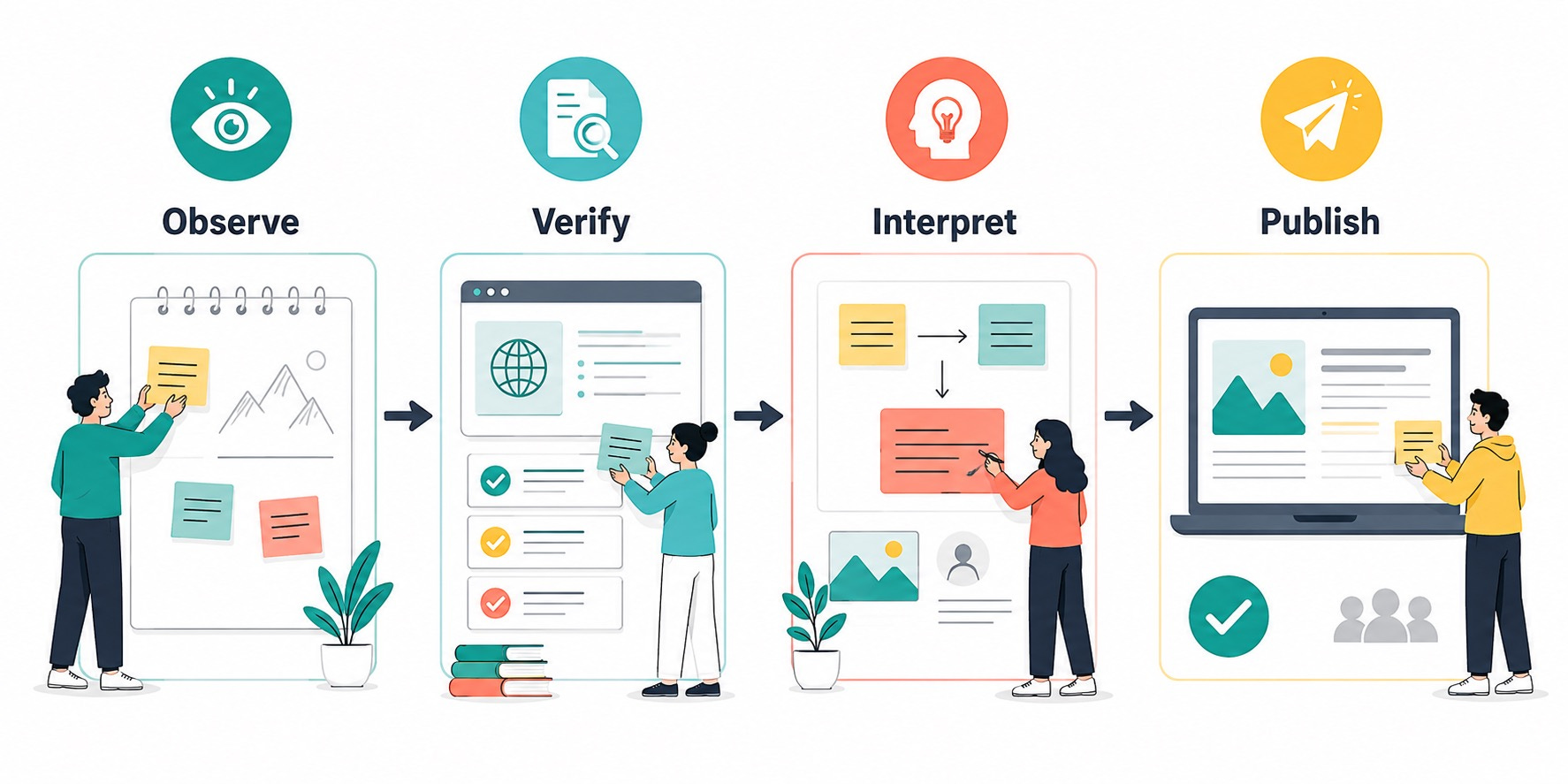
1. Observe What You Actually Know
Start with raw material from real work. Do not start with “give me ten viral LinkedIn post ideas.” That prompt usually pulls you toward generic phrasing because the model has no access to your judgment, constraints, failures, customers, colleagues, field notes, or taste.
Collect observations from repeat client questions, mistakes you see smart people make, decisions you made, before-and-after examples you can discuss, public projects, research notes, and strong disagreements you can explain calmly.
Prompt: “Interview me about one recent professional situation that taught me something useful. Ask one question at a time. Pull out claims, examples, risks, caveats, and possible public angles. Do not draft the post yet.”
2. Verify Before You Amplify
Every useful personal brand claim has a support level. Some claims are personal experience. Some are client patterns. Some need a public source. Some should not be published because the evidence is thin or the context is confidential.
Ask AI to label each claim as experience-backed, example-backed, source-backed, pattern-backed, or speculative. This prevents weak writing. It also improves your language. “I am seeing early signs of this in founder calls” is more credible than “everyone is doing this now.”
Prompt: “Review the claims below. Label each as experience-backed, example-backed, source-backed, pattern-backed, or speculative. For each claim, tell me what evidence is missing before I publish it publicly.”
3. Interpret With Your Own Judgment
Sources do not build a personal brand by themselves. Anyone can paste links. Your value is the interpretation: what the evidence means, who it matters for, what most people misunderstand, what you would do differently, and where the limits are.
This is where many AI-assisted posts go flat. They summarize the source but never reveal the person’s taste. A stronger version sounds like: “The common advice is X, but I would treat it as Y because...” or “This works for enterprise teams, but I would not recommend it for solo consultants until...”
Use AI to pressure-test the interpretation. Ask it to find weak assumptions, overclaims, missing stakeholders, counterexamples, and the version of the argument a skeptical reader would respect.
4. Publish the Smallest Complete Trust Asset
Do not turn every idea into a grand essay. Match the claim to the right public format. A small observation can become a comment. A repeat question can become a FAQ answer. A useful process can become a short post. A deeper pattern can become an article. A technical lesson can become a README or annotated demo.
The point is to leave behind a public record that a real person, recruiter, buyer, collaborator, journalist, or AI answer engine can understand later. You are not just feeding the algorithm. You are creating evidence that travels.
Build a Personal Brand Evidence Bank
A source-backed personal brand becomes easier when you keep an evidence bank. This can live in Notion, Google Docs, Obsidian, a spreadsheet, or any notes app you already use. The tool matters less than the habit.
Create entries with six fields:
Observation: What did you notice?
Context: Where did it come from?
Evidence: What supports it?
Boundary: What can you not claim?
Audience: Who would care?
Asset: What should this become?
Example: a consultant notices that early-stage founders ask for content strategy when the deeper problem is unclear positioning. The context is five discovery calls, with no confidential details included. The evidence is call-theme notes plus public examples of strong positioning pages. The boundary is simple: do not claim this applies to all founders. The audience is solo founders trying to build trust before sales calls. The asset could be a short post on the difference between posting and positioning.
Once the bank exists, AI becomes more useful. Instead of generating generic ideas, it can cluster observations, find repeated themes, rewrite claims with better boundaries, and recommend the right format.
Prompt: “Analyze these evidence-bank entries. Find the three strongest personal brand themes. For each theme, suggest one short post, one long-form article, one profile proof point, and one FAQ answer. Keep all claims tied to the evidence provided.”
Use Sources Without Sounding Academic
Source-backed does not mean every post needs footnotes. It means the reader can feel that your thinking comes from somewhere real.
Use public sources when you make a broad claim about a market, technology, hiring, buyer behavior, creator behavior, or platform change. Link to the source naturally, then explain what it means from your point of view.
Use personal evidence when you are talking about your own process. A concrete example and an honest boundary often matter more than a study.
Use anonymized examples when the lesson comes from client work. Strip names, confidential details, metrics you are not allowed to share, and anything that makes the person identifiable. Keep the shape of the problem and the decision.
AI Disclosure: What to Say and What to Keep Human
Disclosure is not one-size-fits-all. The right level depends on the asset, the audience, the risk, and the role AI played.

If AI helped brainstorm headlines or organize notes, most readers do not need a dramatic disclosure. If AI generated a synthetic image, voice, avatar, testimonial, client quote, or case example, disclosure matters much more. If the content makes claims about health, finance, law, hiring, identity, safety, or qualifications, human review and source clarity are not optional.
A simple disclosure can sound human:
“I used AI to organize my notes, but the examples and judgment are mine.”
“This image is AI-generated and used as an illustration, not a documentary record.”
“I used AI to pressure-test the structure; sources are linked where I rely on external claims.”
“Client details are anonymized and combined to protect confidentiality.”
The point is not confession. The point is clarity. Trust grows when readers understand what they are looking at.
A Practical Claim Review Checklist
Before publishing an AI-assisted personal brand asset, ask:
Can I explain where this claim came from?
Is this a fact, opinion, pattern, prediction, or personal lesson?
Does the wording overstate what the evidence proves?
Would a skeptical peer consider this fair?
Have I removed confidential or identifying details?
Did AI add a claim, statistic, quote, title, or source I have not checked?
Does this asset help the right person trust me for the right reason?
If the answer to the last question is no, the content may still get engagement, but it is not doing brand work.
Examples by Professional Type
Founders: Save investor questions, customer objections, product decisions, and market observations. Turn them into posts that explain how you think, not just what you sell.
Consultants and freelancers: Build from repeated client problems, anonymized before-and-after examples, decision frameworks, and common mistakes.
Job seekers and career changers: Do not rely only on job titles. Create public proof through project notes, teardown posts, learning logs, short demos, or thoughtful comments on industry problems.
AI builders and technical professionals: Explain design choices, failure modes, evaluation methods, source boundaries, and lessons from public projects. Business Insider recently profiled an Amazon AI scientist who found that external reputation grew through publishing, speaking, peer review, and professional communities.
Creators and educators: Show how you learned something, what changed your mind, what sources you trust, where beginners get misled, and what you would practice first. In an AI-saturated feed, curation plus judgment is often more credible than endless originality theater.
A Seven-Day Starter Plan
Day 1: Create your evidence bank with the six fields above.
Day 2: Add ten raw observations from recent work, study, customer conversations, projects, or public research.
Day 3: Ask AI to classify each observation by support level and identify missing evidence.
Day 4: Choose three observations with the strongest mix of relevance, proof, and audience pain.
Day 5: Draft one short post, one FAQ answer, and one profile proof point.
Day 6: Run the claim review checklist and revise anything broader than the evidence.
Day 7: Publish the smallest useful asset and save the response, questions, and objections as new evidence.
This is how consistency becomes easier without becoming generic. You are asking AI to organize the proof of a professional life already in motion.
The Real Goal: Become Easier to Trust at a Glance
Personal branding is often framed as a visibility game: more followers, posts, impressions, polish. Those numbers can matter, but they are not the whole game.
The better question is: when the right person finds you, can they quickly understand why you are credible?
A source-backed personal brand answers that question without making the reader work too hard. Your profile has a clear claim. Your content shows judgment. Your examples prove context. Your sources show care. Your disclosures reduce confusion. Your public artifacts create a trail.
That is the personal branding advantage worth building now. Not louder content. Better evidence.
FAQ
What is source-backed personal branding?
Source-backed personal branding is the practice of building your public professional identity around claims that can be traced to evidence. That evidence may include public sources, personal experience, anonymized examples, project artifacts, client patterns, research notes, or visible work samples.
How can AI help with source-backed personal branding?
AI can interview you, organize raw observations, classify claims, find weak assumptions, suggest formats, rewrite overbroad statements, and turn evidence into clearer public assets. The key is to feed AI your real material instead of asking it to invent generic expertise.
Do I need to cite sources in every LinkedIn post?
No. Cite public sources when you make broad claims about a market, platform, trend, or profession. For personal lessons, a concrete example and honest boundary may be enough. The standard is traceability, not academic formatting.
How is this different from personal brand trust signals?
Trust signals are the visible markers that make people more comfortable believing you. Source-backed personal branding is the workflow that creates those markers from real evidence before you publish. It is upstream of the signal.
Should I disclose when I use AI for personal branding content?
Disclose when AI materially changes what the audience is evaluating, especially synthetic media, avatars, voice, images, testimonials, examples, or high-stakes claims. For light brainstorming or editing, disclosure may not be necessary, but human review still is.
What is the easiest first step?
Start an evidence bank. Add ten real observations from your work, label the support behind each one, and publish one small asset that makes a useful claim with a clear boundary. Repeat that weekly and your personal brand will become more credible over time.