


A practical, proof-first way for founders, consultants, and experts to turn real experience into a page an event organizer can trust.

Your speaker page should make a decision easier, not make a career look bigger.
A speaker page is not a page that says you are impressive. It is the page that lets a stranger decide whether they can safely put you in front of their audience.
That distinction matters more now. AI can produce a heroic bio, a dozen keynote titles, and a row of polished claims before your coffee gets cold. But the person booking a conference, client workshop, leadership offsite, or community event is not looking for more adjectives. They are quietly trying to answer: Will this person help our people? Can I explain why I chose them? Is the evidence real? And will booking them be easy?
If your answer is a generic About page, an old LinkedIn profile, and a folder of attachments, you are asking the organizer to assemble your reputation for you. A dedicated speaker page removes that work. It becomes the public home for your best proof, your clearest point of view, and the practical details that make a yes feel low-risk.
Good personal branding is not a bigger claim. It is a shorter path from someone’s question to your evidence.
Why a speaker page is a personal-brand asset, not a sales page
Speaking is borrowed trust. An organizer is lending you their room, their agenda, and a portion of their audience’s attention. That is why a speaker page should not read like a résumé in party clothes. Its job is to translate what you know into an experience a specific group can understand.
A useful page gives you benefits even when you are not actively pitching a keynote. A prospective client sees that you can teach, not just advise. A podcast host finds an accurate short bio. A colleague can forward one link to introduce you. Search engines and AI systems encounter a stable description of what you do rather than a scattered collection of stale bios.
The important word is stable. Each event listing, podcast page, and social post may disappear or describe you differently. Your own page is where you correct the record, update your current focus, and connect the pieces without pretending every appearance was a stadium keynote.
Start with the five questions every organizer asks
Before writing a word, write the organizer’s questions at the top of a document. A strong speaker page answers them in order.
Who is this for? Name the audience and the moment. “I help finance leaders explain AI risk to boards” beats “AI thought leader.”
What will the audience leave with? Describe a shift, decision, skill, or conversation—not a vague promise of inspiration.
Why this person? Offer verifiable experience, not a superlative. A project, role, publication, client permission, or lived perspective can all count.
What will it feel like in the room? Clarify format: keynote, practical workshop, fireside chat, panel, virtual session, or internal leadership conversation.
How hard is it to book them? Give a direct inquiry path and the few details a host needs to begin.
This order prevents a common mistake: leading with credentials that matter to you before showing relevance to the reader. Your career is the evidence. The audience’s problem is the headline.
Build an honest proof stack before you build the page
You do not need a famous event logo or a glossy speaking reel to start. You do need proof that is proportionate to the claim. Collect it in four small groups and label each item accurately.
1. Lived and work evidence
List the work that earned you a perspective: decisions you owned, projects you shipped, teams you led, research you completed, customers you served, or a transition you navigated. Add a link, date, or artifact wherever you can. Your most useful proof may be a workshop you ran for 12 people, not a title from five years ago.
2. Teaching evidence
Gather recordings, slide excerpts, podcast appearances, office-hours clips, webinars, or a short sample lesson. A two-minute clip of you explaining one useful idea is stronger than a manufactured “speaker reel” full of crowd shots you cannot verify. If you have no footage, record a clear five-minute teaching sample for a real audience problem and describe it honestly as a sample.
3. Third-party evidence
Include organizer or attendee quotes with names and roles when permission allows. Link to an event page, guest episode, article, or partner profile. Do not turn a client logo into an implied endorsement. If the connection was a workshop for their team, say that. Specificity makes modest evidence credible.
4. The talk ledger
Create a short, reverse-chronological list: talk title, event or organization, year, format, and one link when one exists. This is the piece most speaker pages miss. It gives an organizer a quick way to distinguish a claim from a record. It also gives you a ritual: after every event, add one accurate line while the details are fresh.
Use honest proof tiers. You can label an event as “keynote,” “workshop,” “panel,” “guest lecture,” or “internal session.” These are not interchangeable. Precise labels help the right host see a fit and keep you from winning the wrong room with inflated language.

A small, accurate proof stack is more useful than an oversized list of claims.
Use AI as an editor with sources, not as an authority generator
AI is valuable here because it can turn your scattered notes into drafts, variants, and missing-item checklists. It becomes dangerous when it fills gaps in your history with plausible fiction. The rule is simple: give it a source packet and make it work inside that packet.
Create a plain document with your current role, three real stories, links to public work, approved testimonials, a list of past appearances, and any boundaries. Add details that must not be implied: fees, client names, audience sizes, results, credentials, and affiliations. Then ask AI to identify what is unclear—not to invent what would make the page sound stronger.
You are editing a speaker page for accuracy and clarity. Use only the source packet below. Do not invent event names, audience sizes, outcomes, clients, credentials, or endorsements. Flag unsupported claims in [brackets].
Write: (1) a 45-word third-person speaker bio, (2) three audience-problem-first talk descriptions, and (3) a list of proof gaps I should fill with real artifacts. Keep the language specific, warm, and free of hype.
SOURCE PACKET:
[paste your verified facts, links, and approved quotes]
Run a second pass with one question: “Could an organizer verify this or reasonably understand its scope?” Replace “trusted by leading companies” with the names you can use, or remove it. Replace “transforms leadership” with the decision, practice, or conversation your session helps create. If a sentence would embarrass you when read next to the original source, it does not belong on the page.
The simple page structure that makes forwarding easy
A page should work when skimmed on a phone, forwarded to a committee, or read by someone who has never met you. Use this sequence.
Opening promise: one sentence naming the audience, problem, and distinctive lens.
Three signature sessions: a title, the audience problem, the practical outcome, and the formats each can fit.
Why you: a compact speaker bio grounded in relevant experience, not your full career history.
Proof in context: a talk ledger, selected clips or links, and a few attributed quotes.
Host-ready assets: a downloadable short bio, a current high-resolution headshot, and clear technical or format notes if useful.
Inquiry path: one friendly sentence that says what to include: event, audience, date range, format, and expected outcome.
Keep your talk choices narrow. Three distinct sessions are easier to picture than thirteen topics. Each should make a real trade-off: a room for leaders making a decision is different from a workshop for practitioners learning a process. If you cannot say who should not book the talk, the positioning is still too broad.
Build the first version in 90 minutes
Perfectionism is the usual reason an expert has no speaker page. Put a short build session on the calendar instead.
Spend the first 20 minutes collecting source material. In the next 20, write three talk cards: problem, audience, outcome, proof. Spend 20 minutes drafting the bio and the inquiry section using your source-bound AI prompt. Use the final 30 minutes to add one real image, two credible links or quotes, and your talk ledger. Publish the page as version one.
Then make it compound. After every appearance, ask the host for one sentence about the audience’s experience, save one approved photo or clip, and add a ledger entry. After every new project, decide whether it strengthens a talk or belongs nowhere public. Your page will improve because your work improves, not because you kept adding adjectives.
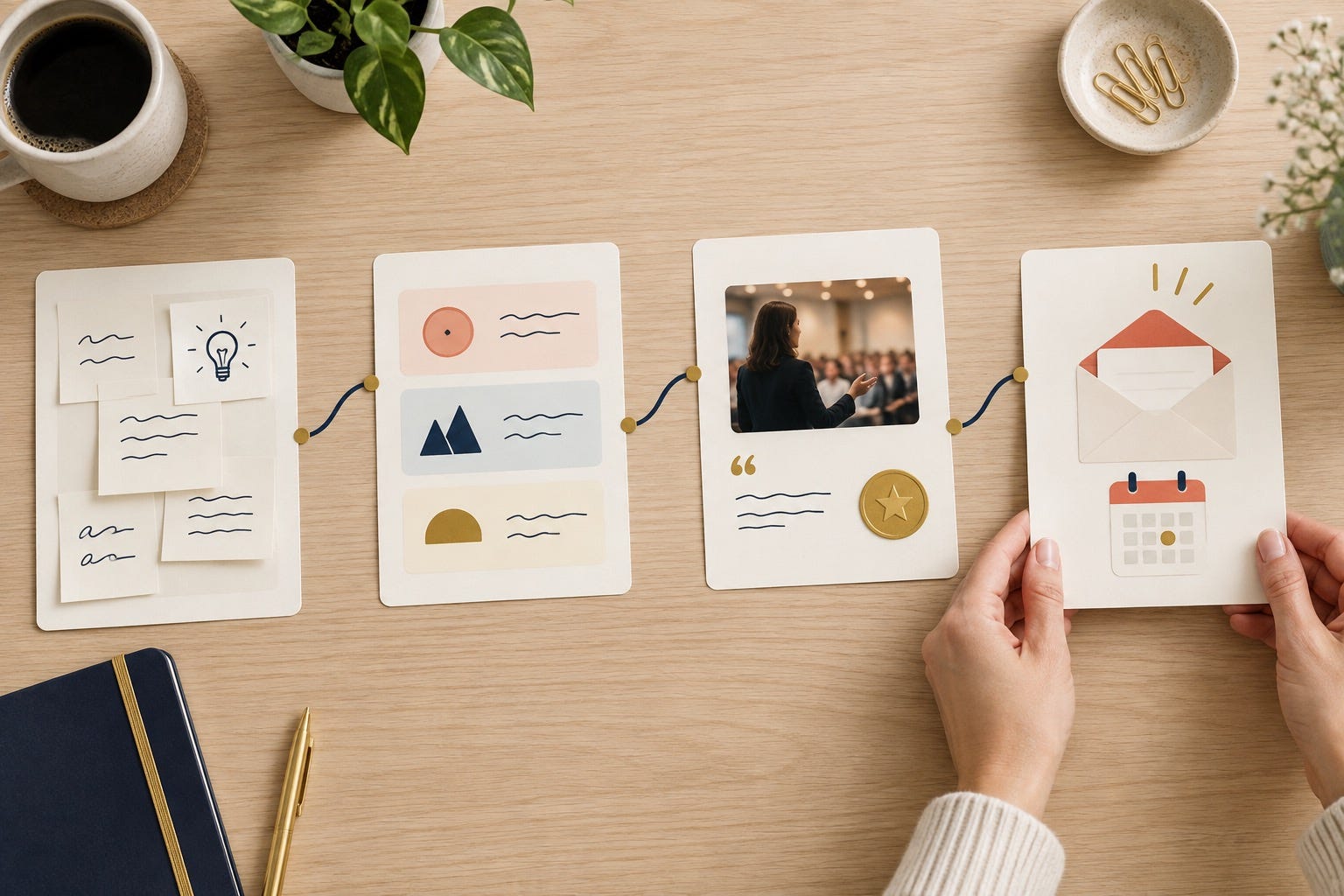
The durable workflow is simple: collect real sources, make a clear page, then update it after each appearance.
Do not let an AI-polished page create an AI-sized promise
There is a difference between presenting your work well and borrowing a level of authority you have not earned. A credible page does not need to win every inquiry. In fact, it should repel rooms that need a different kind of experience. That protects the audience, the organizer, and your reputation.
Use AI to make your ideas more legible. Use evidence to make them believable. And let your speaker page show the next right room exactly why you belong there.
Run a five-minute trust check before you send the link
Open the page in a private browser window and pretend you are the person on an event committee who has been handed the link with no context. Do you know what you speak about before you reach the second scroll? Can you tell the difference between a past event, a sample session, and a future aspiration? Can you find a real reason someone else trusted you with an audience? Can you contact you without searching for a calendar or a social profile?
Then give the page a small red-team pass with AI. Paste the public copy into a new chat and ask: “Which claims sound unsupported, overly broad, or easy to misread? What would a cautious event organizer still need to know before requesting a call?” Do not accept its suggestions as facts. Use them as questions. If it points out that an audience outcome is unclear, sharpen the outcome. If it says a credential cannot be verified, add a source or remove the claim.
Finally, ask one trusted colleague to skim it for two minutes. Ask only what they understood you to speak about, which room they would put you in, and what evidence they noticed. Their answer is more valuable than a compliment. A personal brand works when another person can repeat it accurately. A speaker page works when that person can confidently forward it.
Frequently asked questions
What should a speaker page include?
Include an audience-first opening, two or three signature sessions, a speaker-specific bio, accurate proof, a small talk ledger, host-ready assets, and a simple inquiry route. The goal is to answer fit, credibility, format, and logistics quickly.
Can I create a speaker page before I have keynote experience?
Yes. Start with the truth: workshops, guest lectures, webinars, podcasts, internal teaching, and a concise sample lesson are valid evidence. Label them accurately and build the page around the problems you can genuinely help an audience solve.
How can AI help me write a speaker bio without sounding fake?
Give AI a verified source packet and ask it to edit for clarity, different lengths, and audience relevance. Explicitly prohibit invented clients, outcomes, event names, or credentials. Review every sentence against the source packet before publishing.
Is a speaker page the same as a speaker one sheet?
No. A one sheet is a compact, downloadable handout. A speaker page is the permanent home that can hold your current positioning, evidence, clips, event record, and contact path. A page can link to a one sheet, but it should stand on its own.
Do I need a speaking reel on my personal-brand website?
A reel can help, but it is not required for a first version. Use a real workshop excerpt, podcast segment, or short teaching sample until you have stronger footage. Clear audio, a useful idea, and honest labeling matter more than cinematic editing.
How often should I update my speaker page?
Update it after every meaningful appearance, new approved testimonial, or material shift in your expertise. A quarterly check is enough for most people; the talk ledger and contact details deserve attention every time.
Further reading: a speaker-page asset checklist, machine-readable speaking history, and personal brand foundations for speakers.