


If LinkedIn feels louder, flatter, and more AI-polished every week, Substack Notes offers a quieter way to stay visible. Here is how to use it for authority, trust, and steady audience growth without turning yourself into a full-time content machine.

There is a reason this topic matters now. In a July 2, 2026 Business Insider interview, LinkedIn CMO Jessica Jensen said creators on LinkedIn are growing fast, with a major rise in people labeling themselves as creators. At the same time, Reddit threads about LinkedIn fatigue keep repeating the same complaint: too much polished thought leadership, not enough actual thinking. That combination creates an opening.
Professionals still need public visibility. Founders still need attention. Consultants still need trust. But many of them do not want to perform all day in a feed that rewards hooks before substance. Substack Notes sits in a useful middle ground. It is social enough to create discovery, but still close to long-form writing, subscribers, and real expertise.
That is why Substack Notes for personal branding is becoming such an interesting play. Not because Notes is magic. Not because you should abandon LinkedIn. But because Notes gives smart professionals a place to publish smaller pieces of thinking that feel more conversational, more direct, and more connected to an owned audience.
The goal is not to look active. The goal is to become easier to remember, easier to trust, and easier to subscribe to.
Why Substack Notes fits personal branding so well
Most personal branding advice still assumes the main job is broadcasting. Post more. Repurpose more. Chase more reach. That model breaks down fast for experts who are busy doing actual work. They need a system that lets them show judgment in public without spending their lives manufacturing content.
Substack Notes helps because it rewards a different kind of signal:
Short observations that reveal how you think
Replies that show taste, nuance, and generosity
Lightweight stories that point back to deeper writing
Small proof moments that make your expertise visible
Context, not performance
That matters for personal branding because trust is usually built from repeated exposure to good judgment. People do not remember you only because you posted. They remember you because your posts made a pattern. Your ideas felt coherent. Your tone felt real. Your examples sounded lived, not assembled.
Most search results around Substack Notes focus on newsletter growth. That is useful, but incomplete. Professionals are often asking a different question: how do I stay top of mind without sounding promotional? That is the real content gap. The answer is to treat Notes as a trust layer, not a traffic hack.
What Substack Notes should actually do for your brand
If you are a founder, creator, consultant, operator, or job seeker, your Notes should do at least one of five jobs. If they do none of them, they are probably noise.
1. Clarify your point of view
Your personal brand gets stronger when people can predict what you care about. That does not mean being repetitive. It means being legible. Notes are a good place to repeat the same core belief from different angles.
2. Show active thinking
Long-form essays prove depth. Notes prove you are paying attention. A founder who shares one sharp observation about customer behavior every few days looks more credible than a founder who disappears for three weeks and then publishes a polished manifesto.
3. Bridge social and owned media
Substack Notes is powerful because the subscribe path is built in. On most platforms, someone enjoys your post and then vanishes. On Substack, a useful Note can become the first tiny trust event in a longer relationship.
4. Surface proof without bragging
One of the hardest personal branding problems is showing competence without sounding self-congratulatory. Notes helps because proof can be framed as learning, process, or pattern recognition. “Three objections I heard on sales calls this month” is often more persuasive than “I am an expert in sales strategy.”
5. Create conversation assets
Good Notes give people something easy to respond to. Not vague inspiration. Not recycled frameworks. A useful contrast. A surprising lesson. A question with real stakes. That increases reply quality, which improves recall and relationship depth.
Substack Notes vs LinkedIn for personal branding
This is not a winner-take-all decision. Each platform does a different job.
Use LinkedIn when: you need hiring visibility, B2B discoverability, professional search relevance, and proof close to your resume, role, or company.
Use Substack Notes when: you want to develop a more human public voice, build a direct subscriber relationship, test ideas before expanding them, and stay visible without writing algorithm bait.
Think of LinkedIn as your public storefront and Substack Notes as your working studio window. One tells people what you do. The other lets them watch how you think. Strong personal brands need both surfaces, but they do not need the same voice on both.
If LinkedIn is where people verify your professional relevance, Notes can be where they start to like your mind.
The five-note system that keeps you visible and human
The easiest way to fail on Notes is to post random fragments with no strategic pattern. The easiest way to win is to use a small repeatable system.
The Signal Note
This is a short opinion that marks your territory. Example: “The fastest way to make your personal brand forgettable is to let AI optimize away your rough edges.” Signal Notes help people understand your stance.
The Story Note
This is a tiny lived example. A client conversation. A hiring lesson. A mistake you corrected. Story Notes make your expertise believable because they sound observed rather than manufactured.
The Proof Note
This shows evidence. A before-and-after headline. A screenshot of a lesson. A quick result with context. This is where personal branding turns from self-description into proof-of-work.
The Response Note
Reply to other writers with substance. The Reddit advice around Notes is directionally right here: replies often create stronger second-degree discovery than cold broadcasting. For professionals, this is especially useful because smart replies display judgment in public.
The Bridge Note
This is the transition from short-form to long-form. Instead of dropping a link with “new post live,” extract one compelling slice from the article, deliver that first, then invite the reader into the full piece.
A simple weekly rhythm could look like this:
Monday: one Signal Note
Tuesday: two Response Notes
Wednesday: one Story Note
Thursday: one Proof Note
Friday: one Bridge Note into your longer post
That is enough to stay visible without becoming annoying. It also gives your audience variety. They do not just see what you believe. They see how you notice, interpret, and explain.
How to use AI without making your Notes sound generic
This is where most professionals get into trouble. AI can help with speed, packaging, and consistency. But if you let it generate the raw opinion, the Notes will sound like everyone else. Your readers can feel that. So can your future clients.
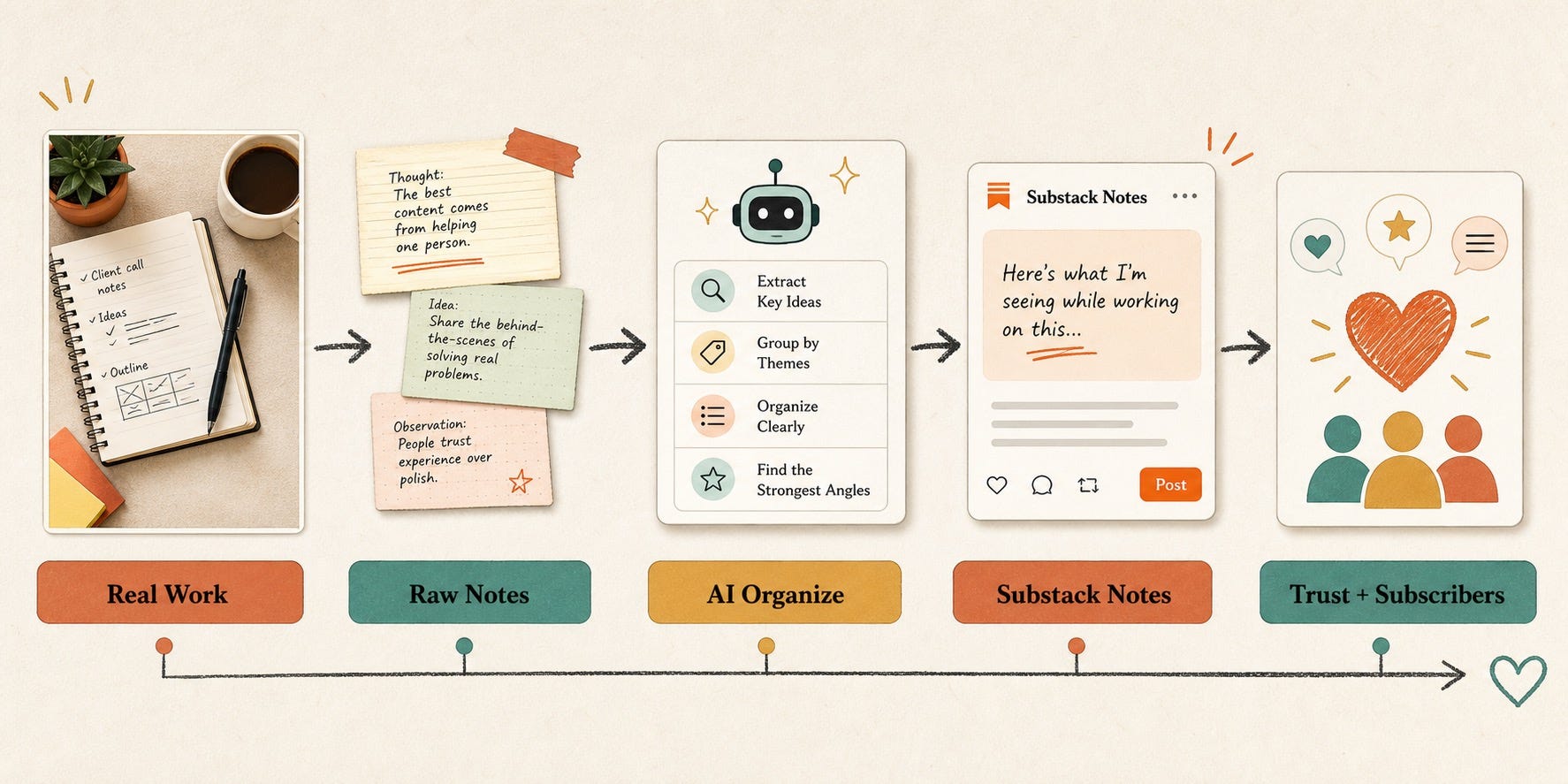
The right model is capture first, AI second.
Step 1: Collect raw material in your own language
Use voice notes, rough bullets, meeting debriefs, margin notes, or sentences you text yourself after a call. The point is to capture the messy version before AI cleans it up.
Step 2: Ask AI to classify, not invent
Have AI sort your raw material into themes such as objections, lessons, patterns, examples, myths, and repeatable principles. Classification is where AI shines without flattening your voice.
Step 3: Turn one idea into three note options
Prompt AI to produce three versions of the same point: one direct, one story-led, one contrarian. Then pick the version that still sounds like something you would actually say in conversation.
Step 4: Add one human detail before posting
A timestamp, a real phrase someone used, a mistake you made, a number with context, or a sentence fragment you naturally say. This step is tiny, but it prevents sameness.
Step 5: Keep a do-not-sound-like-this list
Ban your own overused filler. Examples: “game changer,” “in today’s fast-paced world,” “unlock,” “supercharge,” or any fake-epiphany ending. Personal branding is often damaged more by tone than by topic.
Useful prompt: “Turn these rough notes into three Substack Notes for a founder audience. Keep my sentence rhythm plain and specific. Do not add motivational fluff. Do not invent stories. Preserve blunt phrasing where it helps credibility.”
The biggest mistakes professionals make on Substack Notes
The platform is small enough that bad habits become visible quickly. These are the mistakes that weaken personal branding the fastest.
Posting only promotional links
If every Note is “new article out,” readers learn nothing about you except that you want attention. Give value in the Note itself.
Sounding polished before sounding real
Many people edit out the part that makes them worth following. Slight roughness often reads as honesty. Total smoothness often reads as outsourcing.
Trying to be broad
The desire to appeal to everyone makes most personal brands invisible. A consultant for B2B SaaS should sound like a consultant for B2B SaaS, not a generic business creator.
Copy-pasting LinkedIn style
Notes usually works better when it feels less ceremonial. Fewer fake mic-drop lines. More observations, snippets, side doors, and useful replies.
Ignoring visual identity
You do not need heavy design, but people still respond to coherence. Your profile photo, voice, topic focus, and writing cadence should feel like they belong to the same person.

A simple 30-minute weekly workflow
If you want this to last, it cannot feel like a second job. Use a small operating rhythm.
Spend 10 minutes reviewing your week for moments worth sharing: questions clients asked, patterns you noticed, or decisions you made.
Spend 5 minutes choosing one theme you want people to associate with you.
Spend 10 minutes drafting three Notes from that theme: one signal, one story, one bridge.
Spend 5 minutes replying thoughtfully to other Notes in your niche.
This workflow works for founders, students, recruiters, consultants, engineers, and creators because it starts from reality. You are not inventing content. You are extracting brand signal from work already happening.
The long-term personal branding payoff
Most people underestimate what repeated small exposures do. Over months, good Notes can make you feel familiar before someone ever books a call, replies to your email, or reads your longer essay. That familiarity is not vanity. It is conversion infrastructure.
When someone lands on your profile, they should feel three things quickly:
This person has a clear point of view
This person seems to do real work
This person sounds like a human, not a content system
That is the real job of personal branding in the AI era. Not to look omnipresent. To look credible at the exact moment the right person checks your name.
Substack Notes is not the entire answer. But for professionals who want a quieter, smarter visibility layer, it is one of the most underused tools available right now.
FAQ
Is Substack Notes good for personal branding if I already use LinkedIn?
Yes. LinkedIn is still valuable for professional search visibility and role-based credibility. Substack Notes adds a more conversational layer where people can see how you think over time. The two channels do different jobs.
What should I post on Substack Notes for personal branding?
Post short opinions, mini stories, proof moments, replies to other writers, and small bridges into longer pieces. Focus on useful specificity rather than inspirational filler.
Can AI help me write better Substack Notes?
Yes, if AI helps organize and shape your raw ideas instead of generating your opinions from scratch. Capture your own language first, then use AI for structure, variation, and editing.
How often should founders or consultants post on Substack Notes?
Consistency matters more than volume. Three to five thoughtful Notes per week is enough for most professionals if the Notes are distinct, useful, and connected to real work.
Are Substack Notes better than posting on X or Threads?
Better depends on your goal. Notes is especially strong when you want trust, subscriber growth, and a closer connection between short-form thinking and long-form expertise. X and Threads may offer broader reach, but Notes often gives more context-rich discovery.
How do I avoid sounding promotional on Substack Notes?
Deliver the useful thought first. Do not lead with links or announcements. Share one sharp observation, one practical lesson, or one concrete example before inviting readers into anything larger.