


A lot of smart professionals are asking the same question right now: should you build your personal brand on Substack, on your own website, or both? The wrong answer does not just slow growth. It shapes how searchable, credible, and portable your reputation becomes in an AI-heavy internet.
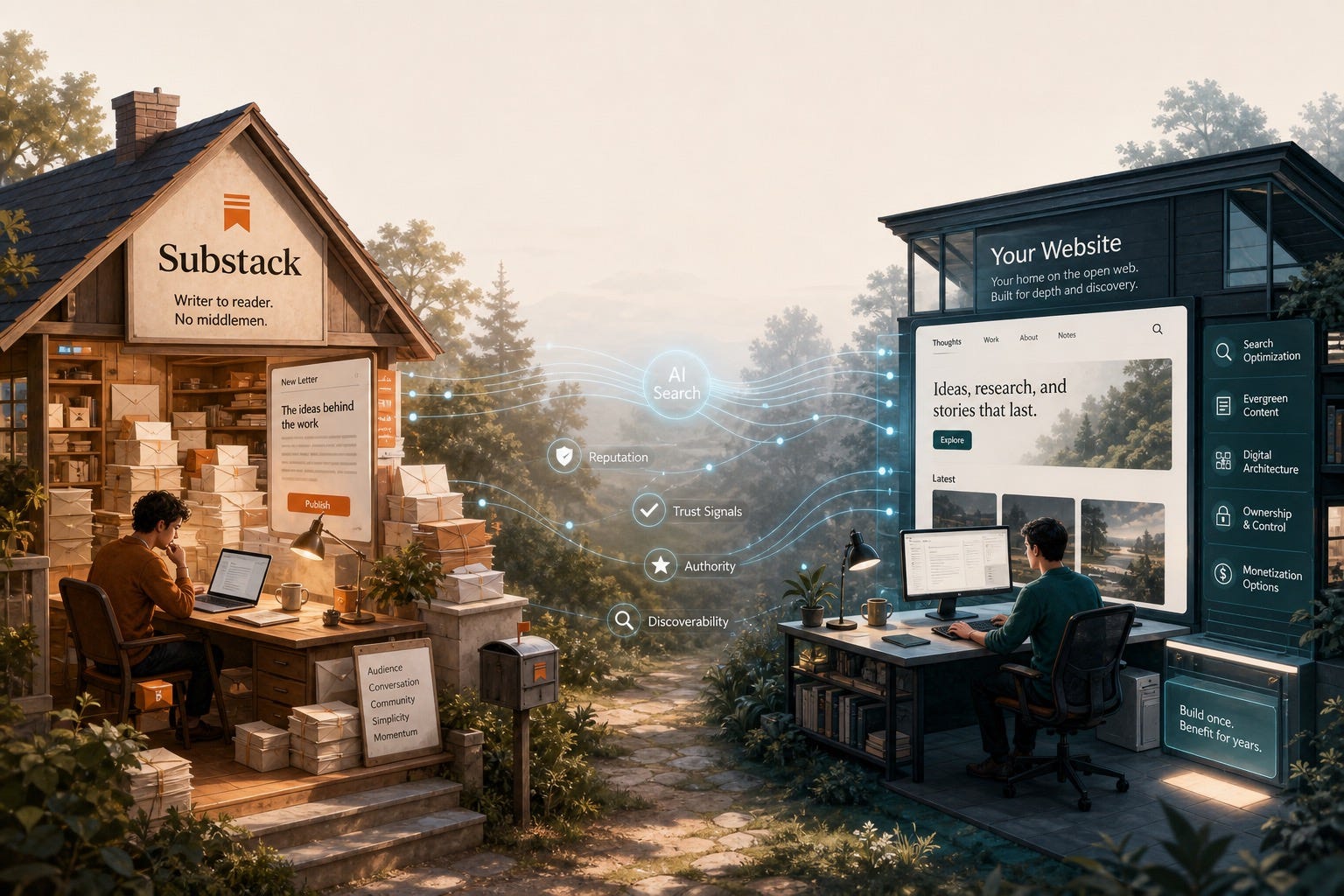
If you are a founder, creator, consultant, executive, student, or job seeker, this is not a tooling question. It is an identity architecture question. Where will people learn who you are, what you know, and why they should trust you? Where will AI systems find the cleanest version of that story? And what happens if one platform stops working in your favor?
Attention can be rented. Reputation should be owned.
The strongest answer for most people is not ideological. It is strategic. Substack and a personal website are not enemies. They are different surfaces with different strengths. The mistake is forcing one to do the other’s job.
Why This Decision Matters More Now
For years, this debate was mostly about blogging preferences. Today, it is about discoverability, trust, and machine-readable identity. AI tools, search engines, recruiters, clients, podcast hosts, and partners increasingly form an opinion about you before speaking to you. They scan your profiles, bios, articles, linked assets, and proof trails. That means your personal brand is no longer only a social impression. It is an information structure.
That is why this decision feels newly urgent. Recent discussions across Reddit communities show a pattern: people want audience growth, but they also worry about ownership, SEO, platform dependence, and the generic sameness that comes from outsourcing too much of their identity to templates and algorithms. That tension is real.
The AI layer makes it sharper. Substack is excellent at reducing friction. A personal website is excellent at reducing ambiguity. If your brand is early, friction matters. If your brand is compounding, ambiguity matters even more.
What Substack Is Best At
Substack is a strong choice when you need momentum, publishing simplicity, and a built-in writing habit. It reduces setup anxiety. You can choose a name, write a post, collect subscribers, and begin building signal fast.
Where Substack wins
It makes starting easy. That matters if your current alternative is endless planning.
It connects content and email in one place, which is powerful for repeat attention.
It has some platform-level discovery and social features, especially for writers and idea-led creators.
It encourages consistency because the publishing path is simple.
It feels more human than many polished personal sites because readers expect active thinking, not brochure copy.
If your biggest problem is “I never publish,” Substack is often a better first move than building a perfect site that stays unpublished for months.
It is also useful if your personal brand is driven by regular essays, letters, commentary, or original analysis. A consultant sharing weekly frameworks, a founder narrating lessons from building, or a job seeker documenting a learning sprint can all benefit from that cadence.
Where Substack struggles
You do not control the environment the way you do on your own domain.
It is harder to shape a richer proof structure with custom pages, case studies, service paths, and portfolio logic.
Your positioning can blur if the publication identity becomes stronger than the person behind it.
For many professionals, Substack alone is not the best “trust on first visit” page.
AI and search systems may understand a structured website more cleanly than a platform profile with scattered context.
Substack is strong at ongoing relationship. It is weaker at being your full identity hub.
What a Personal Website Is Best At
A personal website is your cleanest ownership asset. It is where you control the page hierarchy, messaging, proof, calls to action, bios, and internal links. If someone searches your name or asks an AI tool who you are, your website can become the most stable and legible answer.
Where a website wins
You own the domain, layout, and information architecture.
You can build pages for different trust jobs: home, about, speaking, services, case studies, writing, media, contact, and proof.
It is easier to create a clear professional narrative in under 60 seconds.
It gives search engines and AI systems better structural clues when the site is well organized.
It can hold multiple brand assets without forcing everything into a newsletter frame.
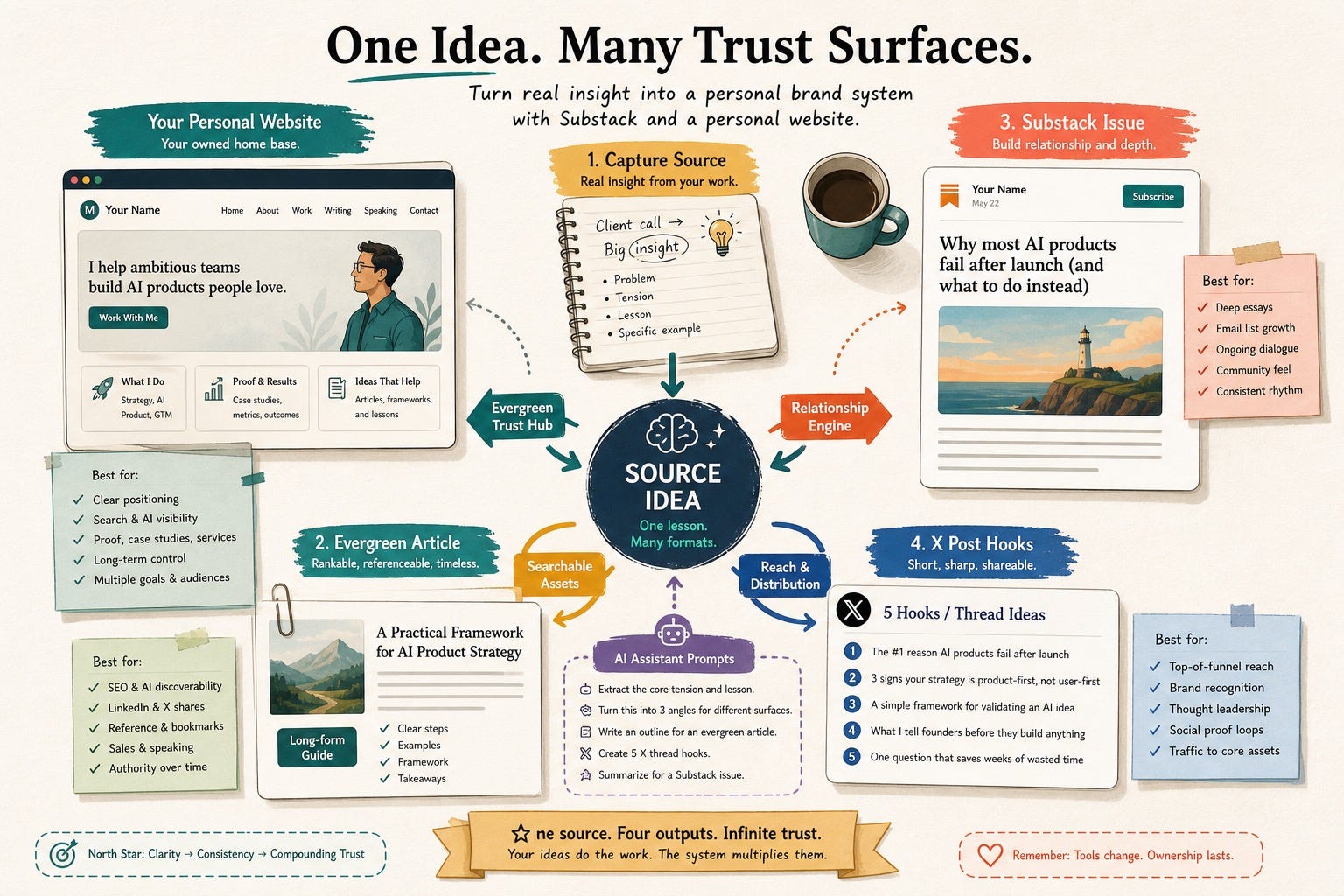
For personal branding, a website does something subtle but important: it tells visitors that your reputation has a home. That home can be simple. It does not need ten tabs and a dramatic manifesto. But it should help the right person answer five fast questions: who are you, who do you help, what do you know, what proof do you have, and what should I do next?
Where a website struggles
It is slower to launch if you overcomplicate it.
You must create your own distribution instead of relying on platform discovery.
Many people build a static site that looks respectable but never earns repeat attention.
Without a content habit, a website can become a dead artifact instead of a living reputation asset.
A clean site without ongoing ideas is a business card. A newsletter without owned context is rented momentum.
How AI Changes the Decision
This is the part many comparison articles skip. AI does not just reward volume. It rewards clarity, consistency, and retrievable evidence. That changes how you should think about both platforms.
A personal website is usually better for structured identity. You can align your headline, about section, proof pages, writing archive, and contact paths around the same positioning language. That makes it easier for systems to classify what you do.
Substack is better for generating fresh, attributable thought. If you write useful pieces consistently, those posts can reinforce your expertise and give AI systems more artifacts tied to your name. But if the publication branding overwhelms the person, the machine may understand the newsletter better than the expert behind it.
The practical takeaway is simple: use your website as the canonical identity layer and Substack as the recurring trust layer. Let the site define. Let the newsletter deepen.
The Best Choice for Different Personal Brand Goals
Choose Substack first if:
You already know your topic but need a publishing habit.
Your brand grows through regular writing more than service pages or portfolio pages.
You want an owned email audience quickly without managing extra tooling.
You are early enough that speed matters more than customization.
Choose a personal website first if:
You need a clear professional home for search, referrals, speaking, hiring, or inbound leads.
Your credibility depends on proof pages, case studies, portfolio samples, or service clarity.
You want your name, not a publication brand, to be the main entity people remember.
You care about long-term control and machine-readable identity.
Use both if:
You want the website to anchor your identity and Substack to carry your ongoing ideas.
You publish often enough that an email relationship matters.
You want to repurpose one insight across search, inbox, and social without sounding repetitive.
The most useful default: build a simple personal website first, then use Substack as your recurring publishing and audience layer. If that feels too heavy, start on Substack now, but reserve your domain and create a migration path before the platform becomes your only home.
A Practical AI Workflow for Running Both Without Burning Out
The fear is understandable: two platforms sounds like double the work. It should not be. A good AI workflow turns one source idea into multiple assets without flattening your voice.
Capture one real source. Use a voice note, client lesson, build log, question from a call, or field note from your work.
Ask AI to extract the core tension, not write the final piece. Example: “Turn this raw note into three angles: one essay, one homepage proof point, one X thread hook.”
Publish the long-form insight where it fits best. If it is reflective and subscriber-oriented, publish on Substack. If it is evergreen and trust-building, publish on your site.
Create a short summary block for the other asset. A newsletter issue can become a site article excerpt. A website essay can become a Substack letter with additional context.
Use social posts to route attention to the right layer. Not every post needs to sell. Some should simply sharpen recall.
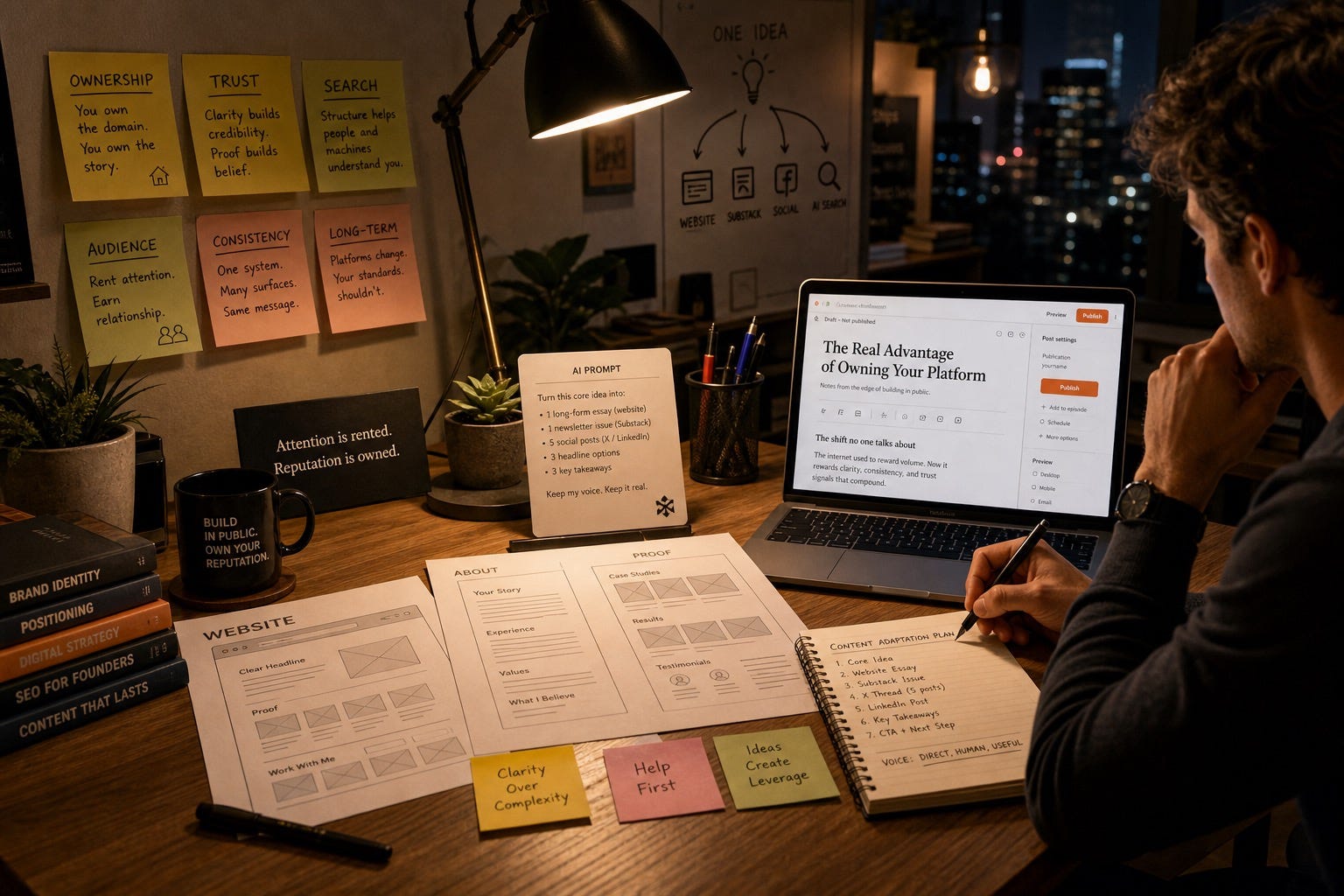
The key is that AI should compress effort, not invent authority. Use it to sort, outline, edit, retitle, and adapt. Do not use it to manufacture a point of view you did not earn.
The Biggest Mistakes People Make
They treat Substack as a full personal website replacement when they really need a clearer trust hub.
They build a beautiful site with no ongoing publishing rhythm, so the brand looks finished but not alive.
They let AI make everything smoother, then wonder why nothing feels memorable.
They create a publication brand that hides their own name and weakens personal recall.
They split their message across bios, handles, headlines, and homepage copy until nobody, human or machine, can summarize them cleanly.
The Smartest Long-Term Setup
If you want the cleanest long-term personal branding stack, think in layers.
Your personal website is the identity layer. It explains who you are and holds your most important proof.
Your Substack is the relationship layer. It gives people a reason to hear from you again.
Your X and LinkedIn posts are the distribution layer. They create discovery, repetition, and recognizable hooks.
Your AI workflow is the adaptation layer. It helps one idea travel across those surfaces without becoming generic.
That model is more durable than betting everything on a single platform. It also creates better conditions for AI visibility because your identity, evidence, and ideas reinforce each other instead of living in isolated fragments.
If you want to be memorable online, do not just publish more. Build a place where your best thinking can accumulate.
Bottom Line
If you need speed, start with Substack. If you need clarity and control, start with a personal website. If you care about long-term personal branding in the AI era, the strongest answer is usually both, with one clear rule: your website should be the home base, and Substack should be the compounding conversation.
The goal is not to choose the trendiest platform. The goal is to make your reputation easier to understand, easier to trust, and harder to lose.
FAQ
Is Substack good for personal branding?
Yes, especially if your personal brand grows through writing and consistent ideas. It is strong for building a recurring relationship with readers, but it is usually weaker than a personal website as a full identity hub.
Is a personal website better than Substack for SEO?
In most cases, yes. A personal website gives you more control over structure, pages, metadata, internal links, and positioning language, which usually makes it easier for search engines and AI systems to understand your professional identity.
Should I use my name on Substack or a publication name?
If personal branding is the goal, your own name should remain highly visible. A publication name can still work, but it should not make the expert behind the publication harder to recognize.
Can I build a personal brand with Substack only?
You can, but there are tradeoffs. Substack-only setups are faster to launch, yet they often provide less control over how your proof, positioning, and search presence are organized over time.
What is the best setup for founders, consultants, and creators?
For most professionals, the strongest setup is a simple personal website for positioning and proof, plus Substack for ongoing essays or newsletters. Then use X or LinkedIn to distribute ideas and create repeated recognition.