


A strong technical writer personal brand is not a feed full of polished prose. It is evidence that you can turn uncertainty into something people can safely use.

The valuable part of documentation is not only the sentence. It is the judgment that makes the sentence safe and useful.
When AI can produce a clean first draft in seconds, “I write clearly” is no longer enough of a public signal. The work that makes a technical writer valuable happens before the sentence and after the publish button: finding the real source, spotting a missing decision, asking the question nobody else asked, protecting readers from a bad assumption, and keeping an answer true after the product changes.
That work is hard to show. Much of it lives in private tickets, tense review calls, source repositories, and customer context you cannot repeat online. So many writers settle for a tool list, a vague “I simplify complexity” headline, or a portfolio of sanitized screenshots. Those are not wrong. They are simply too small.
The better move is to make your documentation judgment visible. This is a personal branding strategy for technical writers who want stronger career proof, better consulting conversations, or a clearer professional identity in an AI-shaped market—without turning client work into content or pretending AI output is expertise.
The shift: from writing samples to decision proof
A writing sample answers, “Can this person produce readable copy?” A decision-proof asset answers a more valuable question: “Can this person help a team make complex information understandable, trustworthy, and maintainable?”
Think about a documentation problem you have seen before. Maybe an API guide assumed a concept users did not have. Maybe a release note described a feature but not the behavior that changed. Maybe an onboarding guide worked for the author and failed for a new administrator. Your contribution was not merely changing words. You chose a reader, found evidence, resolved a conflict, and designed a path through the uncertainty.
Your public brand does not need to reveal the product. It needs to reveal how you reason when clarity, accuracy, and reader safety compete.
That distinction makes AI useful rather than threatening. AI can help you retrieve patterns, create a rough structure, test whether an explanation assumes too much, and generate alternate outlines. It cannot honestly claim it interviewed the subject-matter expert, validated a behavior, or understood which detail was confidential. Those are your signals.
The evidence → decision → teaching loop
Use this repeatable loop to turn invisible documentation work into credible thought leadership. It works whether you write developer docs, regulated procedures, knowledge-base content, internal enablement, or product education.
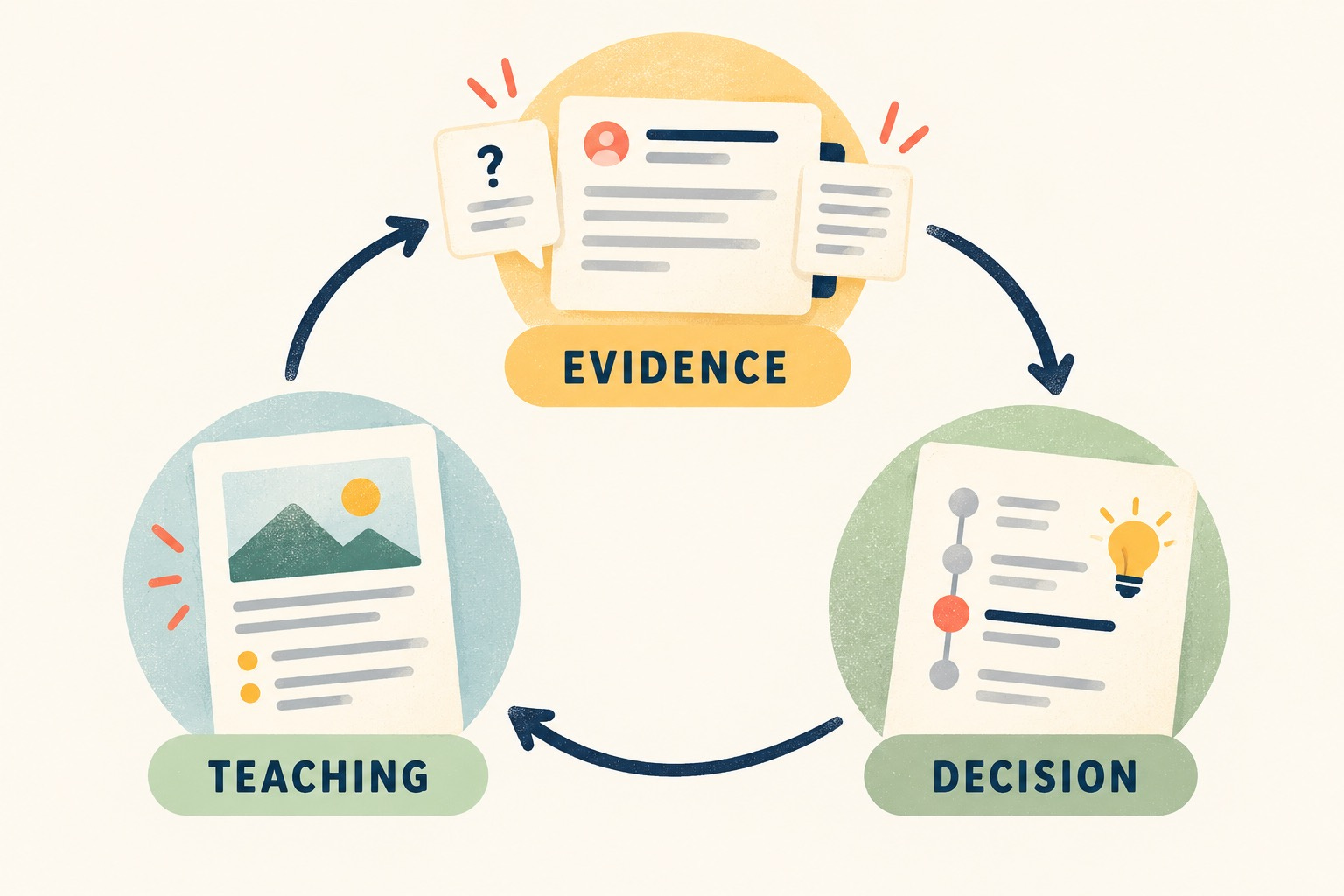
A public lesson should come from a verified pattern, not a clever prompt.
1. Capture evidence privately
Keep a small documentation judgment log. After a meaningful project moment, record five items: the reader’s goal; the confusing or risky moment; the evidence you consulted; the decision you made; and what changed after review. Do this in a private workspace, not a public draft.
The log does not need names, screenshots, client identifiers, prices, unreleased features, or verbatim support tickets. In fact, leave those out by default. You are collecting the shape of the problem. “New administrators skipped a required configuration step because the prerequisite was described after the action” is enough to remember the lesson without exposing anybody.
2. Name the decision, not the deliverable
“I wrote an onboarding guide” is a deliverable. “I moved the prerequisite into a visible checkpoint because new users were making an irreversible choice too early” is judgment. The second version gives someone a reason to trust your work even if they never see the original guide.
Useful decision categories include audience segmentation, information order, terminology, source conflict, progressive disclosure, accessibility, maintenance ownership, and validation. Over time, a pattern will emerge. Perhaps you are especially good at making setup flows safer, translating policy into plain language, or helping developers document edge cases. That is a real technical writer niche—not a decorative label.
3. Turn the pattern into a public lesson
Now generalize. Remove identifying facts, swap in a harmless example, and teach the principle. A public post could be: “The prerequisite test I use before publishing an admin setup guide.” A short newsletter could explain why task order is an integrity issue, not just a style preference. A portfolio note could show a before-and-after information architecture using a fictional workflow.
Do not write “Here is what my client did.” Write “Here is the test I use when a setup guide hides a prerequisite.” You are teaching a durable method, not borrowing authority from private work.
Use AI as a bounded editorial partner
AI can speed up the conversion from your private log to a public lesson. But it needs a tight job description. Never paste customer data, confidential documentation, private transcripts, credentials, or unreleased roadmap details into a general AI tool. Your goal is to give AI a sanitized pattern and ask it to help with editorial options—not to let it reconstruct your employer’s knowledge base.
Start with your own anonymous notes. Then ask AI to expose assumptions, create audience-specific angles, or challenge a weak claim. The human review is the point: you decide whether the pattern is real, whether the example is safe, and whether the final lesson carries the right amount of certainty.
I am a technical writer creating a public lesson from a sanitized work pattern. Do not invent facts or outcomes.
Pattern: [describe the recurring reader problem without names, product details, or metrics]
Decision: [what changed in the information design and why]
Audience: [developers / administrators / leaders / writers]
Give me three angles for a short, practical teaching piece. For each, state the claim, the safe fictional example needed, a limitation or caveat, and a question I must answer from my own experience before publishing.
This prompt does something important: it forces the model to leave space for your evidence. If it gives you a beautiful sentence that you cannot support, cut it. Personal branding is not a contest to sound certain. It is a system for becoming reliably useful.
Build a technical writer portfolio that shows how you think
A portfolio still matters. Just make each item do more than display an artifact. For three selected samples, create a compact decision card with four parts.
The reader problem: What was difficult, risky, slow, or confusing? State it without confidential detail.
The information move: What did you change—sequence, vocabulary, source process, structure, review path, or format?
The reason: Which constraint shaped that move? A user goal, evidence conflict, accessibility concern, policy requirement, or maintenance reality is more useful than “best practice.”
The boundary: What can you not show, and what can a reader inspect instead? Use a fictional example, a public open-source contribution, a reusable checklist, or a redacted structure.
This format protects confidentiality while making your role legible to people who do not understand technical communication. A hiring manager can see that you are not merely the last stop before publication. A potential client can see the difference between content production and documentation strategy.
Choose a public rhythm that does not turn you into a content machine
You do not need daily posts. One useful pattern each month can build a clearer personal brand than a month of generic AI tips. Pick a format that makes your documentation judgment easy to encounter: a short LinkedIn lesson, a Substack field note, a public checklist, a speaking outline, an annotated fictional example, or a small open-source contribution.
Use a simple three-part content mix. First, publish a reader problem: why a confusing concept repeatedly traps people. Next, share a decision method: how you decide what belongs first, what needs proof, or when a guide is too broad. Finally, publish a maintenance insight: how a good answer stays accurate after launch. This last category is underused and immediately separates you from people who only discuss first drafts.
Keep a boundary list beside your content log. Never publish something that reveals a customer, makes a claim you cannot substantiate, implies approval you do not have, or uses a sanitized example that remains recognizable to the people involved. If in doubt, teach a public pattern from open documentation instead.
Make collaboration part of your credibility

Documentation judgment is often collaborative: the writer creates a path to a usable shared understanding.
Technical writers are often hired into an information gap. The product team knows one part of the truth. Support hears another. Engineers understand the system. Legal or security teams set a boundary. The reader experiences the gaps between them. Making that collaboration visible is not self-promotion; it is a clear description of the work.
In your public teaching, show the questions you use: “What must the reader know before this step?” “Which source wins when the ticket and the interface disagree?” “What breaks if this instruction is skipped?” “Who owns this answer after release?” These questions demonstrate an operating method. They also make AI use safer because they show where a model’s confident draft must stop and human verification must begin.
A 30-day documentation judgment sprint
For the next month, do less posting and more noticing. In week one, start the private judgment log and collect three moments from current or past work. In week two, choose the safest pattern and write a fictional example that preserves the decision but removes the context. In week three, use AI to produce three editorial angles, then verify every sentence against your own knowledge. In week four, publish one short lesson and add one decision card to your technical writer portfolio.
After publishing, pay attention to the quality of replies rather than vanity metrics. Did a developer say, “We keep seeing that”? Did another writer ask for your checklist? Did someone understand your specialty more precisely? Those are the signs that your personal brand is becoming useful. Reuse questions in the comments as input for the next loop.
The reputation worth building
The technical writers who stand out in an AI-heavy market will not necessarily be the people who produce the most words. They will be the people who can show how they turn unreliable, scattered, or sensitive information into guidance others can act on.
That is a credible personal brand: not “I am a great writer,” but “Here is how I help people understand complex systems without making false promises.” AI can help you package that insight. It cannot replace the evidence, care, and accountability that make the insight worth trusting.
Frequently asked questions
How can a technical writer build a personal brand without sharing confidential work?
Publish the decision pattern, not the client story. Use anonymous notes, fictional examples, public documentation, or redacted structures to explain the reader problem, the information choice, and the reasoning behind it.
What should a technical writer include in a personal branding portfolio?
Include selected samples plus decision cards that explain the audience, problem, information move, reasoning, and safe substitute for material you cannot share. This shows strategy as well as writing ability.
Can technical writers use AI for personal branding?
Yes, for outlining, question generation, editing alternatives, and assumption checks. Keep confidential information out of general tools, verify every claim yourself, and do not present AI-generated language as lived expertise.
What is the best personal branding niche for a technical writer?
Choose a recurring decision you genuinely make well—such as developer onboarding, regulated procedures, API discoverability, information architecture, or documentation maintenance. A repeatable judgment is more credible than a broad tool list.
How often should a technical writer post on LinkedIn or Substack?
Start with one evidence-backed lesson a month. Consistency matters, but a smaller volume of useful, specific work will build more trust than frequent generic posts.
How do I avoid sounding like an AI-generated technical writer online?
Lead with a real observation, state the constraint that shaped your decision, use only claims you can defend, and include a limitation. Specific judgment is difficult to fake and more helpful to readers.