


A credible public identity is not a gallery of confidential screens. It is a clear trail of the judgment you bring to difficult decisions.

A UX researcher’s best work is often the hardest work to show. The interviews are private. The product is confidential. The decision trail is scattered across tools. So the internet sees a job title while the people closest to the work see judgment.
That gap matters more now. AI can produce a neat summary, a polished post, or a tidy case-study outline in minutes. But it cannot earn trust for you. If the public version of your work is vague, overconfident, or quietly exposes people who did not consent to be visible, AI has made the risk faster—not smaller.
The useful alternative is not to become a louder content creator. It is to become a clearer translator of how you think. This article offers a privacy-first system for turning real research practice into public proof: no participant data, no product leaks, no synthetic authority.
Personal branding for UX researchers is a translation problem
A recruiter, a founder, or a product leader does not need every artifact from your last study. They need confidence that you can frame a messy question, select an appropriate method, notice a pattern, challenge a weak conclusion, and help a team decide what to do next.
That is different from self-promotion. It is evidence of professional judgment. Nielsen Norman Group’s portfolio guidance makes the same basic point: research portfolios should communicate context, methods, findings, and impact in plain language—not just show deliverables. It also reports that communication is central to the role. Your public presence can extend that communication skill beyond a password-protected portfolio.
The temptation is to prove credibility with volume: more screenshots, more jargon, more “insights.” Resist it. The strongest signal is a narrow, repeatable lesson that a stranger can understand and a peer can challenge.
Do not publish what participants said. Publish the decision habit their experience taught you.
Why the usual advice fails
Generic personal-brand advice says “pick a niche and post consistently.” Generic portfolio advice says “show your process.” Both are incomplete for research. Your process contains sensitive data. Your work may sit behind an NDA. And a polished story can make a small, contextual study sound like a universal truth.
There is another trap: treating AI output as evidence. AI can help you find structure after you have created a safe abstraction. It should not be given raw participant material just because it is convenient, and it should never become the final judge of what a theme means. Recent research-industry surveys show AI is widely used in synthesis, but practitioners remain split on how much of that work should be democratized. That is a useful warning: speed is not the same thing as confidence.
Your personal brand is not your research repository. It is the small, public layer where you demonstrate the standards you bring to research, communication, and decision-making.
The Signal-to-Story workflow
Use this workflow once a month. It takes less effort than inventing a new opinion every week because it starts with work you have already done—carefully transformed.
1. Capture a decision pattern, not a project recap
After a study, write one private sentence that begins: “When we saw this condition, I learned that this decision rule was safer or stronger because this evidence pattern.”
For example: “When early users could complete the task but repeatedly paused before a commitment step, I learned to separate apparent usability from decision confidence.” That sentence does not identify a user, an employer, a feature, or a metric. It still reveals a real piece of research judgment.
Keep a small decision-pattern ledger with the date, situation category, method, the counterargument you considered, what changed, and what you are not allowed to share. This is more useful than a list of “content ideas” because it preserves the reasoning that made the lesson yours.
2. Draw the safety boundary before you draft
Ask four questions. Could this identify a participant indirectly? Could it reveal a client, roadmap, internal metric, or unreleased interface? Did the consent process permit public reuse? Would a teammate recognize a sensitive situation even without a name?
If any answer is “maybe,” abstract further. Replace a company category with a broader setting. Remove exact sample sizes, dates, locations, job titles, screen details, and distinctive quotes. Do not rely on blurring alone; a unique combination of details can still be identifiable.
When a lesson cannot survive abstraction, it is not a public lesson. Keep it private. That restraint is part of the brand you are building.
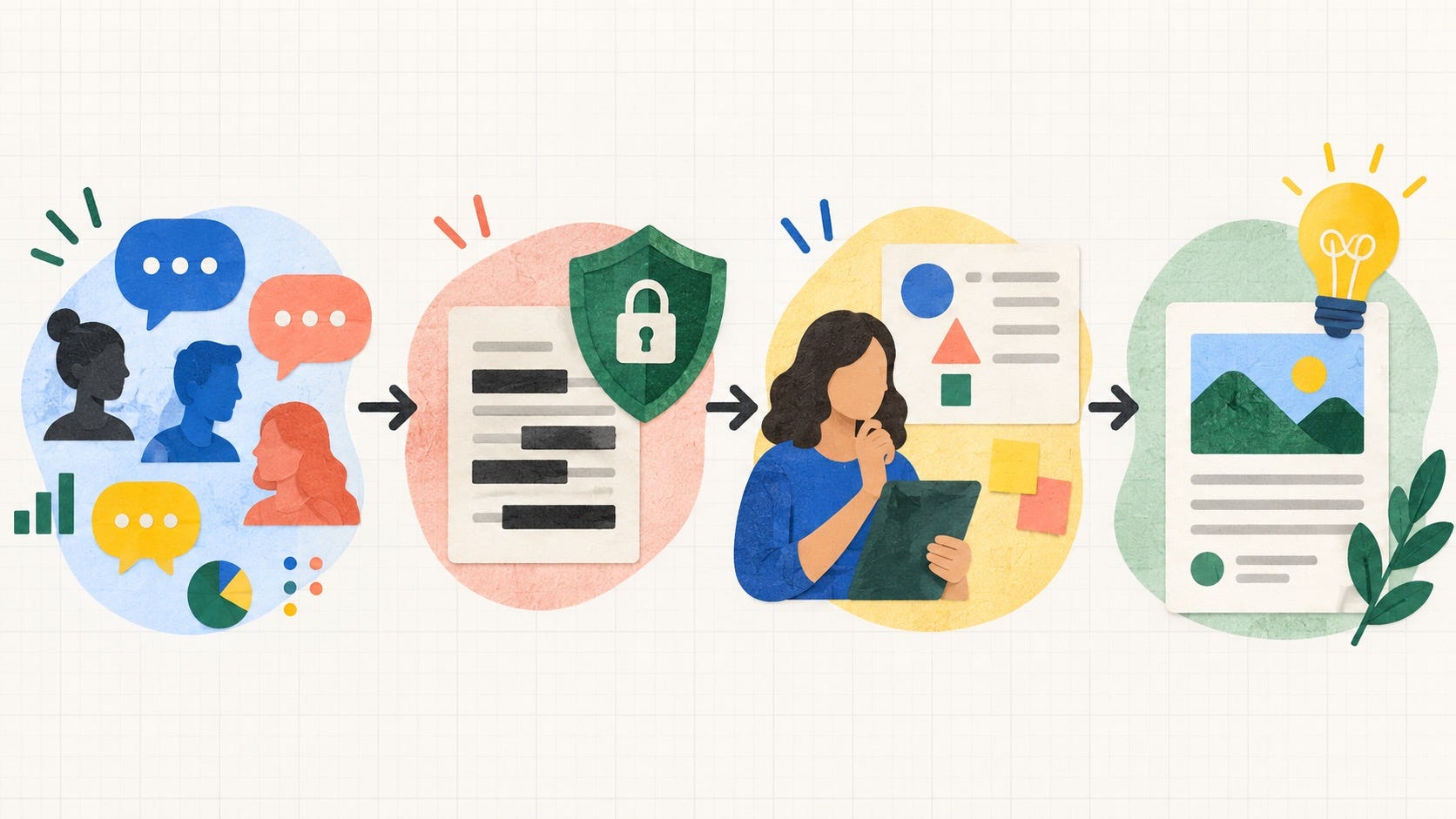
3. Use AI as an editor of safe material, not a witness to raw research
Once you have a de-identified decision pattern, AI can help you explore formats: a LinkedIn post, a short newsletter note, a talk outline, or a case-study section. Give it only the public-safe abstraction. Ask it to preserve uncertainty, surface assumptions, and suggest what a skeptical reader would need to know.
I am a UX researcher sharing a de-identified professional lesson.
Turn the material below into three short teaching angles for [audience]. Keep the claim proportional to the evidence. Do not invent a result, statistic, user quote, company detail, or universal rule. Mark any statement that needs human verification. Preserve the limitation.
Safe lesson: [paste your abstracted decision pattern]
Limitation: [what this does not prove]
Audience: [who should learn from it]
Then do the part AI cannot do: reopen your source material privately and check every implication. Did the draft turn “several participants” into “users prefer”? Did it claim causation when you observed a correlation? Did it erase the condition that made the insight useful? If so, fix it or discard it.
4. Publish one useful, bounded teaching asset
A good public asset has four pieces: the situation category, the decision tension, the method or observation that earned the lesson, and the limit. You might write: “In high-stakes onboarding, completion rates can hide uncertainty. In moderated testing, I listen for the pause before commitment and pair the task result with a confidence probe. This will not diagnose every onboarding problem, but it catches a failure mode teams often miss.”
That is more memorable than “I conducted usability testing.” It is also honest. Over time, ten such lessons reveal your point of view: perhaps you are the researcher who makes uncertainty visible, who keeps AI outputs accountable, or who helps teams distinguish activity from confidence.
What this looks like across your public surfaces
On LinkedIn, use one decision pattern as a short post. Start with the tension, not an announcement: “A completed task is not always a confident task.” Add the method in plain English, then the limit. Invite a specific discussion from product peers.
In a portfolio, make a “how I make decisions” page separate from confidential case studies. Explain your research principles, common methods, quality checks, and a few safely abstracted patterns. Link to public writing where the work is intentionally generalized.
In a newsletter, create a recurring “research decision note.” One note, one pattern, one caveat. Consistency does not mean repeating yourself. It means readers learn what kind of care they can expect from you.
In conversations, use the same language. If your profile says you turn ambiguity into decisions, your interview examples should show the method, the trade-off, and the result—not only the final recommendation.
The proof stack that makes a researcher believable
Public writing works best when it sits beside other verifiable signals. Maintain a concise bio that names your research focus, a methods list limited to work you can defend, a selected portfolio or project walkthrough, and a small set of source-backed lessons. If you speak, teach, contribute to a community, or publish a framework, make the artifact easy to find.
This is not a demand to be everywhere. Choose two places: one profile where someone decides whether you are credible, and one owned place where your ideas can remain useful after a feed moves on. A carefully maintained body of work beats a busy-looking posting schedule.
A 45-minute monthly practice
10 minutes: review recent studies, stakeholder debates, and debrief notes for one decision pattern worth keeping.
10 minutes: apply the safety boundary. Remove identities, private context, and information you cannot substantiate.
10 minutes: ask AI for three formats from the safe abstraction, then reject any inflated framing.
10 minutes: write the smallest useful version: a post, note, short diagram, or portfolio paragraph.
5 minutes: log the source, limitation, publication link, and feedback you received.
The feedback log matters. It tells you which ideas readers actually find useful and which claims need sharper context. That is audience research applied to your own reputation—without turning people into content fuel.
Run a recognizability review before you publish
Privacy review is not only a checklist for names and faces. A former colleague may recognize a project from a rare combination of industry, timing, workflow, team shape, product stage, screenshot fragment, or unusually specific customer behavior. A participant may recognize themselves from a quote even when their name has disappeared. Ask someone who understands the context to perform a “could this be recognized?” read before a sensitive piece goes live.
Also review the claim itself. Separate what you observed, what you inferred, what the team chose, and what happened after. “We noticed a pattern” is not the same as “all users want.” “The team changed direction” is not the same as “research caused growth.” Research practice becomes more credible when these distinctions remain visible.
This is where AI needs the strictest boundary. A fluent draft can make a modest lesson sound like a universal law. It may fill missing causal links with plausible language or turn an illustration into a claim. Your final pass should deliberately look for those upgrades. If you cannot show where a sentence came from, rewrite it as a question, add a limitation, or remove it.
That discipline is public proof in its own right. People trust researchers who make the strength of their evidence clear—especially when everyone else is rewarded for sounding certain.

The career advantage is not louder visibility
UX researchers are increasingly asked to operate near strategy, AI product work, service design, and consulting. In those settings, your value is not merely that you can collect research. It is that you can make evidence usable without oversimplifying people.
A public body of careful work lets a future collaborator see that before the interview. It shows that you protect participants, distinguish observation from inference, and can make a complex decision legible to a non-researcher. That is executive presence for a research practitioner: calm, specific, and accountable.
So start smaller than you think. Do not publish a heroic case study. Publish one safe, useful decision rule that only someone who has done the work could explain. Then do it again next month.
Frequently asked questions
How can a UX researcher build a personal brand without sharing confidential work?
Share de-identified decision patterns instead of project artifacts. Explain the general situation, method, reasoning, and limitation while removing client names, product details, distinctive quotes, metrics, and participant information.
Can I use AI to write UX research thought-leadership posts?
Yes, after you create a public-safe abstraction. Use AI for framing and editing, not as a repository for raw transcripts or as evidence. Verify every claim against your private source material and restore the limits AI often smooths away.
What should a UX researcher post on LinkedIn?
Post short, useful lessons about research decisions: a tension you noticed, the method that helped, what changed, and where the lesson does not apply. Avoid generic “five insights” posts that cannot show how the conclusion was earned.
Do UX researchers need a portfolio if they have a strong LinkedIn profile?
Usually, yes. A profile helps people discover you; a portfolio or decision page gives them a durable place to inspect your methods, judgment, and selected proof. It can be concise and should never compromise participant privacy or an NDA.
How do I make a UX research case study safe to publish?
Start with consent and contractual boundaries. Remove direct and indirect identifiers, proprietary screens, raw recordings, distinctive quotes, exact timing, and private metrics. If the case cannot be honestly abstracted, use a personal, academic, or open study instead.
What is the most credible personal-brand signal for a UX researcher?
A consistent record of carefully bounded, source-aware teaching. It shows you can turn evidence into a decision, explain uncertainty, and respect the people whose experiences made the research possible.