


Most job seekers waste their video resume in the first 20 seconds. A strong script does not try to say everything. It gives a recruiter one clear reason to remember you, trust you, and keep reading

The hiring market is getting stricter in a strange way. Candidates can now use AI to polish resumes, rewrite cover letters, and rehearse interview answers, so employers are relying on faster trust signals. That means your first impression is no longer just a PDF. It can be a recruiter search result, a portfolio, a short Loom, a work sample, or a quick video that shows how you think and communicate.
This is why the video resume script matters more than the video itself. Most people assume the hard part is recording. It is not. The hard part is deciding what to say, what to cut, and how to sound like a real person instead of a nervous list of bullet points.
If you get that part right, a short video resume can do three things your written resume cannot do on its own. It can show judgment. It can show presence. And it can make your experience easier to remember.
If you get it wrong, it can feel awkward, too long, generic, or risky for the role. That is why the best approach is not “be more charismatic.” It is using a structure that keeps you relevant, specific, and human.
Why a Video Resume Script Works Now
Search data and live site behavior both point in the same direction: job seekers are still looking for practical help on video resumes, but the strongest need is not abstract inspiration. It is execution. People want a script template, a structure, examples, and a safer way to stand out without sounding rehearsed.
That gap exists because a lot of ranking content still treats video resumes like a novelty. The advice tends to repeat the same basics: keep it short, dress professionally, and smile. That is not wrong. It is just incomplete. In 2026, a useful guide also has to answer harder questions:
When is a video resume actually a smart move?
How do you stay concise when your background is messy or nontraditional?
How do you use AI to speed up the process without sounding synthetic?
What do you do if you are camera-shy but still want the upside?
How do you make the video support your application instead of distracting from it?
That is the angle worth owning: not “video resumes are cool,” but “here is how to make one that fits modern hiring logic.”
When to Use a Video Resume and When to Skip It
A video resume is not universally good. It is situational. Use it when it adds signal that a written resume cannot deliver as quickly.
Use a video resume when: you are applying for client-facing, sales, creator, recruiting, marketing, consulting, teaching, founder, community, or leadership roles where communication is part of the value.
Skip it when: the employer clearly wants a standard process, the role is highly formal, or the video would not materially improve your case.
The video should never replace the written resume. It should make the resume easier to trust. Think of it as a positioning layer. The written resume says, “Here is what I have done.” The video says, “Here is how I think, what I prioritize, and why I fit this role.”
The best video resume is not a performance reel. It is a compressed trust-building asset.
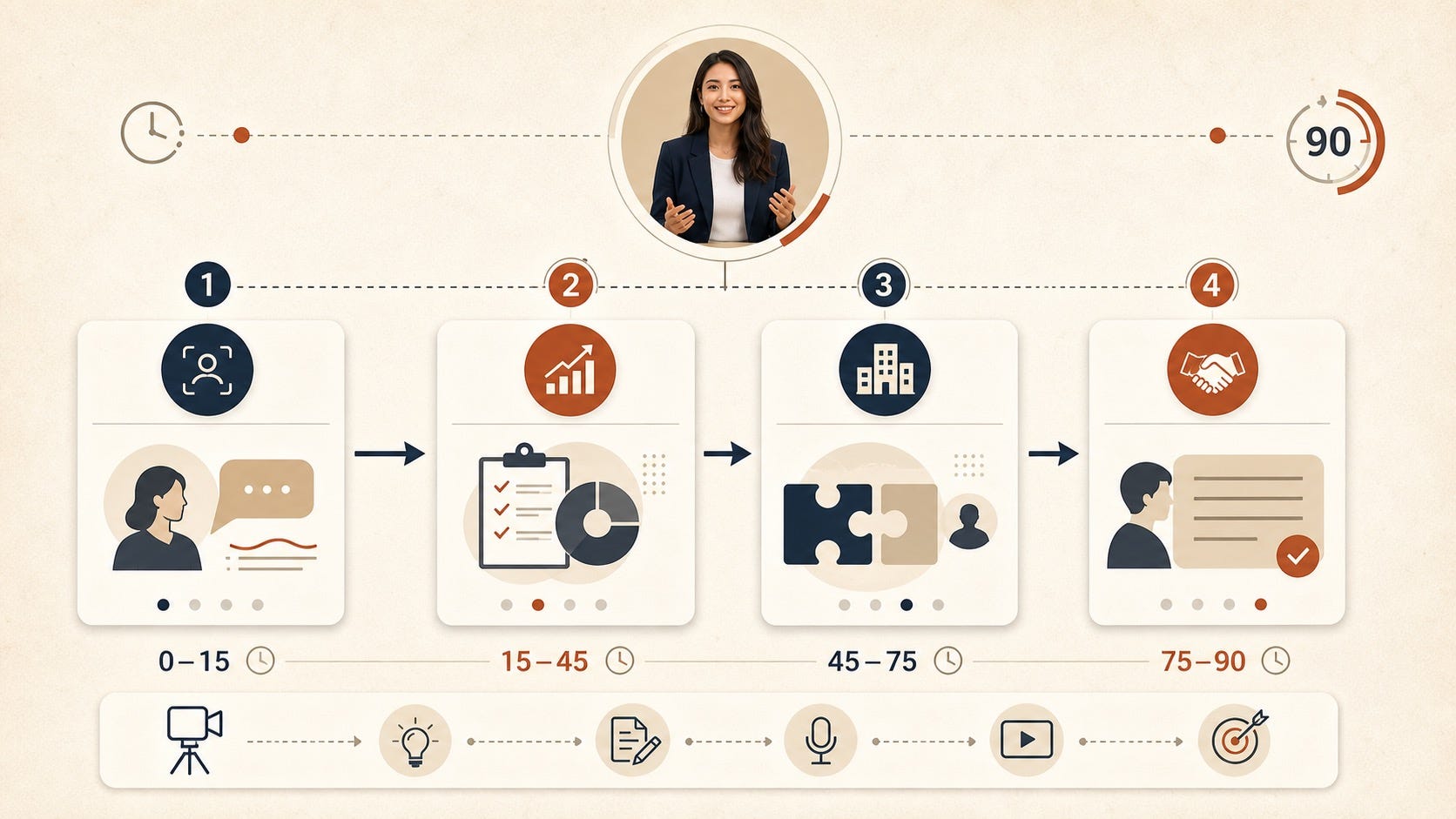
The 90-Second Video Resume Script Formula
If you try to cover your whole background, you will ramble. If you try to sound impressive, you will probably sound vague. A tighter structure works better:
0-15 seconds: who you are, what role you want, and what kind of problem you solve.
15-45 seconds: two or three proof points with concrete outcomes.
45-75 seconds: why this role or company fits your strengths now.
75-90 seconds: clean close with next-step energy, not desperation.
1. Open With Relevance, Not Biography
Do not spend your opening on your full name, school history, or a generic “I am passionate about growth.” Start with role alignment. A recruiter wants to know, almost immediately, whether the next minute will be worth their time.
A stronger opening sounds like this: “I am a customer success manager with five years of SaaS onboarding experience, and I specialize in helping new accounts reach activation faster.” That is better than “Hi, my name is Sam, and I am excited to introduce myself.”
2. Use Proof Points That Travel Well on Video
Not every achievement belongs in a video resume. Choose examples that are easy to understand without a lot of setup. The best proof points usually have one of these qualities:
A measurable result
A visible responsibility increase
A strong before-and-after contrast
A customer, project, or team outcome that signals judgment
In other words, “I improved onboarding completion from 54% to 71% in two quarters” lands much better than “I helped improve customer workflows.”
3. Show Fit Without Flattery
This is the most underused part of a video resume script. Most candidates either skip company fit or overdo it. A better middle ground is to name one thing about the company, role, or team model that matches how you work best.
That makes you sound thoughtful instead of eager for the sake of being eager.
4. End With a Calm Call to Action
Do not end with a hard sell. End with clarity. You want the closing to feel like a natural next step: “If this role needs someone who can simplify technical information for customers and move fast with cross-functional teams, I would love to speak further.”
A Sample Video Resume Script You Can Adapt
Here is a simple example for a mid-level candidate. The wording matters less than the structure and rhythm.
Hello, I’m Maya, a product marketer focused on turning complex software into clear stories customers actually understand.

Over the last four years, I’ve led launch messaging, customer education, and sales enablement for B2B tools. In my current role, I rewrote the onboarding message flow for a new feature launch, and activation improved by 22% in the first six weeks. I also partnered with sales to build a tighter demo narrative, which helped reduce common objections earlier in the cycle.

I’m interested in this role because your team sits at the intersection of product clarity and revenue impact. That is the kind of work I do best: simplify the message, sharpen the story, and help the market understand why the product matters.

Thank you for watching. I’d welcome the chance to discuss how I could contribute.
Notice what is missing. There is no life story. No filler. No “hardworking team player.” No attempt to cover every bullet on the resume. It is a selective summary built for recall.
How to Make the Script Sound Human, Even If You Use AI
AI is useful at the outline stage, not the final voice stage. That is the difference many job seekers miss.
Use AI to help you sort your experience into a sharper order. Ask it to identify your strongest proof points, rewrite clunky lines, or turn a long paragraph into a shorter spoken version. Then edit it until it sounds like something you would actually say to a smart colleague.
A good rule: if the sentence would feel fake in a real conversation, it will feel fake on video. Spoken language needs shorter sentences, stronger verbs, and cleaner transitions.
Three edits usually make the biggest difference:
Replace abstract claims with evidence.
Cut any sentence that repeats your written resume.
Read it aloud and remove whatever feels too polished to be believable.
This is also where pacing matters. Most strong video resume scripts land between 140 and 190 spoken words, depending on the role and style. If you are closer to 250, you are probably saying too much.
The Camera-Shy Workflow That Still Looks Professional
A lot of people want the upside of a video resume but hate the idea of filming themselves from scratch. That is a real constraint, not an excuse. The smart move is to reduce friction without reducing trust.
Start by writing and refining the script first. Then decide on the format. You do not have to use the same style as everyone else. Some candidates do better with a direct-to-camera delivery. Others are stronger with a light hybrid format: short talking-head sections, simple captions, and supporting visuals. If you want a faster draft path, tools such as https://portfoliovideo.com can help convert a written narrative into a cleaner first version before you refine tone, pacing, visuals, and delivery.
The key is transparency of intent. If you use AI support, the outcome still needs to sound like you and reflect your actual experience. Do not let the tool invent confidence for you. Let it reduce production friction so you can focus on message quality

Five Mistakes That Make Video Resumes Easy to Ignore
1. Leading with generic enthusiasm
Excitement is fine. Relevance is better. Your first sentence should explain why the viewer should keep listening.
2. Repeating the written resume line by line
The video is not a narrated PDF. It should add judgment, context, and priority.
3. Using too many proof points
Two strong examples beat seven weak ones. Recruiters remember shape, not volume.
4. Sounding overrehearsed
A script is a safety tool, not a performance cage. Internalize the sequence, then speak with some natural variation.
5. Sending a video where it is culturally wrong for the role
Context still matters. A brilliant asset in one application can be noise in another.
Your Final Video Resume Checklist
Your hook explains your role fit in under 15 seconds.
Your proof points include outcomes, not just responsibilities.
Your total script is under two minutes and ideally closer to 90 seconds.
Your language sounds like spoken English, not written corporate copy.
Your close makes the next step easy.
Your video adds value beyond the resume and cover letter.
A video resume script does not need to be flashy to work. It needs to be clear, selective, and believable. That is what makes someone think, “I get this person.” In a crowded hiring market, that reaction is a competitive edge.
FAQ: Video Resume Script
How long should a video resume script be?
A strong video resume script usually lands between 60 and 90 seconds. Two minutes is the outer edge for most roles. If you need more time, you probably need tighter editing.
What should I say first in a video resume?
Start with role relevance. State who you are professionally, what kind of role you are targeting, and the type of problem you solve well. Skip the generic introduction.
Can I use AI to write my video resume script?
Yes, but use AI as a drafting and editing assistant, not as your final voice. The script still needs to reflect your real experience, natural speaking style, and role-specific judgment.
Should a video resume replace my regular resume?
No. A video resume should support your written resume, not replace it. Most applicant tracking systems still rely on text documents for screening.
What if I am camera-shy?
Write the script first, practice with bullet points, and use a lighter format if needed. Short talking-head segments, captions, and simple visuals can reduce pressure while still making the video useful.
Are video resumes good for every industry?
No. They tend to work best in communication-heavy, client-facing, and creative or growth-oriented roles. In more formal or highly traditional hiring environments, they may add less value.