


If your AI-assisted content sounds polished but forgettable, the problem usually starts before the prompt. Voice notes give you the raw material most professionals are missing: your phrasing, your priorities, your edge, and the small human signals that make people trust you.
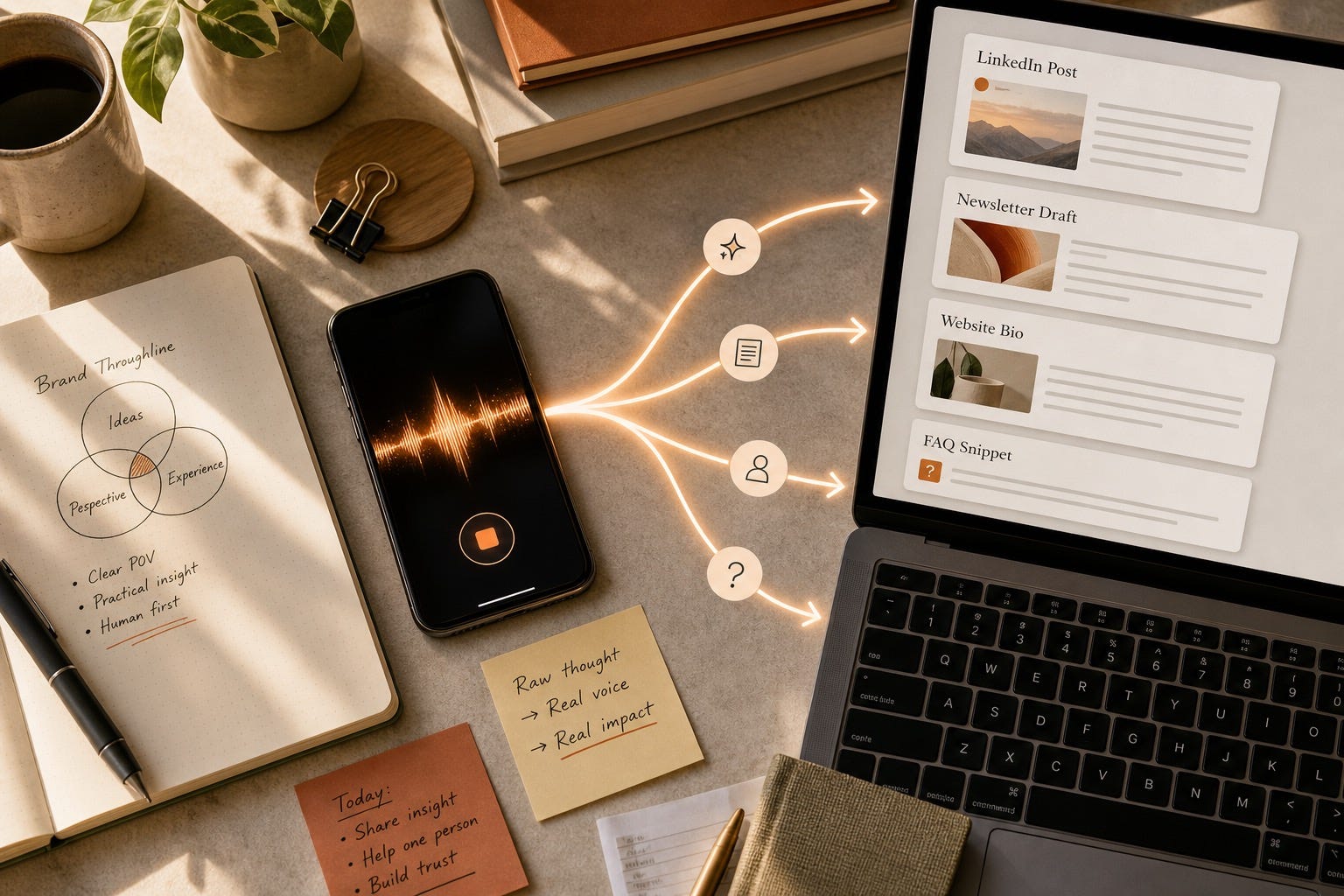
Most people are using AI backwards for personal branding. They open ChatGPT, ask it to write a LinkedIn post, dislike the result, then spend thirty minutes trying to remove the robotic tone they accidentally invited in. The draft is fast, but the trust cost is high. It sounds clean, but it does not sound like a person worth following.
A better system starts earlier. Instead of prompting from nothing, capture your rough thinking in voice notes. Talk through what you learned this week, what clients keep asking, what mistake you keep seeing, what you changed your mind about, or what you wish more people understood about your field. Then use AI as a distillation layer, not as a substitute for judgment.
This is why voice notes are becoming one of the most practical AI personal branding workflows for founders, consultants, executives, creators, job seekers, and technical professionals. They reduce blank-page friction, preserve your natural language, and create reusable raw material for LinkedIn posts, Substack essays, website copy, speaker bios, FAQ pages, and short videos.
The goal is not to sound unedited. The goal is to sound unmistakably like yourself after editing.
In this guide, you will learn how to use voice notes for personal branding, how to turn them into publishable assets with AI, which prompts actually protect your brand voice, and how to avoid the trap of turning your public identity into generic AI content.
Why voice notes outperform blank prompts
Personal branding is not just information transfer. It is signal design. People decide whether to trust you based on specificity, conviction, pattern recognition, and consistency. Those signals are hard to invent from scratch in a text box. They appear much more naturally when you speak.
When you talk out loud, you reveal the things that make your point of view useful:
Your natural vocabulary and sentence rhythm
The examples you reach for without overthinking
The tradeoffs you actually care about
The phrases you repeat because they reflect real conviction
The emotional texture that makes your perspective feel lived, not assembled
That matters because the AI slop problem is now obvious to most readers. Professionals can tolerate AI assistance. What they do not tolerate is the feeling that your content could have been posted by any other consultant, founder, or aspiring thought leader in your niche.
Voice notes solve three personal branding problems at once. First, they make content creation less intimidating. Second, they give AI better source material. Third, they create a repeatable capture habit that works even when you are busy, traveling, or thinking in fragments.
Practical rule: if you would never say the sentence out loud in a conversation, it probably should not survive the edit in your public content either.
What a strong voice-note personal branding system looks like
The best system is not complicated. It is lightweight enough to repeat, but structured enough to turn messy thoughts into trust-building assets. Think in five stages: capture, transcribe, distill, adapt, and publish.
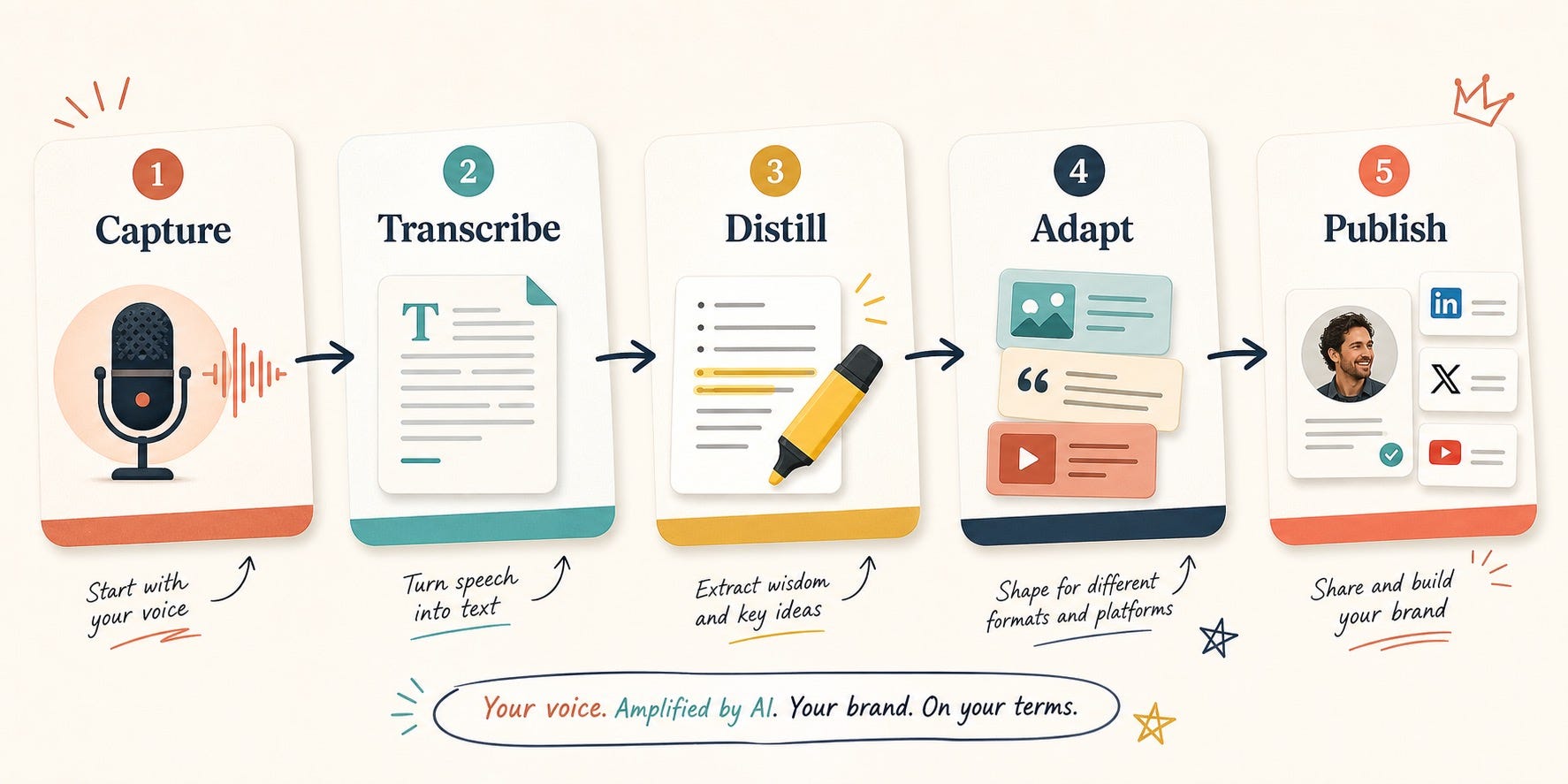
1. Capture ideas while they are still alive
Do not wait for a formal writing session. Record 60- to 180-second notes when something is fresh. After a sales call, after a product sprint, after a hiring interview, after reading a strong article, after noticing a repeat question from clients, or after disagreeing with a popular take in your industry.
Useful prompts for the voice note itself:
What happened?
Why does it matter?
Who keeps misunderstanding this?
What is the practical takeaway?
What example proves the point?
2. Transcribe without polishing too early
Use any accurate transcription tool. The important thing is to preserve the original wording before you clean it up. Filler words are fine. Tangents are fine. Rough edges are useful because they often contain the insight that polished AI drafts erase.
3. Distill the signal
Now bring AI in. Ask it to identify the strongest claim, the most memorable example, the audience, the implied pain point, and the single most actionable takeaway. Do not ask for a final post first. Ask for extraction. This keeps the model focused on understanding your thinking before it starts rewriting it.
4. Adapt for channel and intent
The same voice note can become several personal brand assets:
A short LinkedIn post with one sharp insight
A Substack essay that explores the argument in depth
A website FAQ answer that reduces friction for prospects or recruiters
An About page paragraph that clarifies your philosophy
A speaker pitch angle for podcasts or events
5. Publish only after human compression
AI can expand quickly. Good personal branding usually requires compression. Remove generic openers. Cut unnecessary abstraction. Keep the strongest sentence near the top. Make one point per piece. If the draft sounds smarter than you sound in real life, that is not a compliment. It is a trust warning.
The weekly workflow: 30 minutes to a month of usable brand assets
You do not need to become a full-time creator to build authority. One practical cadence is enough:
Monday to Thursday: record one or two short voice notes when an idea appears
Friday: transcribe all notes into one document
Friday or Saturday: use AI to cluster the notes by theme
Choose one note for a short post, one for a longer article, and one for a website or profile update
Edit for proof, specificity, and tone before publishing
This works because personal branding compounds when one idea becomes multiple trust surfaces. A strong note about how you handle client expectations could become a LinkedIn post, a website FAQ answer, a sales-call talking point, and a speaker bio line. You are not creating more opinions. You are packaging one real opinion more intelligently.
A useful personal brand is not built by producing endless new thoughts. It is built by turning your best recurring thoughts into durable public assets.
The prompts that keep AI from flattening your voice
The wrong prompt asks AI to write like a polished expert. The right prompt asks AI to preserve the evidence of a real mind. That means your prompts should instruct the model to keep your tension, examples, tradeoffs, and natural language patterns.
Here is a solid base prompt for turning a transcript into a personal branding draft:
You are helping me adapt a raw voice-note transcript into a personal-branding asset.
Task:
- Identify the strongest single idea in the transcript.
- Preserve my point of view, vocabulary, and sentence rhythm where possible.
- Keep specific examples and tradeoffs.
- Remove filler, repetition, and unclear tangents.
- Do not make the writing sound corporate, generic, inspirational, or influencer-like.
- Do not invent stories, achievements, or statistics.
Output:
1. One-sentence core argument
2. Three memorable phrases from the transcript worth preserving
3. A LinkedIn post draft under 220 words
4. A longer article outline
5. Two lines that sound generic and should be cut or rewritten
Transcript:
[paste transcript here]
After that, use a second prompt for sharpening rather than regenerating:
Tighten this draft without changing the point of view.
Rules:
- Make it clearer, not smoother.
- Keep one surprising or concrete sentence near the top.
- Replace vague claims with evidence or examples from the transcript.
- Remove any line that could appear in a generic AI branding post.
- Keep the final draft sounding like a smart human, not a content machine.
This two-step method matters. If you ask for a polished final draft too early, AI fills gaps with clichés. If you ask it to extract and preserve first, the final output stays anchored in your own material.
Where to use the output in your personal brand
One reason this workflow works so well is that it creates reusable language across surfaces. That helps your digital identity feel consistent without feeling repetitive.
LinkedIn posts
Use voice-note-based posts when you want to sound closer to how you actually explain things. This is especially valuable for founders, consultants, and executives who want authority without sounding like they hired a ghostwriter. Keep the post narrow. One lesson. One example. One implication.
Substack and long-form essays
A rough voice note often contains the seed of a better article than a keyword-first outline does. Why? Because the argument starts with friction. You noticed something broken, surprising, or misunderstood. That energy helps retention, which matters more than perfect polish in long-form writing.
Website copy and FAQ answers
Your website should not read like a cleaned-up LinkedIn profile. Voice notes help you write copy that sounds more grounded and useful. Talk through how you work, what outcomes you care about, what clients misunderstand before hiring you, and what kind of problems you are best at solving. Then shape that into FAQ answers, About page paragraphs, and service explanations.
Speaker bios and guest pitches
Many bios sound inflated because they are written from distance. Voice notes let you explain your work in more human language first, then compress it into a stronger speaker paragraph. That usually produces a clearer signal of expertise than starting from third-person hype.

The trust rules: how to use AI without outsourcing your identity
There is nothing unethical about using AI to organize your ideas, clean transcripts, or adapt content for different channels. The problem starts when AI begins to replace your lived judgment rather than support it.
Use these rules to stay credible:
Do not publish claims you did not personally validate
Do not let AI add intensity you did not mean
Do not let it invent certainty where you actually have nuance
Keep proof close to claims: examples, outcomes, observations, constraints
Disclose AI assistance when the context calls for it, especially for avatar, cloned-voice, or highly automated formats
In personal branding, authenticity does not mean rawness. It means traceability. Can the reader feel where this opinion came from? Can they see the work, the experience, or the pattern behind the point? Voice notes help because they create an evidentiary trail from thought to transcript to final asset.
Common mistakes that weaken this workflow
Mistake 1: Recording without a point
Not every voice note becomes content. If the note has no clear tension, no audience, or no practical takeaway, it is probably just a diary entry. That is fine. But do not force every fragment into a public post.
Mistake 2: Publishing the first AI draft
Speed is seductive. Resist it. Your first AI draft is a diagnostic tool, not a publishing asset. Edit until the strongest sentence feels believable in your actual voice.
Mistake 3: Using the same note everywhere without adaptation
Repurposing is smart. Copy-pasting is lazy. LinkedIn, a website, and a newsletter each have different reader expectations. Adapt the structure and depth while keeping the underlying idea consistent.
Mistake 4: Chasing volume instead of recognizability
You do not need more posts than everyone else. You need more recognizable thinking than everyone else. The best personal brand content system makes you easier to remember, not merely more active.
A simple starting plan for the next seven days
If you want to test this without rebuilding your whole content process, do this:
Record five voice notes over the next week, each under three minutes
Choose only moments where you noticed a real problem, disagreement, or lesson
Transcribe them into one document
Use AI to find the top three recurring themes
Turn one into a LinkedIn post, one into a longer article, and one into a website FAQ answer
Ask: does this sound like me, or like a version of me optimized for the internet?
If the answer is the second one, go back and reintroduce more of your real language. Keep the rough but meaningful phrase. Keep the concrete example. Keep the sentence that reveals your standards. Those are the details that make a personal brand feel trustworthy in an AI-saturated feed.
Voice notes will not automatically make your content good. But they are one of the strongest ways to make AI-assisted personal branding feel human again. And in a market full of polished sameness, that difference is not cosmetic. It is strategic.
FAQ: voice notes, AI, and personal branding
Can voice notes really improve personal branding?
Yes, because they preserve the way you naturally explain ideas. That gives AI better source material and makes the final content feel more specific, believable, and human.
What is the best way to turn voice notes into LinkedIn posts?
Transcribe the note first, ask AI to extract the core argument and memorable phrases, then edit the draft manually for specificity and tone. Do not publish the first generated version.
How long should a voice note be for personal brand content?
Sixty to one hundred eighty seconds is usually enough. Shorter notes are easier to review and repurpose, and they force you to focus on one useful idea instead of rambling.
Does this workflow work for founders and executives who do not post often?
Yes. It is especially useful for busy professionals because it captures ideas in the flow of work. One strong note can become a post, an article outline, and website copy without requiring daily content production.
Which AI tools are useful in a voice-note personal branding workflow?
Any stack that handles transcription, summarization, and drafting can work. The key is not the specific tool. The key is using AI for extraction and adaptation, while keeping your own judgment in charge of the final message.
How do I know if AI has flattened my voice?
If the draft sounds smoother than your real conversation, uses vague corporate phrasing, or removes the tradeoffs and examples you care about, your voice has probably been flattened. Reintroduce your wording and cut generic lines.