



A practical guide for professionals who want stronger proof of work in an AI-shaped job market
On May 7, 2026, OpenAI expanded workspace agents for enterprise use, pushing another large piece of daily knowledge work toward automation. That update did not make resumes useless. It made generic resumes weaker.
When employers can automate research, screening, note-taking, scheduling, and first-draft analysis, they start valuing a different signal: can this person explain what they have done, how they think, and whether they can communicate clearly in ambiguous situations?
That is where a strong video resume platform becomes more useful than another polished PDF. A document still handles keywords, chronology, and compliance. Video handles judgment, presence, clarity, and trust. In a market flooded with AI-assisted writing, those human signals matter more, not less.
This does not mean every job seeker needs a dramatic cinematic reel. It means professionals need a faster way to package evidence, communication skill, and domain fluency into a format recruiters can evaluate in minutes. The right system is less about performance and more about compression. You are helping a hiring manager understand your value with less effort.
The job market changed from document review to signal review
Most professionals still treat the job search as a writing exercise. That is understandable. Applicant tracking systems read text. Recruiters search keywords. Hiring teams ask for links. So candidates keep tuning nouns and verbs on the page.
But the bottleneck has moved. The problem is no longer only whether your resume gets parsed. The problem is whether you look memorable once you are parsed.
AI has made baseline resume quality cheaper. More candidates now submit cleaner bullets, stronger summaries, and tailored phrasing. That raises the floor. Once the floor rises, the winners are often the people who add legible proof of thought.
The new hiring advantage is not better formatting. It is better evidence.
A video resume platform helps create that evidence in three ways:
It shows communication skill instead of forcing employers to infer it.
It gives context to achievements that look flat in bullet form.
It creates a shareable asset for applications, referrals, outbound networking, and portfolio pages.
That last point matters more than most candidates realize. A modern application is not one submission. It is a sequence: application, recruiter screen, referral follow-up, hiring manager review, and often a second look from leadership. A reusable video asset can support each stage without requiring you to retell your story from scratch every time.
What a good video resume platform actually needs to do
Many tools promise to help job seekers stand out, but the useful ones solve operational problems, not vanity problems. You are not buying a stage. You are buying leverage.
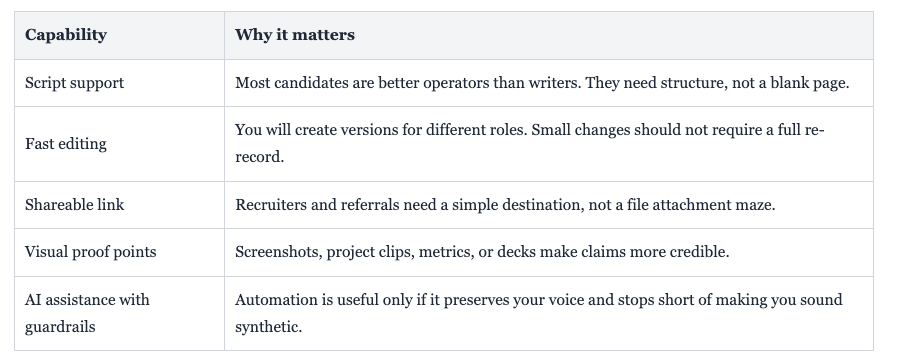
That is the first filter I would use when comparing any video resume platform. If the product helps you create a polished but empty introduction, it is not helping. If it helps you transform real work into a short, credible story, it is probably useful.
The strongest format is not a biography. It is a proof stack.
The mistake many candidates make is recording a mini autobiography. They introduce themselves, describe their passion, mention teamwork, and stop. That format feels safe because it sounds familiar. It also sounds like everyone else.
A better structure is a proof stack. Instead of trying to tell your whole life story, you show three things:
What problem space you solve
What evidence supports that claim
What kind of role you want next
That is enough. Hiring teams do not need your entire history in the first two minutes. They need a sharp model of why you deserve the next conversation.
A simple two-minute structure
Use this sequence:
Opening: one sentence on the role you play and the outcome you create
Evidence: two or three concrete wins with numbers, scope, or constraints
Working style: how you solve problems with teams, systems, or customers
Direction: what opportunities you are targeting now
Notice what is missing: generic confidence statements. Replace “I am a hard worker” with “I reduced onboarding time by 28 percent across three customer segments.” Replace “I love innovation” with “I launched a workflow that moved a weekly manual report to a daily automated dashboard.”
How AI should help you build the asset
AI should not write your entire identity for you. It should help with extraction, compression, and iteration.
A useful workflow looks like this:
Feed your resume, LinkedIn profile, portfolio, and recent project notes into a drafting prompt.
Ask AI to extract measurable proof points, not personality adjectives.
Generate a short script tailored to one role family.
Revise the script until it sounds like you in conversation.
Pair the script with visuals that support each claim.
Here is a prompt template that works well for turning raw experience into a usable script outline:
Role target: Senior Product Manager in B2B SaaS
Goal: Create a 90 to 120 second video resume script

Instructions:
1. Extract only specific accomplishments, scope, constraints, and outcomes
2. Remove vague claims unless they can be supported by evidence
3. Write in spoken English, not resume English
4. Keep the structure:
   - one-sentence intro
   - three proof points
   - one sentence on working style
   - one sentence on target role
5. Flag any claim that sounds inflated or unprovable
This is where AI genuinely helps. It reduces blank-page friction and catches resume language that does not survive contact with a human conversation.
Three real-world use cases where video beats text
1. Career changers
A career changer usually has a narrative problem, not a capability problem. Their work history looks discontinuous on paper, even when the underlying skills are coherent. A short video gives them space to bridge the logic: what they learned, what transferred, and what they can now do better because of that unusual path.
2. Client-facing professionals
Consultants, customer success leads, solution engineers, recruiters, founders, and sales professionals are often hired partly for how they communicate. A text resume cannot fully show calm, clarity, or executive presence. A good video resume can.
3. Builders with invisible work
Operations leaders, product managers, analysts, and technical generalists often drive outcomes that are hard to make vivid on paper. Their best work lives in systems, decisions, and tradeoffs. Video lets them explain the “why” behind metrics, which often reveals seniority better than another bullet list.
Where most video resumes fail
Video can help, but weak execution creates a new problem. Most bad video resumes fail for one of five reasons:
They start with a long self-introduction instead of value.
They sound like a cover letter read aloud.
They use no evidence, examples, or numbers.
They feel overproduced and underpersonal.
They are not tailored to a role family.
If you want a useful quality check, ask one question: would a hiring manager learn anything from this that they could not get from the resume alone? If the answer is no, the video is decoration. Start over.
How to make a video resume feel human in an AI-heavy market
The fear many professionals have is reasonable. If everyone uses AI tooling, won’t every candidate start sounding the same?
Yes, if they outsource judgment.
No, if they use AI as an editor.
The difference is simple. Synthetic candidates optimize for polish. Credible candidates optimize for recognizability. You want someone who knows you well to say, “Yes, that sounds like you.”
To keep the delivery human:
Use spoken language, including short sentences.
Keep one or two natural imperfections if the meaning stays clear.
Use examples with context, not just outcomes.
Avoid motivational language that could fit any applicant.
Say what you learned, not only what you shipped.
One practical option is to create a base script with AI, then mark every sentence that you would never say in a real conversation. Rewrite those lines first. That small pass often removes the robotic tone.

A lightweight workflow professionals can use this week
You do not need a media team. You need a repeatable system.
Choose one role family, not every possible role.
Pull five measurable achievements from the last three years.
Write a 120-second script built around three proof points.
Add supporting visuals: a dashboard, project screenshot, slide, artifact, or customer result.
Record a version that sounds conversational.
Share it with two people who know your work and ask what feels generic.
Publish a clean link and use it in high-intent applications and referrals.
If you want help producing the asset without dealing with full video setup, tools such as PortfolioVideo can turn a resume, script, and headshot into a shareable professional video workflow that is easier to iterate on than a manual production stack.
That sentence is not the strategy. The strategy is the repeatable loop around it. The advantage comes from versioning, tailoring, and using video where it improves evaluation.
What employers are really buying when they watch
Employers are not looking for the candidate with the most polished transitions. They are looking for evidence that lowers hiring risk.
A useful video resume lowers three kinds of uncertainty:
Communication risk: Can this person explain ideas clearly?
Credibility risk: Do their achievements sound specific and grounded?
Fit risk: Do they understand the kind of role they are actually pursuing?
This is especially important for high-context roles. A recruiter can scan your resume for eligibility, but a hiring manager is often looking for signs of judgment under constraints. The right video does not replace assessment. It earns enough trust to justify the assessment.
That is why a video resume platform fits the current market so well. It supports a hiring process that is becoming more AI-assisted on the back end and more signal-hungry on the front end.
The irony is useful: as more work gets automated, professionals benefit from showing the parts of value that are still difficult to fake at scale. Judgment. Taste. Explanation. Priority. Presence.
Final thought
The May 7, 2026 wave of agent updates is one more reminder that job search mechanics keep changing. But the core hiring question has not changed at all. Why should we trust you with important work?
A text resume still opens doors. A strong video resume platform helps you walk through them with more context, more credibility, and less friction. In a market crowded with AI-polished sameness, that difference is becoming easier to notice.