


Most personal brands explain what they do. Very few explain how they work. That gap is where confusion, mismatched expectations, and bad-fit leads quietly pile up.

There is a strange failure pattern in personal branding right now.
Smart founders, consultants, freelancers, creators, and fractional executives spend weeks polishing their LinkedIn profile, refining their bio, and posting thoughtful content. Then the same people lose time to vague inbound messages, repetitive pre-call questions, and discovery calls that were never a fit in the first place.
That is not only a lead quality problem. It is a clarity problem.
Recent July 2026 reporting on AI-written professional content suggests LinkedIn is now heavily saturated with polished, synthetic-sounding posts. In that environment, buyers and collaborators do not just want more content. They want fewer surprises. They want to know what you are like to work with, what kind of problems you take seriously, how your process works, and whether your way of thinking matches their situation.
This is why a simple, underused trust asset matters more than most people realize: the working with me page.
A strong personal brand does not just create attention. It reduces uncertainty.
A working with me page is not a generic services page. It is not a brochure. It is not a public diary of your preferences. It is a practical page that helps the right people self-select in while giving the wrong people a reason to opt out early.
That is good branding. That is also good energy management.
In this guide, you will learn what a working with me page should include, how to use AI to draft it without sounding robotic, and how to make it one of the most useful pages on your personal brand website.
Why This Page Matters More in the AI Era
When content gets easier to produce, process clarity becomes a differentiator.
Anyone can use AI to generate a decent-looking About page, a polished LinkedIn summary, or a week of opinion posts. What is harder to fake is operational honesty. The way you define scope, set expectations, communicate progress, handle feedback, and decide what kind of work is worth doing says more about your professional identity than another thought-leadership post ever will.
This is especially true for reputation-led professionals:
consultants who sell judgment, not just deliverables
fractional executives who need fast trust with new teams
freelancers who want fewer budget tourists
founders whose personal brand opens partnership and advisory doors
creators and experts whose audience sometimes becomes a client pipeline
A personal brand usually fails at the exact moment curiosity turns into buying intent. Someone likes the content, clicks around, and still cannot answer basic questions:
Who is this really for?
What does working together actually look like?
How opinionated is this person?
What boundaries do they have?
What kind of client or project tends to work best?
Your working with me page closes that gap.
What a Working With Me Page Actually Is
Think of it as the external version of a “Manual of Me,” but adapted for trust, fit, and decision-making.
Internal “how to work with me” documents are usually written for managers or teammates. They explain communication preferences, work rhythms, and collaboration habits. A public working with me page takes the useful part of that idea and translates it for prospects, collaborators, podcast hosts, referral partners, hiring managers, or anyone trying to understand whether your style matches their needs.
It should answer one core question:
If we decide to work together, what should I expect from your process, your standards, your communication, and your boundaries?
That is why this page is powerful. It turns vague credibility into usable credibility.
The Hidden Job of This Page: Fit Filtering
Most people think personal branding is mainly about attraction. In reality, the mature version is about attraction and filtration.
If everyone feels like a fit, your positioning is too vague.
A strong working with me page helps you:
reduce bad-fit inquiries
answer repetitive questions once
set scope expectations before the first call
signal professionalism without sounding corporate
show what kind of collaboration you value
protect time, energy, and reputation
For many experts, this page quietly does what endless posting cannot. It improves the quality of the people who reach out.
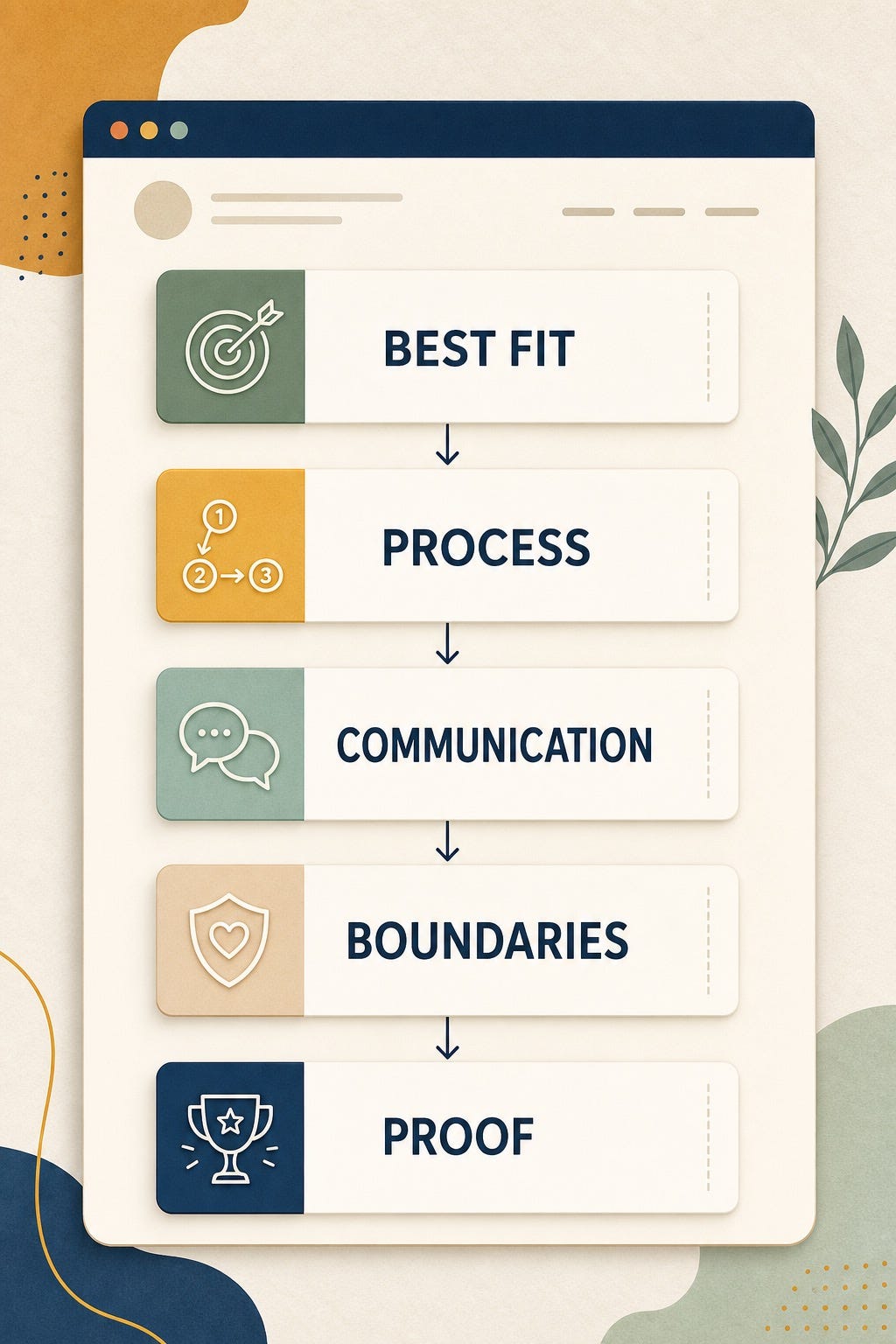
What to Include on a Strong Working With Me Page
You do not need a long page. You need a useful one.
Here is a structure that works well for most personal brands.
1. A clear statement of who this page is for
Open with a short paragraph that tells the reader whether this page is meant for clients, collaborators, media partners, employers, advisory opportunities, or some combination.
Example:
This page is for founders, teams, and collaborators who already know the problem they need solved and want to understand how I think, communicate, and run engagements before we talk.
This creates immediate orientation.
2. Best-fit projects or situations
Describe the kinds of work that usually go well. This is where many personal brands become more persuasive by becoming more selective.
What stage of company or career do you help best?
What problems energize you?
What kind of client behavior makes the work stronger?
What situations usually produce the best outcomes?
Instead of saying, “I help anyone with content strategy,” say something like:
I am usually a strong fit when the expertise is real, the positioning is muddy, and the team wants sharper thinking, not just more output.
3. How your process works
This is the section most people skip and later regret skipping.
Explain your process in plain language:
what happens first
what information you need
how decisions get made
how work is reviewed
how progress is communicated
You do not need to reveal trade secrets. You do need to reduce mystery.
4. Communication style and response expectations
This is where you stop future friction before it starts.
Be direct about:
preferred communication channels
typical response times
whether you like async collaboration or live calls
how feedback is best given
what counts as urgent
This does not make you sound difficult. It makes you sound organized.
5. Boundaries and non-fit conditions
This is the difference between a page that feels helpful and one that actually protects your reputation.
You can politely say what is not a fit:
rush projects with undefined goals
clients who want “just make it go viral” work
advisory relationships without a clear decision owner
heavy meetings with little implementation capacity
engagements where honesty is less welcome than flattery
Good buyers usually respect clarity. Bad buyers often remove themselves.
6. Proof signals
Do not leave the page as pure philosophy. Add credibility.
Useful proof might include:
one or two short testimonials about your working style
links to relevant case studies or essays
a short note on repeat clients, referral patterns, or project outcomes
examples of deliverables or artifacts
The point is not to brag. The point is to make your claims easier to trust.
7. A simple next step
End with a calm invitation. Not hype. Not pressure. Just a clean handoff.
For example:
If this sounds aligned, send a short note with your context, what you are trying to solve, and why now feels like the right time.
How to Use AI to Draft the Page Without Sounding Like AI
AI is useful here, but only if you feed it raw material that came from lived experience.
The biggest mistake is asking a model to “write a working with me page for a consultant” and then lightly editing the result. That produces the same foggy language everyone else is publishing.
The better workflow is capture first, draft second, refine third.
Step 1: Capture your real operating preferences
Before you generate anything, answer these questions in messy bullet form:
What kinds of projects usually go well for me?
What patterns show up in bad-fit projects?
What do clients misunderstand most often?
What do I wish people knew before the first call?
What communication style helps me do strong work?
What does a great collaborator usually do?
What boundaries make the work better?
Step 2: Feed the model evidence, not adjectives
Use examples from real projects, real messages, real frictions, and real testimonials. AI gets sharper when the inputs are specific.
Good input:
Clients often come to me after they have already published six months of content that sounds polished but says nothing distinct. The best engagements happen when they want sharper positioning and are willing to cut weak claims.
Weak input:
I am strategic, collaborative, and results-driven.
Step 3: Ask AI to organize, not invent
Use AI for structure, compression, and contrast. Ask it to:
group your notes into best-fit, process, communication, boundaries, and proof
rewrite vague lines into specific language
identify sentences that sound generic or inflated
surface contradictions between what you say and what you actually prefer
Step 4: Humanize the final draft with friction
The lines that make the page trustworthy are often the slightly uncomfortable ones. They reveal standards. They show judgment. They create edges.
For example:
“I prefer async feedback because it leads to better decisions than live brainstorming theater.”
“If the real problem is political but the brief is pretending it is strategic, I will usually say so.”
“I am a strong fit for teams that want fewer assets and more clarity.”
That kind of specificity is what generic AI writing rarely produces on its own.
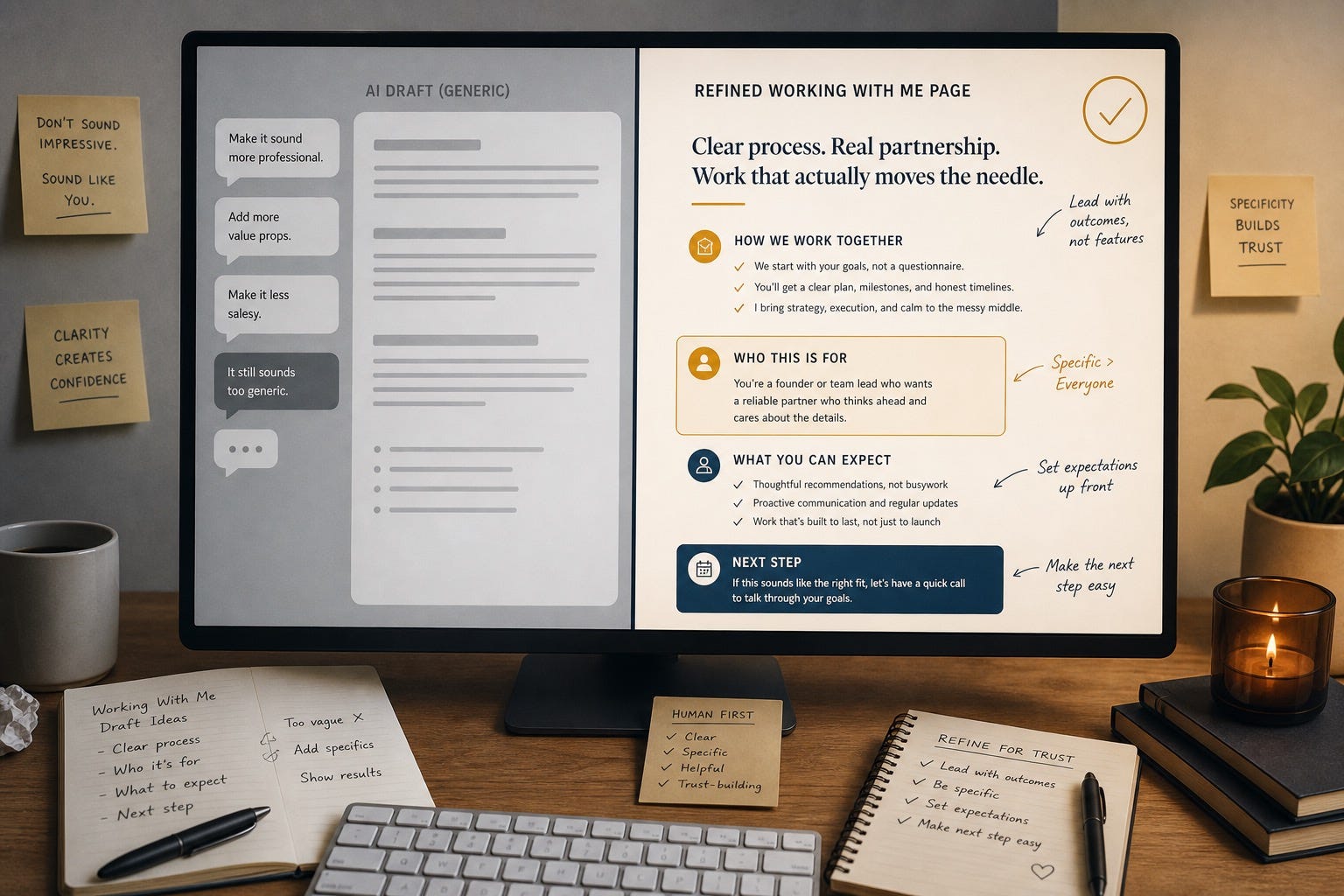
A Simple Prompt You Can Adapt
If you want a practical starting point, use a prompt like this after writing your own raw notes:
Organize these notes into a working with me page for my personal brand website. Keep the tone direct, credible, and human. Do not invent traits or use marketing fluff. Emphasize best-fit projects, process clarity, communication style, boundaries, and proof. Flag any sentence that sounds generic, overclaims, or could apply to anyone.
Then edit aggressively. The model should save time, not decide your identity.
Three Versions of This Page for Different Personal Brands
For consultants and fractional executives
Focus on decision-making, scope, stakeholder alignment, response expectations, and where you add leverage rather than labor.
For freelancers and creators
Focus on project fit, revision norms, content process, turnaround rhythms, and how you turn ideas into final assets without chaos.
For founders and experts
Focus on advisory opportunities, podcast requests, collaborations, introductions, and the kinds of conversations or projects worth saying yes to.
Not every personal brand needs the exact same page. The point is not the template. The point is explicitness.
Mistakes That Make the Page Weaker
Writing it like a generic services page with no real process detail
Making everything sound endlessly flexible so nobody feels excluded
Copying internal “manual of me” language that is too personal or too vague for buyers
Using AI-polished filler instead of real operating preferences
Forgetting to include proof, examples, or a next step
The fastest way to improve this page is to delete any sentence that could belong on a thousand other websites.
A 60-Minute Build Sprint
Write messy notes on best-fit work, worst-fit work, process, communication, and boundaries for 15 minutes.
Paste the notes into AI and ask it to structure them into sections for 10 minutes.
Edit every section until it sounds recognizably like you for 15 minutes.
Add proof links, a testimonial, and a next-step CTA for 10 minutes.
Read the page once asking only one question: would this prevent a bad-fit call? Spend the final 10 minutes tightening weak spots.
If the answer is yes, you have already built a stronger trust asset than most personal brands ever publish.
Final Thought
In the AI era, a stronger personal brand is not always the one that publishes more. Sometimes it is the one that makes working reality easier to understand.
A working with me page does exactly that. It makes your standards visible. It shows how you think. It helps the right people lean in and gives the wrong people a graceful exit.
That is not just better website copy. That is better reputation design.
FAQ
What is a working with me page?
A working with me page is a website page that explains how you collaborate, what kinds of projects are a fit, how your process works, what boundaries you keep, and what people should expect before contacting you.
Is a working with me page different from a services page?
Yes. A services page usually explains what you sell. A working with me page explains how you think, communicate, operate, and decide whether the relationship is likely to work well.
Who needs a working with me page for personal branding?
It is especially useful for consultants, freelancers, founders, fractional executives, coaches, creators, and experts whose personal reputation helps attract work, partnerships, interviews, or advisory opportunities.
Can AI write a working with me page?
AI can help structure and refine the page, but it should not invent the substance. The strongest version comes from your real project patterns, communication preferences, proof, and boundaries.
What should I include on a working with me page?
Include who the page is for, best-fit situations, your process, communication style, response norms, boundaries, proof signals, and a clear next step.
How long should a working with me page be?
Long enough to remove uncertainty, short enough to stay useful. For most people, 600 to 1200 words is enough if the language is specific and practical.
Should job seekers use a working with me page?
Sometimes. It can work well for senior candidates, operators, or technical professionals who want to clarify how they collaborate, lead, and solve problems, especially when their work style is a meaningful part of the value they bring.